Convict
Transportation Tokens
WG-9289: 1830
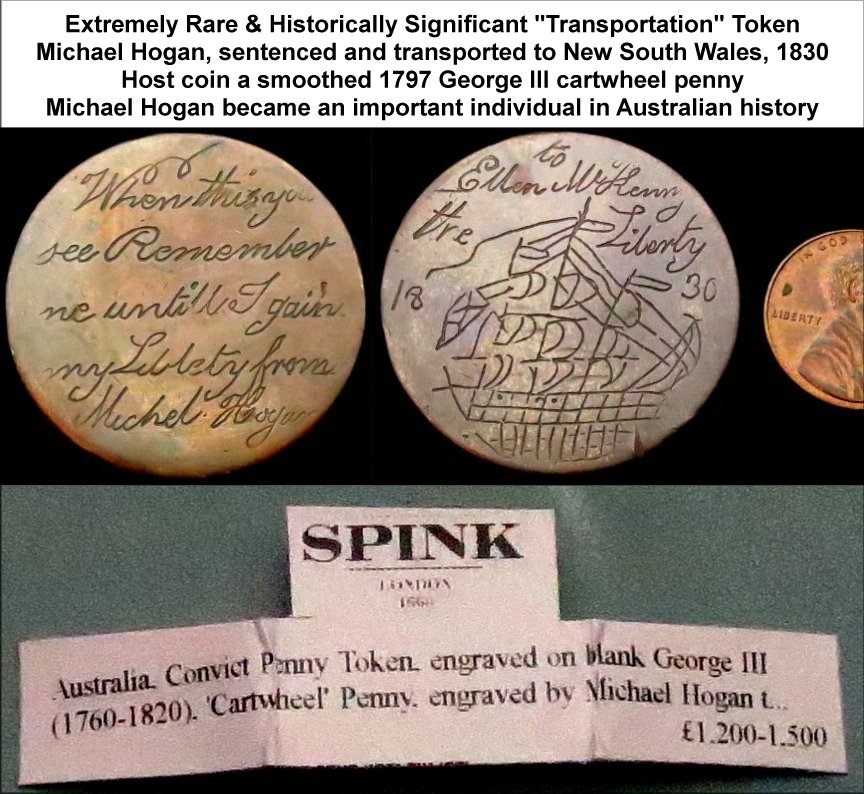
Australian "Convict Transportation" Token. A 1797 Cartwheel penny, smoothed both sides,
then hand engraved by Michael Hogan for Ellen McHenry. Rigged ship under sail right, cannons
engraved on gun ports, in script above to Ellen McHenry the Liberty 1830, rev. "When this
you see, Remember me, until I gain, my Liberty, from Michael Hogan",
engraved in script in five lines, 24.42g, rotation 11h. Some minor signs of contact wear, no evidence
of the original host coin on the smoothed surfaces. A proficient hand engraving
(although retaining a pleasingly naive touch), very fine and of significant
historical, social and numismatic importance, as you will see when you read the
research below. These Transportation tokens are excessively
rare, coming only from individuals who were sent overseas as a punishment. They form a poignant snapshot of history at
the time of departure, but probably of even greater historical and social
interest is to be found in the subsequent lives these individually led together
with the contributions they made, including those of their offspring, once
they'd served their sentences. Not quite
the Pilgrim Fathers (!), and not wishing to get
embroiled in the wrongs done to Australia's own indigenous people, but
transportation convicts were an integral element in the mix in making Australia what it is today. It is important to look at things from an
individual's point of view - there were quite a few transported convicts
(Michael Hogan's ship alone transported 167 convicts) but ask yourself, how
many would have gone to the trouble of fashioning a convict token? How many would have had the skill and
literacy to engrave one? How many
convicts would have had a spare cartwheel penny to literally make worthless in
terms of currency? Of those who contracted
skilled artists to do the engraving for them (and they do exist), how many
would have had the ready means of paying those artists? And so on, and so on. The answer is stark - literally very few of
all the convicts who were transported would have had an engraved convict token
in their hands immediately prior to setting sail for Australia.
Then we look at those few convict tokens that were in the convict's
hands - what became of them? The whole
point of the token was to give it to someone to remember them by: close family
or lover. The latter cohort, not wishing
to sound overly heartless, would surely have gotten on with their own lives,
just as Michael Hogan's girlfriend, Ellen McHenry did. As such, those tokens would surely have been
discarded; lost forever. With regard to
the close family, we all know how unlikely it is that small things last even
one generational pass-over, let alone several.
Things lose their connection very quickly as we move down the
generations - just look at old photographs, or even war medals. Another point to be made is that before the
1970's and very early 1980's, these things were considered worthless. If you were lucky they'd be in coin dealers'
junk boxes but more than likely, as still happens today with worn base coinage,
it would be scrapped for copper along with several other kilos of junk
coinage. Finally, we look at significant
contributions made. Most convicts did
not return to the UK after their sentence was up,
rather choosing to enter into Australian society and culture. Some remained criminals,
some chose a more productive path. Very
few convicts did anything significant with their lives, pretty much mirroring
life everywhere. Taking all that into
consideration, we have here a rare surviving convict transportation token from
an individual who founded an iconic (not to mention the most expensive to date)
Australian establishment that at its last sale went for $166,000,000. Not only that, Michael Hogan's daughter
turned out to be an infamous member of the 1840's Californian Gold Rush criminal
underworld. I really don't think there
can be many, if any, convict tokens to top this one in terms of historical and
social context!! £2,650
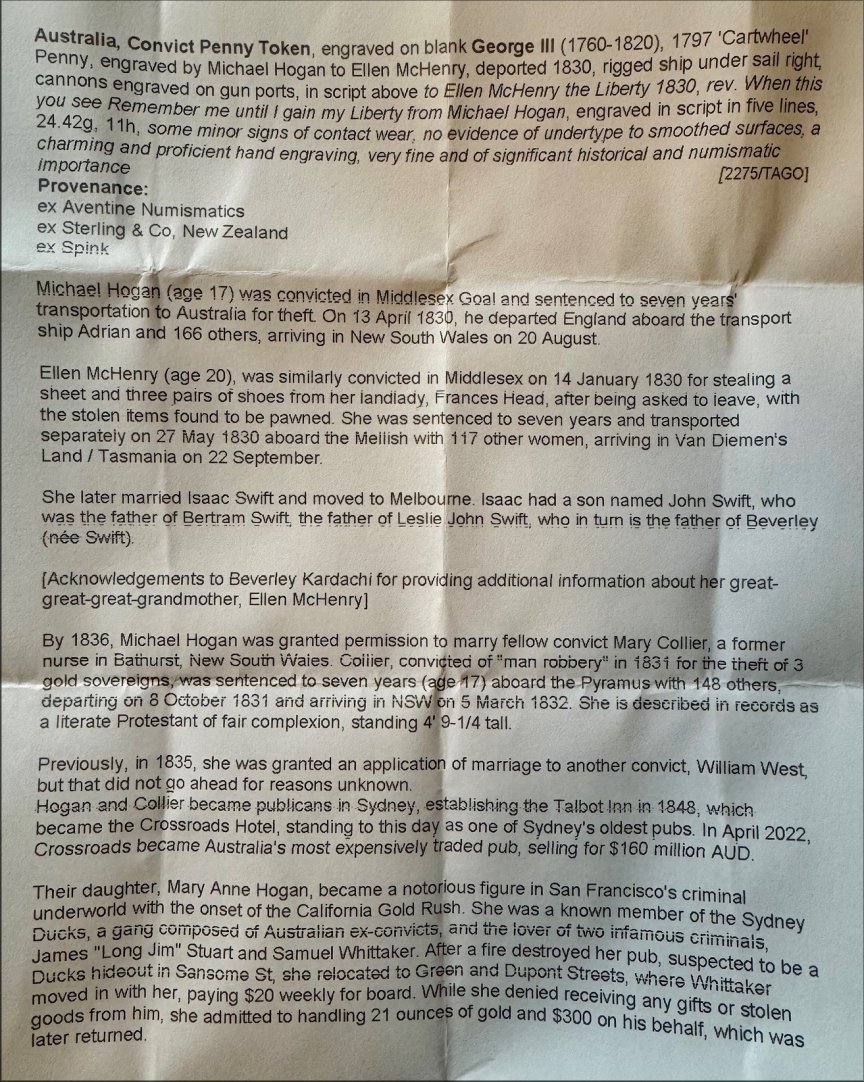
Provenance:
ex Aventine Numismatics
ex Sterling & Co, New Zealand
ex
Spink
Research:
Michael
Hogan (age 17) was convicted in Middlesex Goal and sentenced to seven years'
transportation to Australia for theft. On 13
April 1830,
he departed England aboard the transport ship Adrian and 166 others, arriving in New South Wales on 20 August.
Ellen
McHenry (age 20), was similarly convicted in Middlesex on 14 January 1830 for
stealing a sheet and three pairs of shoes from her landlady, Frances Head,
after being asked to leave, with the stolen items found to be pawned. She was
sentenced to seven years and transported separately on 27
May 1830
aboard the Mellish with 117 other women, arriving in Van Diemen's
Land / Tasmania on 22 September. She later married Isaac Swift and moved to Melbourne. Isaac had a son named John Swift,
who was the father of Bertram Swift, the father of Leslie John Swift, who in
turn is the father of Beverley (née Swift).
[Acknowledgements
to Beverley Kardachi for providing additional
information about her great-great-great-grandmother, Ellen McHenry]
By 1836,
Michael Hogan was granted permission to marry fellow convict Mary Collier, a former
nurse in Bathurst, New
South Wales. Collier, convicted of "man robbery" in 1831 for
the theft of 3 gold sovereigns, was sentenced to seven years (age 17) aboard
the Pyramus with 148 others, departing on 8
October 1831
and arriving in NSW on 5 March 1832. She is described in records as a
literate Protestant of fair complexion, standing 4' 9-1/4 tall.
Previously,
in 1835, she was granted an application of marriage to another convict, William
West, but that did not go ahead for reasons unknown. Hogan and Collier became publicans in Sydney, establishing the
Talbot Inn in 1848, which became the Crossroads Hotel, standing to this day as
one of Sydney's oldest pubs. In April 2022, Crossroads became Australia's most expensively traded pub, selling for $160 million AUD.
Their daughter, Mary Anne Hogan, became a notorious
figure in San Francisco's criminal underworld with the onset of the California Gold Rush. She
was a known member of the Sydney Ducks, a gang composed of Australian
ex-convicts, and the lover of two infamous criminals, James "Long
Jim" Stuart and Samuel Whittaker. After a fire destroyed her pub,
suspected to be a Ducks hideout in Sansome St, she
relocated to Green and Dupont Streets, where Whittaker moved in with her,
paying $20 weekly for board. While she denied receiving any gifts or stolen
goods from him, she admitted to handling 21 ounces of gold and $300 on his
behalf, which was later returned.