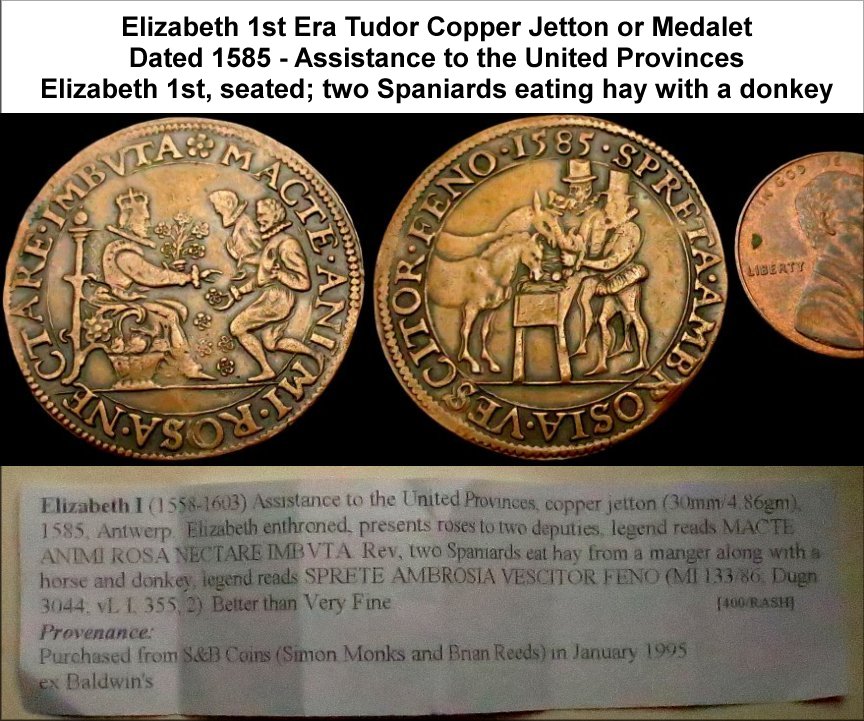
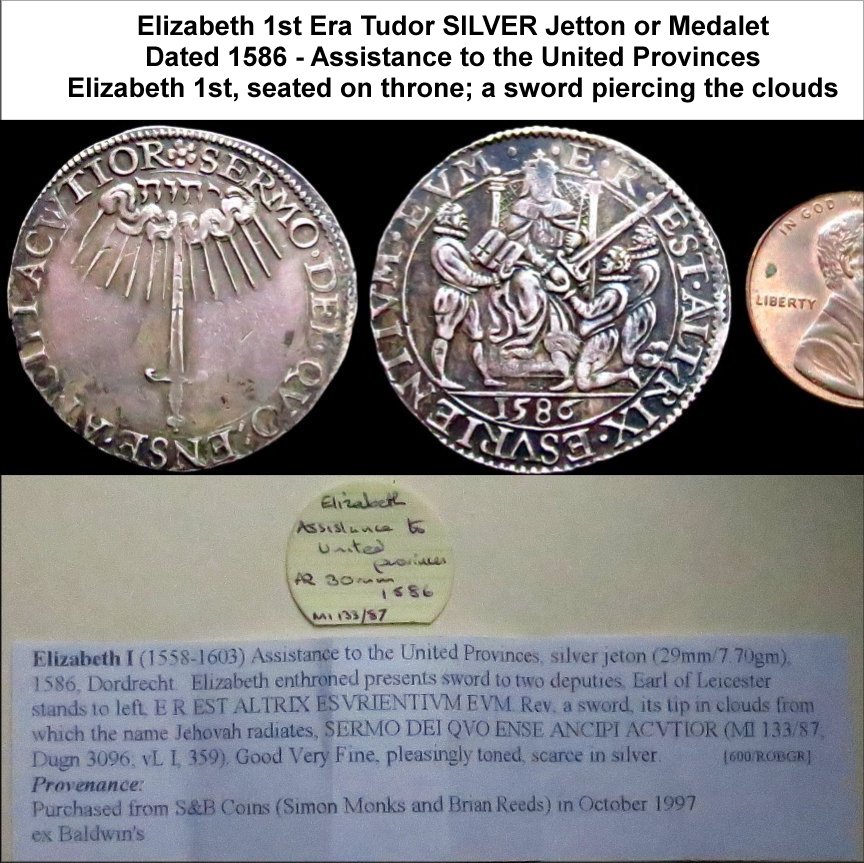
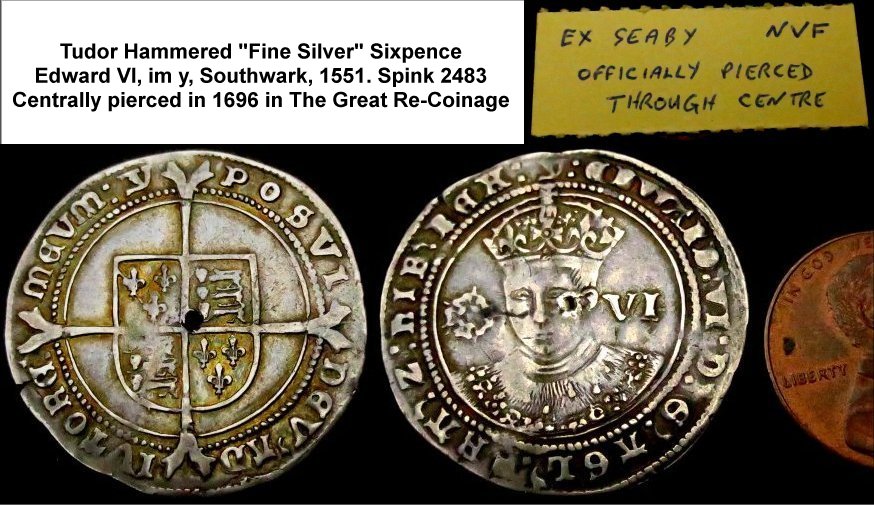
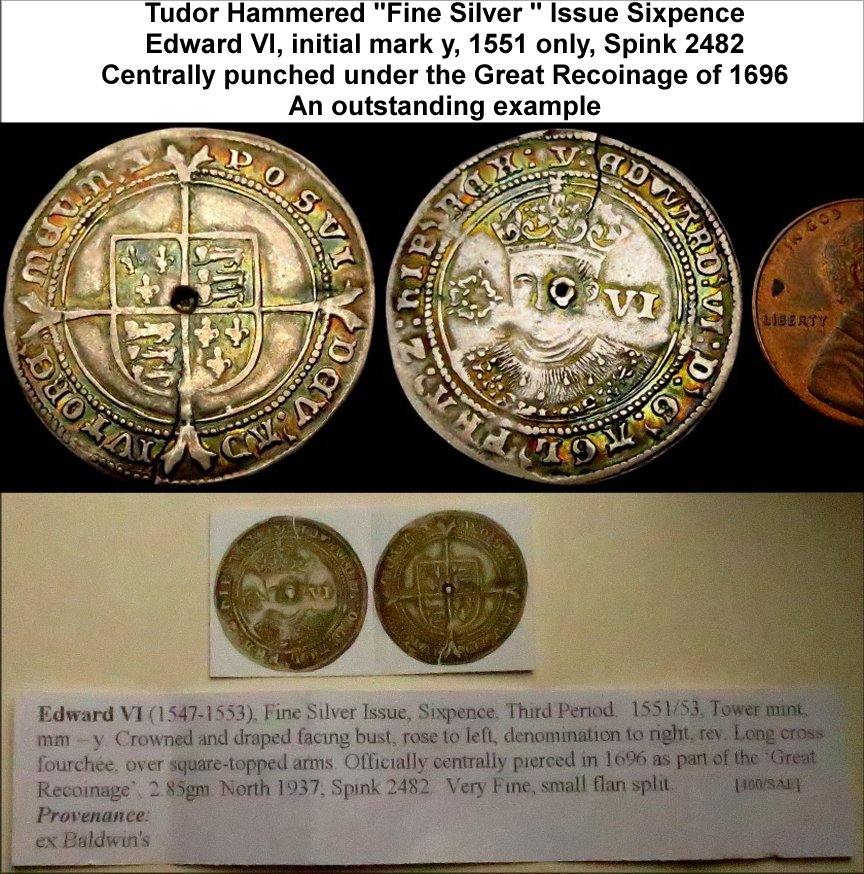
A selection of some of the
better / more interesting coins SOLD through
HistoryInCoins.com
in 2026
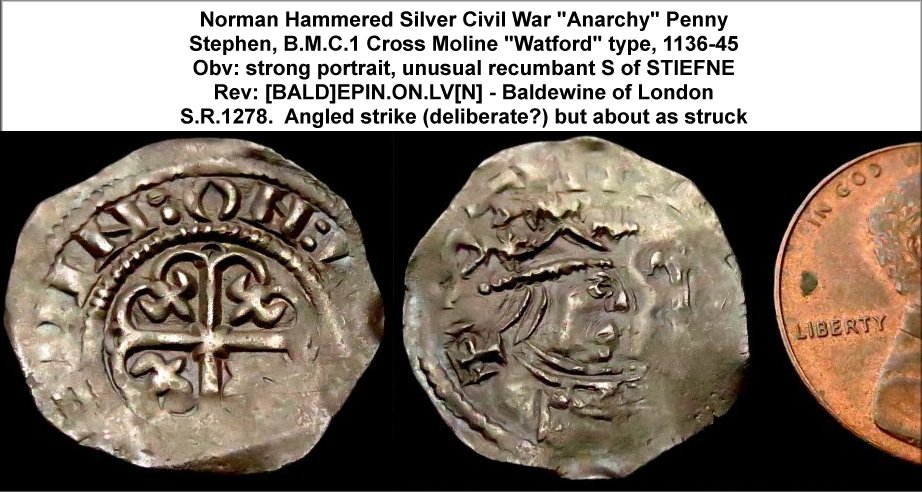
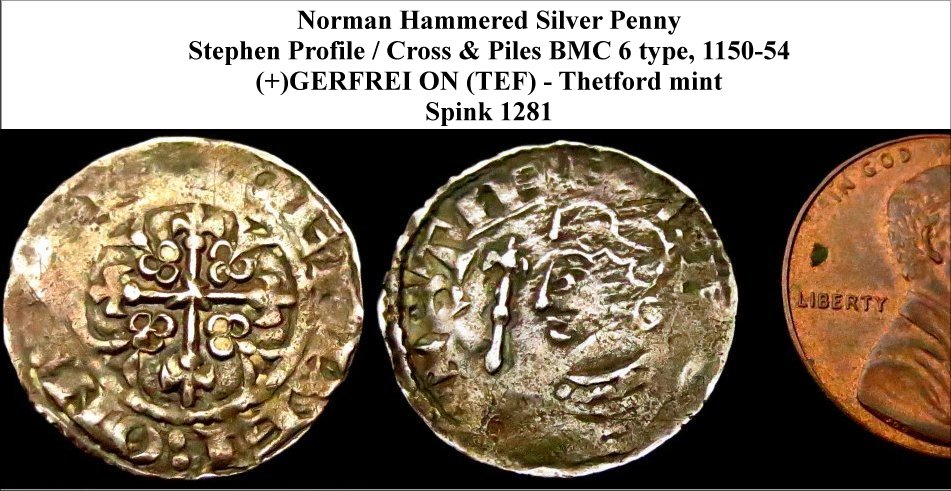
WMH-9424: Outstanding Stephen Norman
Civil War Hammered Silver Penny. B.M.C. I,
Cross Moline “Watford” type, no obverse inner circle:
[+BALD]EPIN.ON.LV[N] – Baldewine
(Baldwin) of London.
Full flan, excellent weight at 1.25g (19.2 grains), attractive dark
toning. An exceptionally strong, almost
unprecedented strike both sides albeit an angled strike. This angled strike phenomena for Stephen
coinage has been suggested as deliberate (R.P. Mack, Stephen and the Anarchy,
1135-54 is one who states this) - a device for anonymity: Mack postulates that
a moneyer working for Stephen would be all too aware that Matilda could well
have become queen at any time during the Anarchy and that if that had happened,
that moneyer would automatically be seen as a Stephen supporter by the new
monarchy, having freely placed his name on Stephen coinage. The penalties would have been severe so a
simple yet deliberate angled strike, obliterating part of the moneyer's name
(here we have only the very ending of the moneyer's name extant) which although
perhaps not ideal in the above scenario, would be enough to keep Stephen and /
or Matilda happy and at the same time ambiguous enough to avoid repercussions
on the event of a change of monarch for friend Baldwin of London. The coin is accompanied by some research
where the previous owner had tried to work out the moneyer, but failed (music
to the ears of moneyer Baldwin of London 900 years ago!!!) It was down as an unpublished coin but it's
not - it is as described above. I've
added that to the research notes. One of the best grade examples of a Stephen penny that you're ever
likely to see. Rare
thus. SOLD
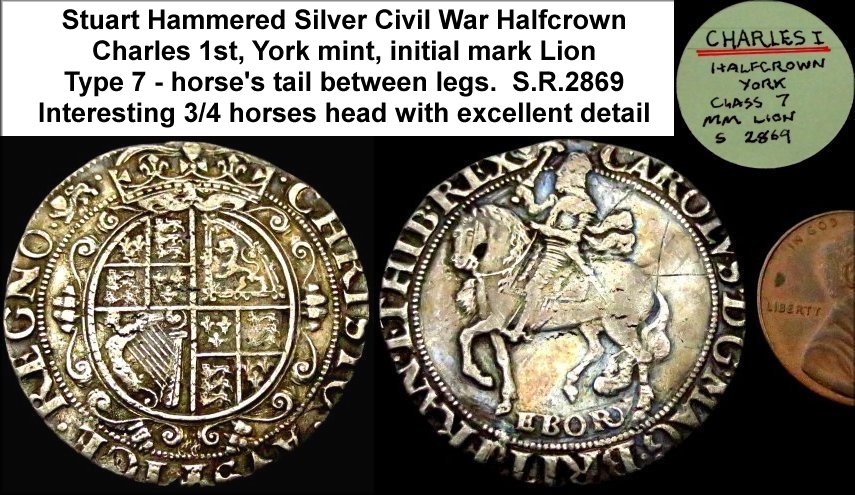
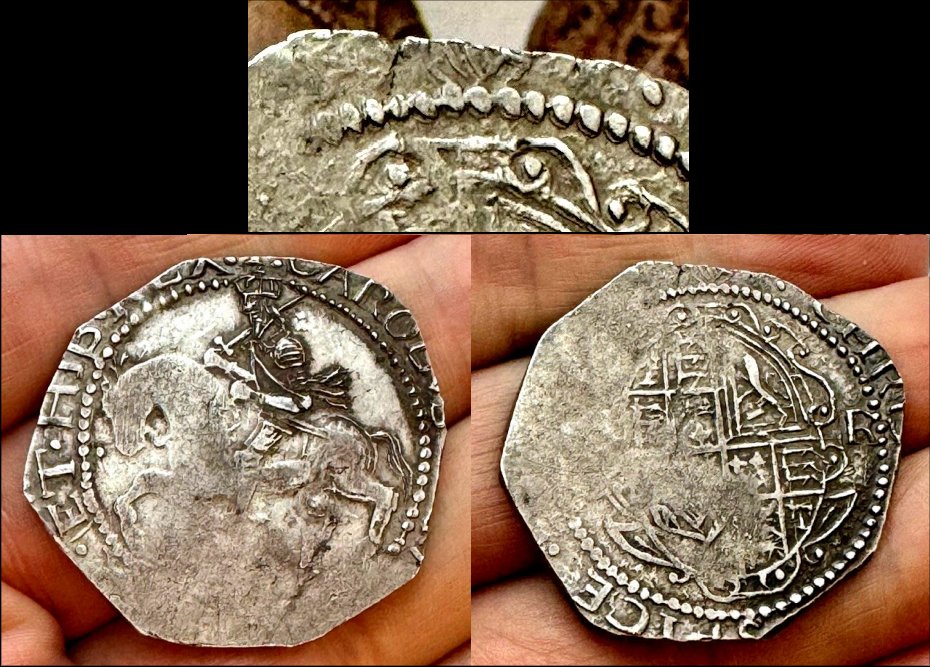
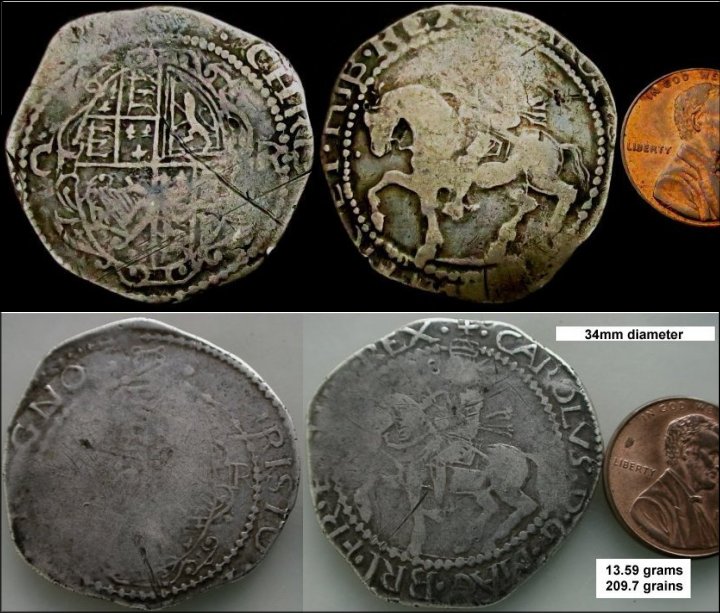
WJC-9427: Charles 1st Hammered
Silver "In Readiness for Civil War" EBOR Halfcrown. Type
7, horses tail firmly in between its legs. York mint, initial mark
Lion, 1643-44. S.R.2869, Brooker 1086 but
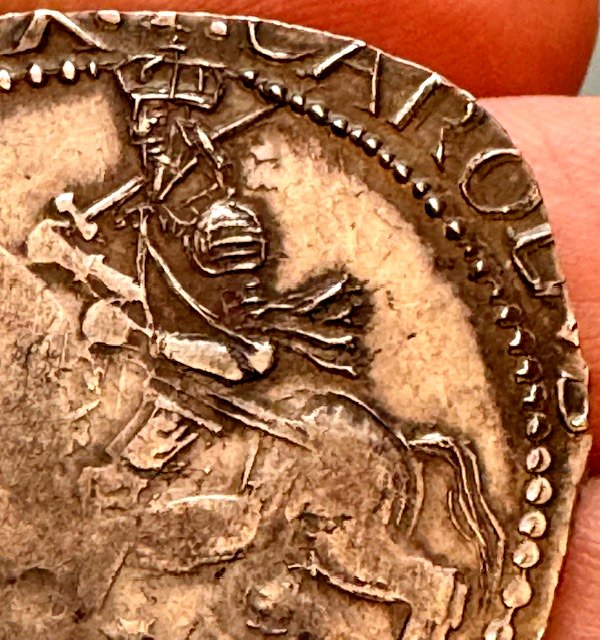
a better grade example that the Brooker plate coin. Of particular interest is the facial detail
of the horse - the three quarter faxing head shows both eyes, something none of
the Brooker examples do other than the rare HIBA example (ex Locket, Brooker
1088). During the first Civil War, when
the London mob made life too dangerous for
King Charles I in the capital, he moved to York, bringing his family and court
with him. Foreign ambassadors, members
of the nobility and officers of the state were compelled to come to the city
too. For six months York was, in effect, capital of the
kingdom again. York council hoped for a peaceful
settlement. It put the city's 600-strong
militia at the king’s disposal but asked that it were not called away from the
city to fight. In July 1642 the
authorities started strengthening York’s defences. The walls were repaired and sentry boxes set
up. After the king made an unsuccessful
raid at Beverley, it was clear that war was on its way. In August 1642, Charles grew tired of
Parliament’s demands and left York.
Just six days later, he raised his standard at Nottingham and hostilities officially began. Intermediate coinage struck at York is unique to the Civil War. Excellent grade, attractively toned, although
may have been cleaned at some point in antiquity. Minor reverse graffiti by
the horse's flank and some clipping.
Cheap. SOLD
Provenance:
ex Tim
Owen, much older ticket
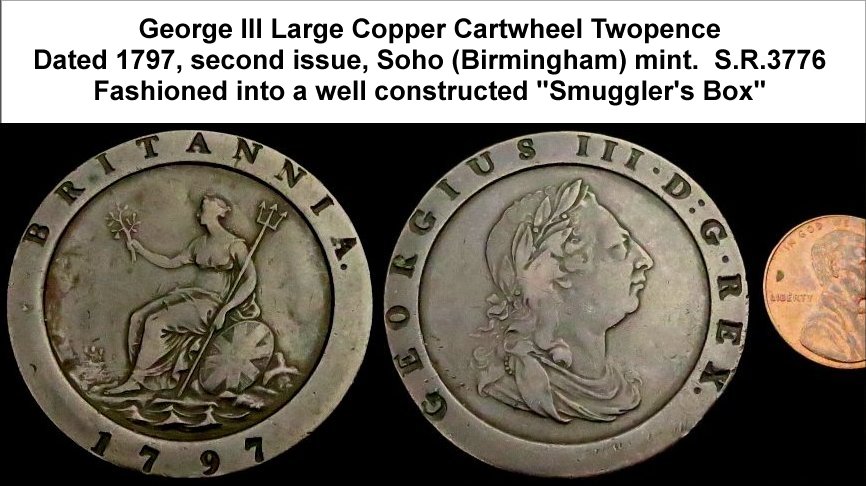
WG-9218:
1797 George III Copper
Cartwheel Twopence SMUGGLER'S BOX. Second issue, Matthew Boulton's Soho (Birmingham) mint, S.R. 3776. At first glance, a
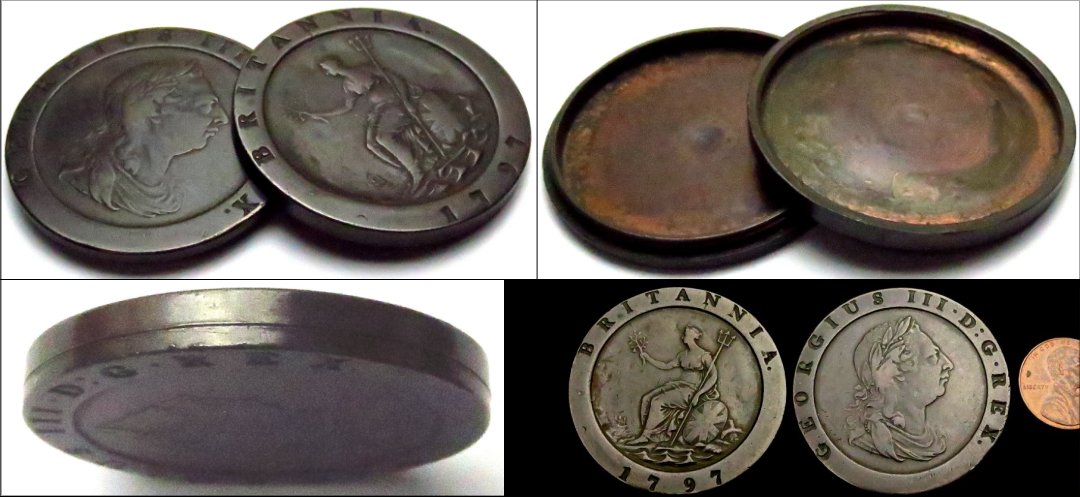
standard huge 1797 George III cartwheel twopence. Look closer though and you'll see that this
coin cleverly unscrews to reveal a hidden cavity inside. Possibly a very early 1800's apprentice
piece. Another story I've heard is that
these were used to hide a gold guinea inside so that, for instance, if you were
taking a horse & coach trip in Georgian times and were held up by a
highwayman, he would not really be interested in a paltry penny or twopence. These
things have always been termed "Smuggler's Boxes" so clearly there
was an element of smuggling involved here, although what you could physically
smuggle inside one of these things back in the early 1800's, even in a coin of
this size, is beyond me! Crucially, the
thread mechanism on this coin is in perfect working order - virtually
every other example I've previously had has been problematic on the
thread. Further, unlike other example
I've had, this thread is much deeper, ie requires more turning, thereby
creating a more solid and stable fit. Extra
images here. These coins just don't turn up anymore and
are therefore keenly sought-after when they do - non
of the others I've previously listed on HistoryInCoins
have hung around for more than a week or so.
SOLD
WI-9105:
Charles 1st
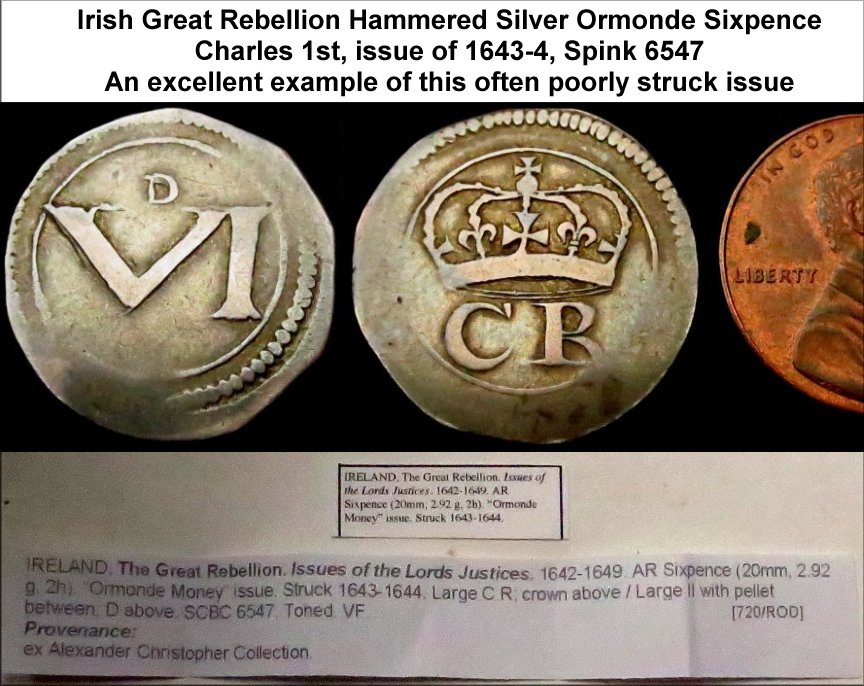
Irish Hammered Silver Ormonde Money Sixpence. Issued during the Great Rebellion, this is an
issue of 1643-44. S.R.
6547. Very much along the lines
of the English Newark, Pontefract, Carlisle etc siege pieces, the Ormonde Money
was crudely cut from flattened silver plate and then stamped. These stamps were not engraved to anywhere
near the quality of coin dies and the "stamping" resulted in a coin
far from what we might expect a professional moneyer to produce working out of
an official mint. As a result, Ormonde
coinage is usually poor. This is the
very best example of a sixpence that I have ever handled and possibly even
seen. Rare thus. SOLD
Provenance:
ex
Alexander Christopher collection
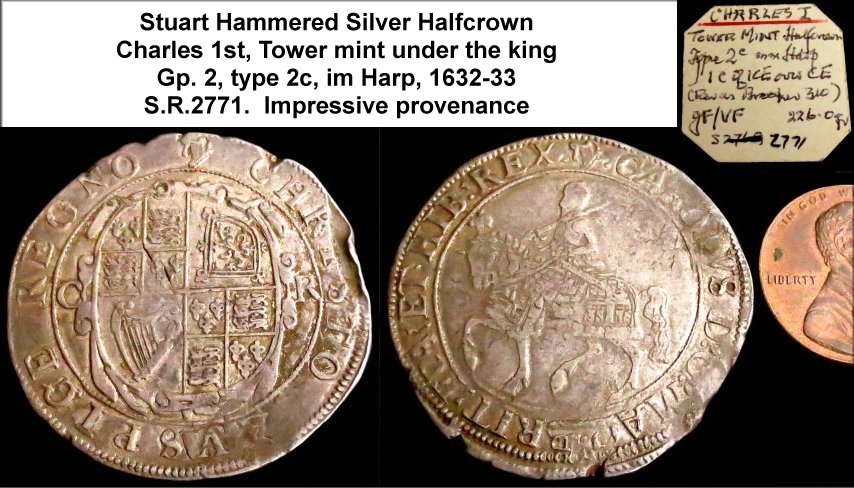
WJC-9422: Charles 1st Hammered
Silver Stuart Halfcrown. Tower (London) mint under the
king. Group 2, type 2c, initial mark Harp,
1632-33. Second
horseman, no ground, horse with head-plume. S.R.2771. The reverse letters IC of AVSPICE are
over CE (very clear) which highlights that the Brooker example (310) is from
the same dies. The Maurice Bull
reference is 148a/20 and is this exact same coin. 180 degree die
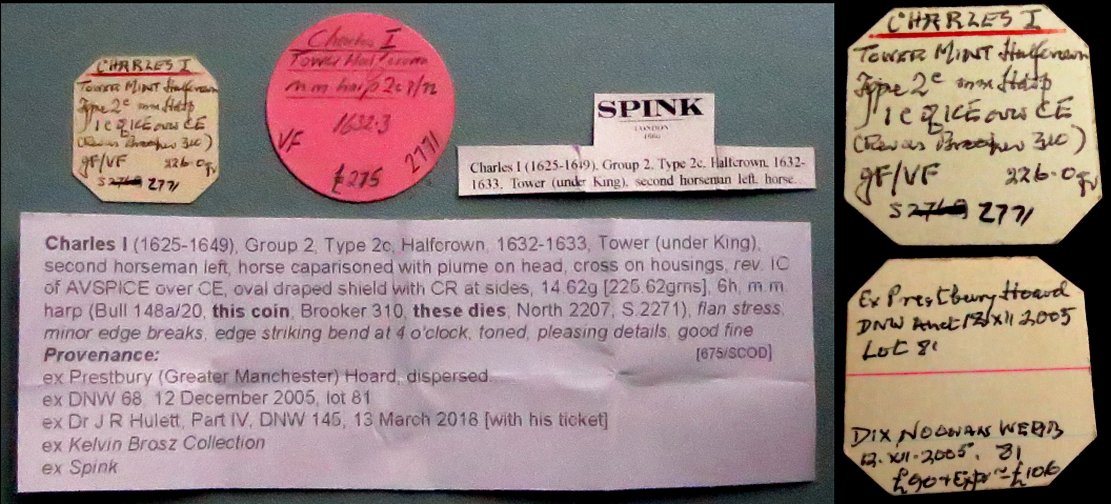
rotation, 14.62 grams. Excellent provenance, being originally part of the famous Prestbury Civil War Hoard of 2004. Old
tickets here. The hoard was
found on 15 June 2004 by Jason Scott in the course of
his digging footings for a barn conversion at Prestbury,
Cheshire. Comprising 1,366 coins, its
content is typical of so many Civil War deposits, being mainly comprised of
silver halfcrowns, shillings and sixpences from the coinages of Edward VI to
Charles I. Also included are groats of Mary, Philip and Mary and Elizabeth I,
again not unusual, together with some threepences of Elizabeth I. Their face
value amounts to almost £43, a significant sum at the time. The land on which the find was made is known
to have been owned by Thomas Legh, the Royalist High
Sheriff of Cheshire, a prominent landowner who resided at Adlington
Hall, Macclesfield. It was likely leased to a tenant farmer. The most recent
coins bear the mintmark triangle-in-circle, in use 1641-3, suggesting this a very early Civil War era deposit. On 15 July 1642, a
just five weeks before the King raised his Standard at Nottingham, the Royalist
Lord Strange entered Manchester, predominantly of Parliamentarian persuasion,
with a small body of his men and a fracas ensued, a precursor to the troubled times
in store. In September Strange, by then Earl of Derby, following the recent
death of his father, laid siege to Manchester. This was something of an
anti-climax from a Royalist standpoint and the reluctance of the Cheshire levies to serve outside of their
own county doubtless had its effect. It might be reasonable to suggest this
hoard was deposited at that time. The
hoard was contained in a cylindrical jar, found in six fragments, thought
contemporary and of local manufacture in the Northwest Purple tradition. It was
declared Treasure at an inquest held on 19 October 2004 and released to the finder, who had
retained a few of the coins as mementos, earlier that year. A significant coin. SOLD
Provenance:
ex Prestbury Civil War Hoard, 2004, dispersed ...
ex DNW
68, December 2005, lot 81, purchased by ...
ex
Unidentified dealer (pink ticket priced up at £275), sold to ...
ex Dr
J.R. Hulett collection (his ticket), dispersed ...
ex DNW
146, March 2018, purchased by ...
ex
Kelvin Brosz collection, dispersed ...
ex
Spink
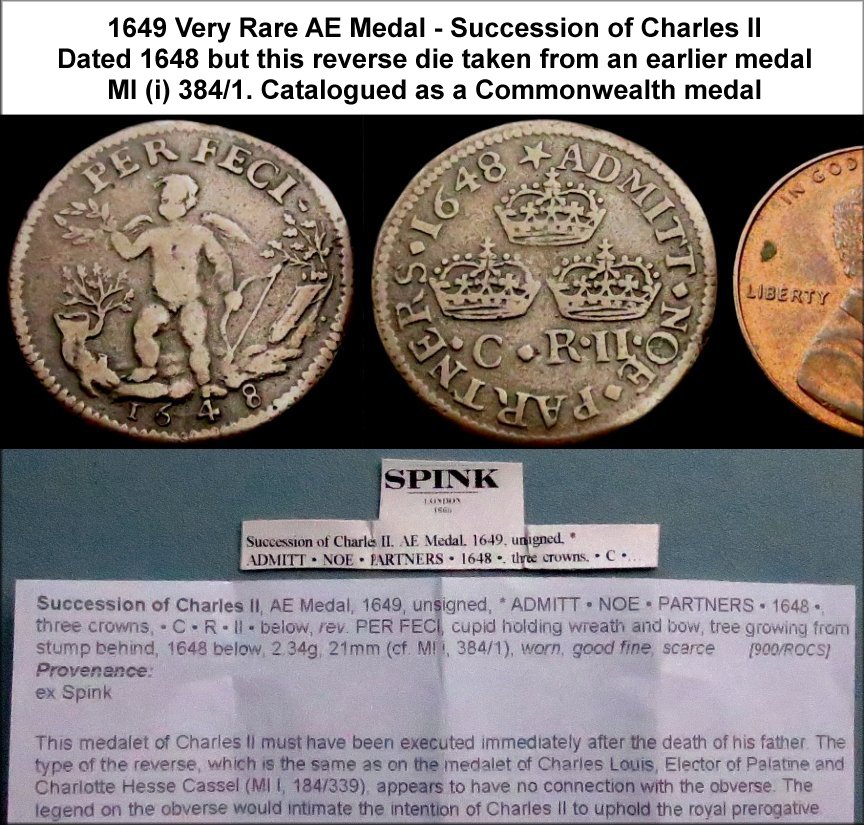
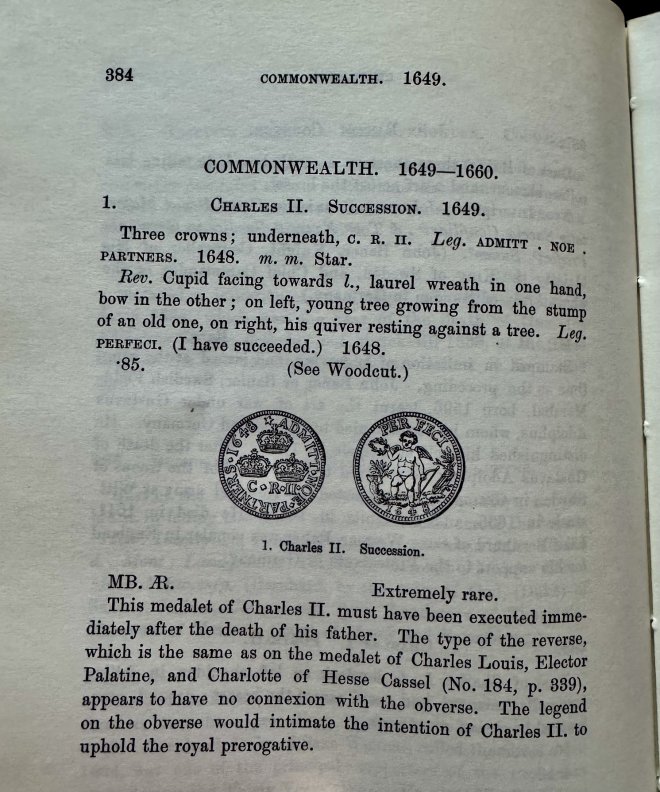
WCom-9401: 1649 Commonwealth Period
Medal - Succession of Charles II.
Obv: Three crowns, C.R.II under, ADMITT.NOE.PARTNERS, 1648
surrounding. Rev: Cupid facing, PER FECI
above, 1649 below. The obverse is an old
legal process and translates to "Adding a New Individual or Entity into an
Existing Practice", ie adding Charles II to the monarchy's line of
succession, which perhaps has the tone more of a question rather than a fait accompli. The reverse is actually recycled from an
earlier betrothal medal, illustrating the great rush to get this medal out
there, thus we have the 1649 date already in situ on the reverse of the medal,
thus accounting for the fact that King Charles 1st died January 1649. The reverse translates to "I Have
Succeeded", which works perfectly well as the original betrothal medal but
is perhaps a questionable choice for this medal, bearing in mind the way that
events had already panned out by the time Charles was losing his head on the
block. Still, they were at least
optimistic, which is somewhat reminiscent of the tactics employed by the
Jacobites on their medals just a few decades later. Medallic
Illustration (i) 384/1
where it is listed as the very first medal in the Commonwealth section. A very great rarity in the medal world - I
have certainly never seen another - as well as an immensely interesting window
into one of the most pivotal and turbulent periods in British history. SOLD
Provenance:
ex
Spink
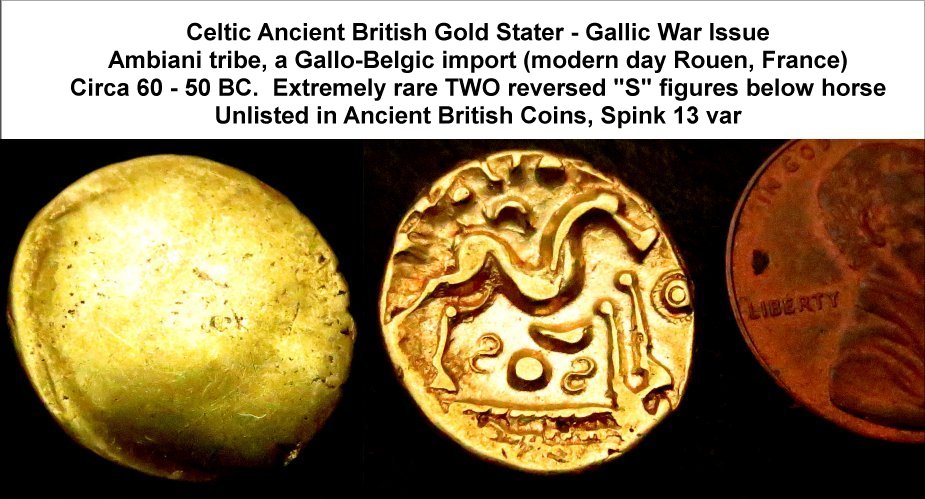
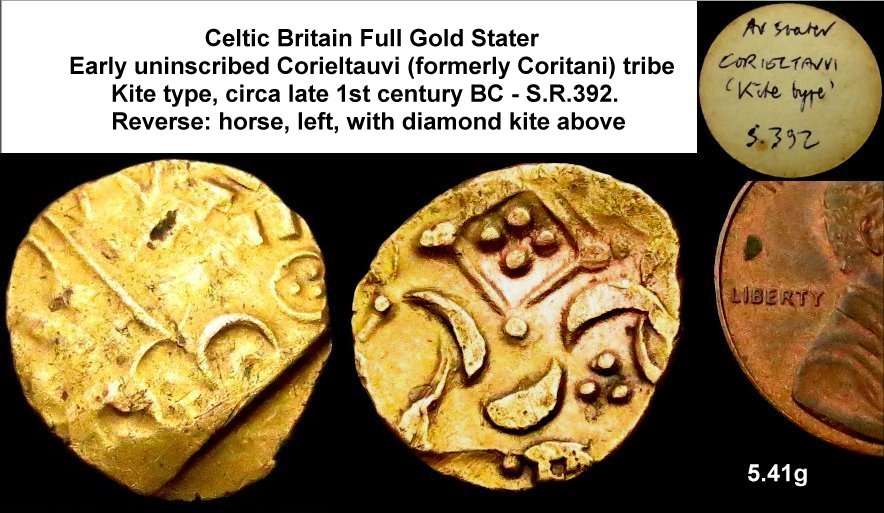
WAu-7993: Extremely Rare Celtic
Gold Full Stater. Gallic War issue - Ambiani -
imported from Gaul or specifically, the modern day Rouen area of France, circa 60-50 BC.
A seemingly common enough Ambiani stater from the
Gallic War period with the disjoined or sinuous horse, right, and a blank
obverse. However, the double
"S" below the horse and either side of the pellet render this coin
excessively rare. Ancient British Coins
(ABC) by Chris Rudd, the go-to reference for Celtic coins since 2010, taking
over from Van Arsdell, has no recorded examples. Ambiani is ABC 16, with nothing either side
of the pellet. He lists an Atrebates
stater (ABC 19) as having a single S below the horse but the coin for sale here
is NOT Atrebates (the Atrebates were separated from the Ambiani by the Canche river) as they have a letter A on the obverse. S.R. lump
the Gallic War issues together and put forward S.R.
13 - a stater with a single S on the reverse, but this turns out to be
Atrebates and references back to ABC 19 - but again, even if this was the
correct attribution, and it isn't, it's just a single S whereas this coin has a
double reversed S. Interestingly, the
double reverse "SS" symbols appear on slightly later staters and
quarter staters from the North
Thames region, ABC 2237 and
2243-49 (these are the only marks on an otherwise plain reverse, unlike the
symbols on this coin) and are thought to represent lightning flashes
rather than letters. So, a very common
tribe (although interestingly, Ambiani staters now seem to be more expensive
than Coritani staters, which certainly wasn't the case a decade ago) but an
excessively rare variant that is to my knowledge unrecorded and / or
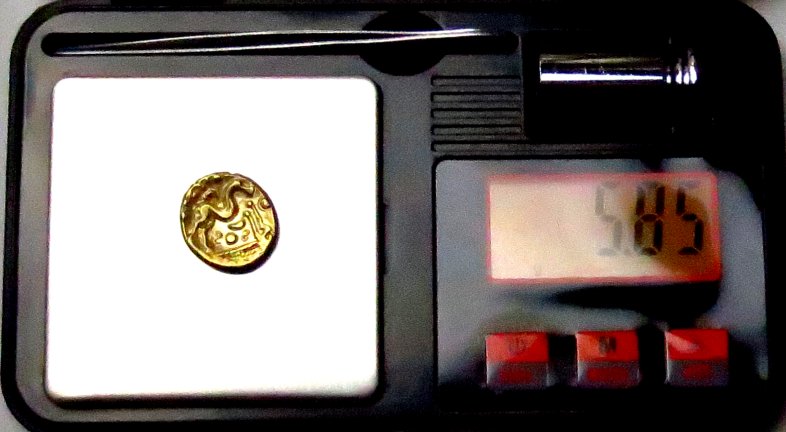
unpublished. Quite a find! 5.85g (see image here). From an old Northern collection - the
collector does not want to be named on the internet but is willing for me to
disclose his name and town to the buyer for provenance. SOLD
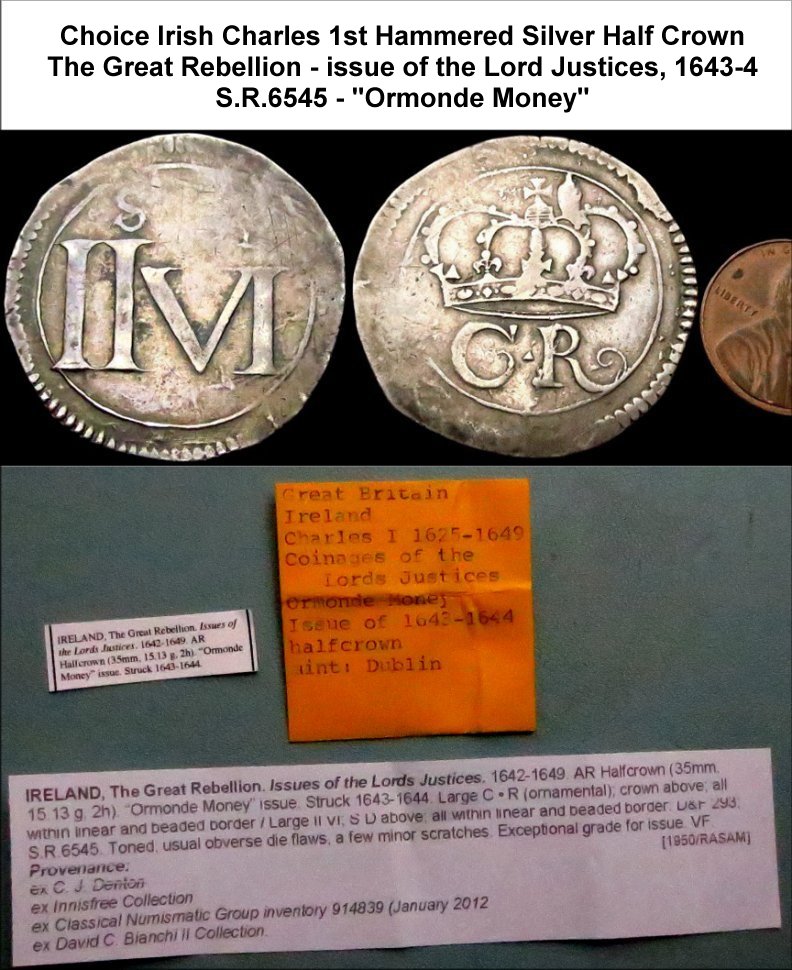
WI-9363: **Choice**
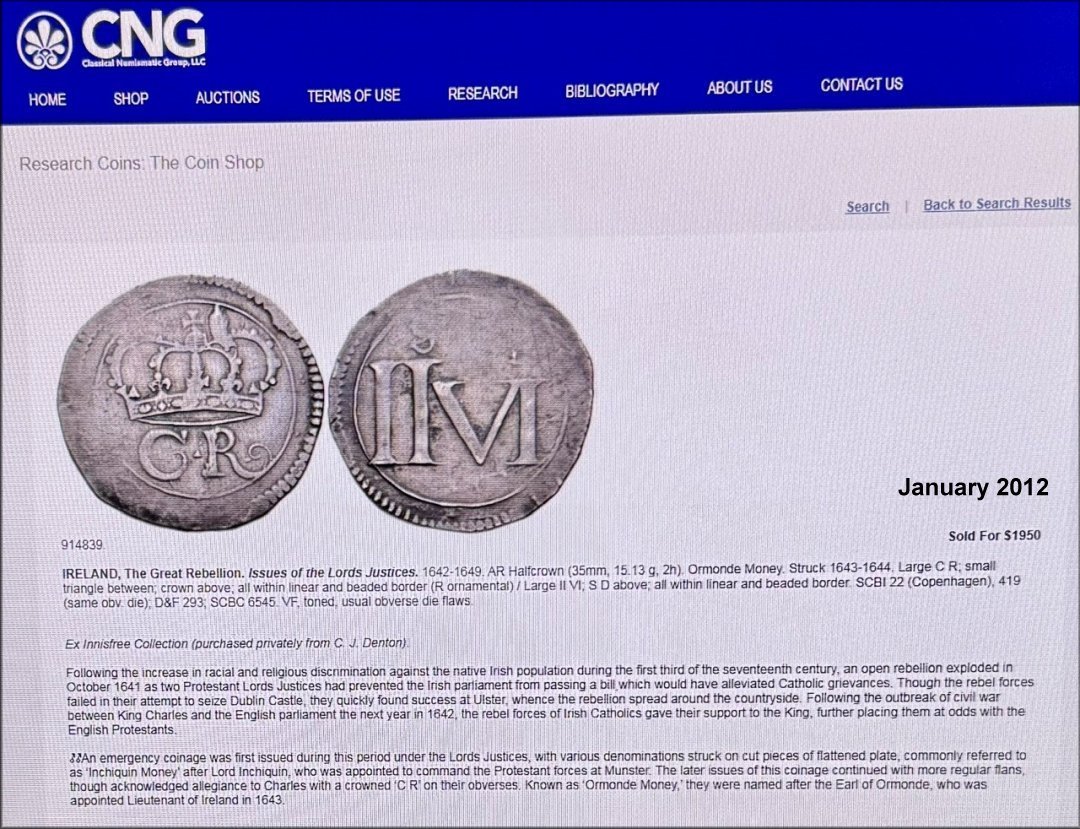
Charles 1st Irish Hammered Silver Ormonde Money Halfcrown. The Great Rebellion in Ireland.
Issued by the Lords Justices at Dublin and termed Ormond Money due to the
Earl of Ormonde being appointed Lieutenant of Ireland in 1643. This was the final coinage of the rebellion
period to be issued. This issue demonstrated
allegiance to the monarch by incorporating the king’s crown on the
obverse. Issued
1643-1644. Obverse: a large C•R
with a much flourished R, crown above; all within a linear and beaded border / reverse:
a large II with a small S above and large VI with small D above (2 shilling, 6
pence); all within a linear and beaded border. S.R.6545. Very much along the lines of the
English Newark, Pontefract, Carlisle etc siege pieces; the Ormonde Money was
crudely cut from flattened silver plate and hammered with the die. These dies were not engraved to anywhere near
the quality of regular coinage, resulting in a coin far from what we might
expect a professional moneyer to produce working out of an official mint. As a result, Ormonde coinage is usually poor,
as ever summed up eloquently and concisely by Coincraft: "This [halfcrown]
issue is scarce but obtainable, although coins are rarely found in better than
Fine condition." The
Coincraft plate coin is not as good as this coin. The S.R. plate coin is a decidedly odd
example with the II and VI bizarrely being of equal height. Very similar to the Baldwin example, even down to the slightly
angled strike creating matching flat areas, which sold for north of £2,000 if
memory serves. The London Coins example
was a lesser grade coin, also being off-struck, which sold for £1,500 after
commissions in 2017. This same coin sold
14 years ago (2012) in a CNG featured auction for $1,950 before add-ons. Choice. SOLD
Provenance:
ex
C.J. Denton, sold to the...
ex Innisfree Collection, sold by...
ex
CNG, January 2012, sold for $1,950 to the...
ex
David Bianchi collection
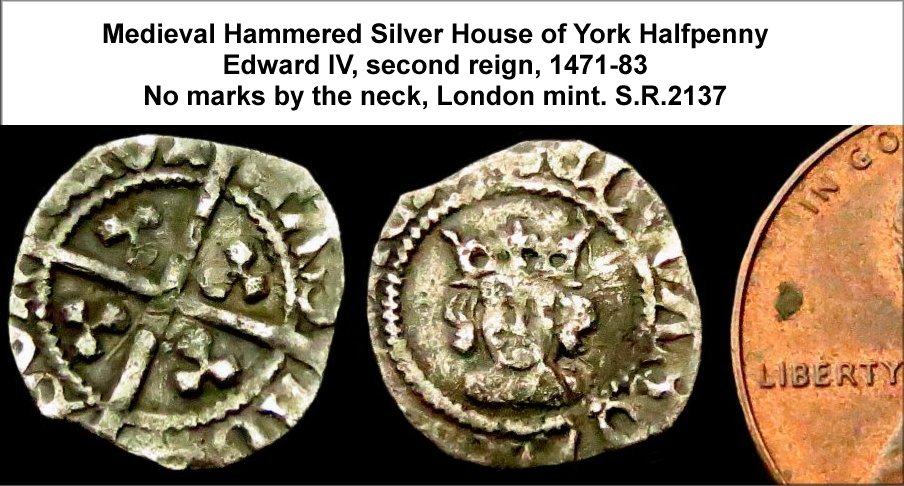
WMH-9419: Edward IV House of York
Hammered Silver Halfpenny. Second
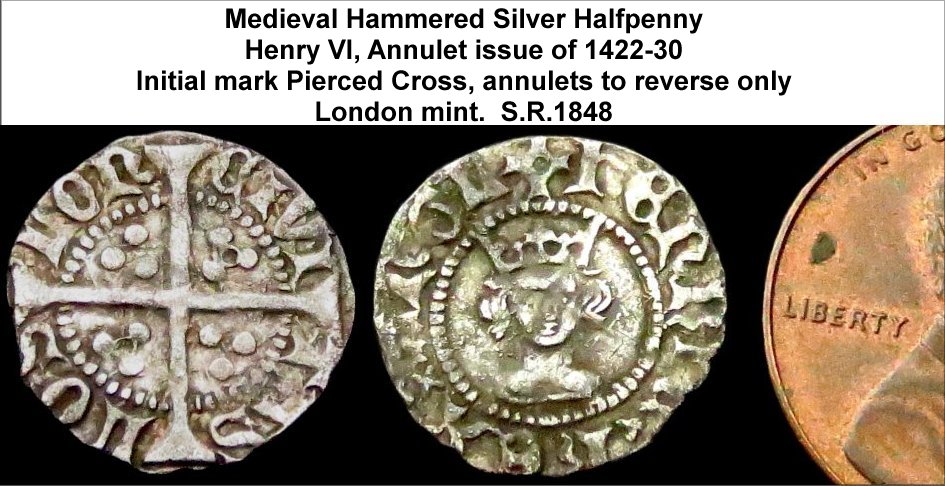
reign, 1471-82, London mint, no marks by the neck. S.R.2137. Very good grade for issue. SOLD
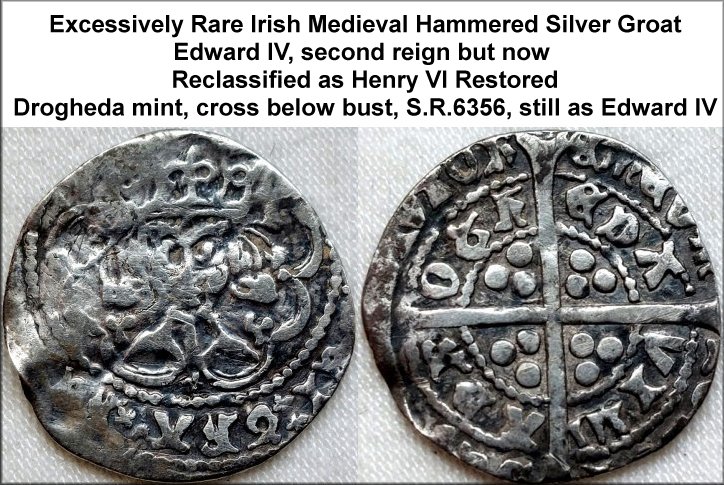
WI-9411: Excessively Rare Irish
Henry VI Readeption (Second Reign - Restored)
Hammered Silver Groat. Catalogued in
S.R. as 6356 [6329]: Ireland, Edward IV, Drogheda mint, second reign (1471-1483),
Light "Cross and Pellets" Coinage, Groat, Second Issue, [i.m.] EDVARDVS. DEI. GRA. REX ANGLI, English titles only, rosette stops, crowned
bust facing of local (Yorkist) style, flanked by
trefoils at neck, in tressure with four fleurs,
saltire in spandrel below bust rev.
POSVI + DEVM [x] ADITORE MEVM // : VILLA DROGh : EDA, single and double saltire stops, long cross,
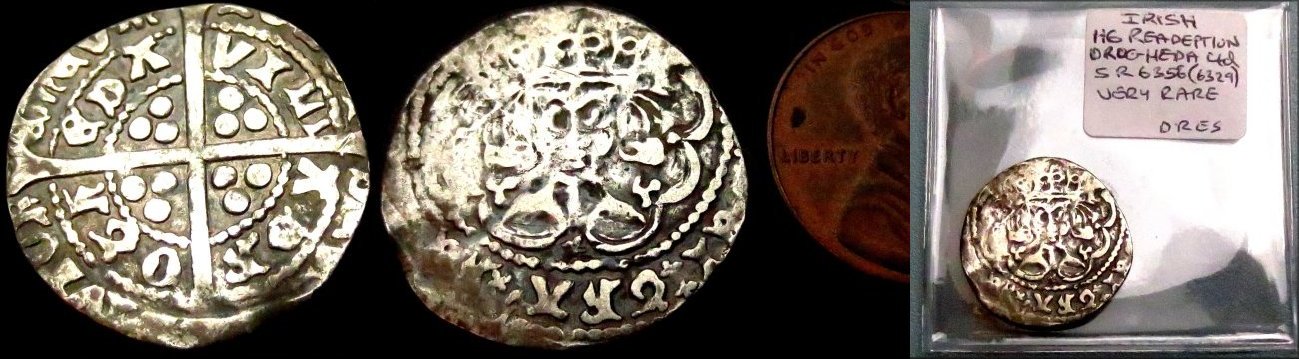
trio of pellets in angles, 1.96g. 10h. My attempt at photography using my
usual setup was a particular low point (it's here for those
interested), hence the slightly different front image. This is researched to be a Yorkist
coin of local dies, most likely struck during the readeption
of Henry VI: current chronology given as November 1470 (Henry VI
restored was October 1470 to April 1471). At some point, and Sovereign Rarities allude
to this in the 2026 edition of their Coins of Scotland, Ireland and the Islands
edition (p.154), this coin will need to be reclassified as being Henry VI
restored. A couple of decades ago, there
were only 4 known examples. John
Stafford-Logan (who has authenticated this attribution) had one of those four
coins back in the day but agrees that more have been recovered from the plough
soil in recent years, particularly around the north of England. The John Noel Simpson example (albeit a
better coin) sold in 2025 at Spink Auction 25021 for over £3,500 after buyer's commission. The National Museum of Ireland has but a
single example and states, "Only one groat assigned here, slightly
water-worn otherwise toned and on a fuller flan, the critical legend variety
clear, almost very fine, excessively rare, only one other example identified,
an inferior die duplicate..." To
summarise, An Irish Dogheda mint groat with ENGLISH
TITLES researched to have been struck in November 1470, ie during the readeption of Henry VI, but without altering the regnal name
of Edward, as they did for one of the Cork issues. A great rarity. SOLD
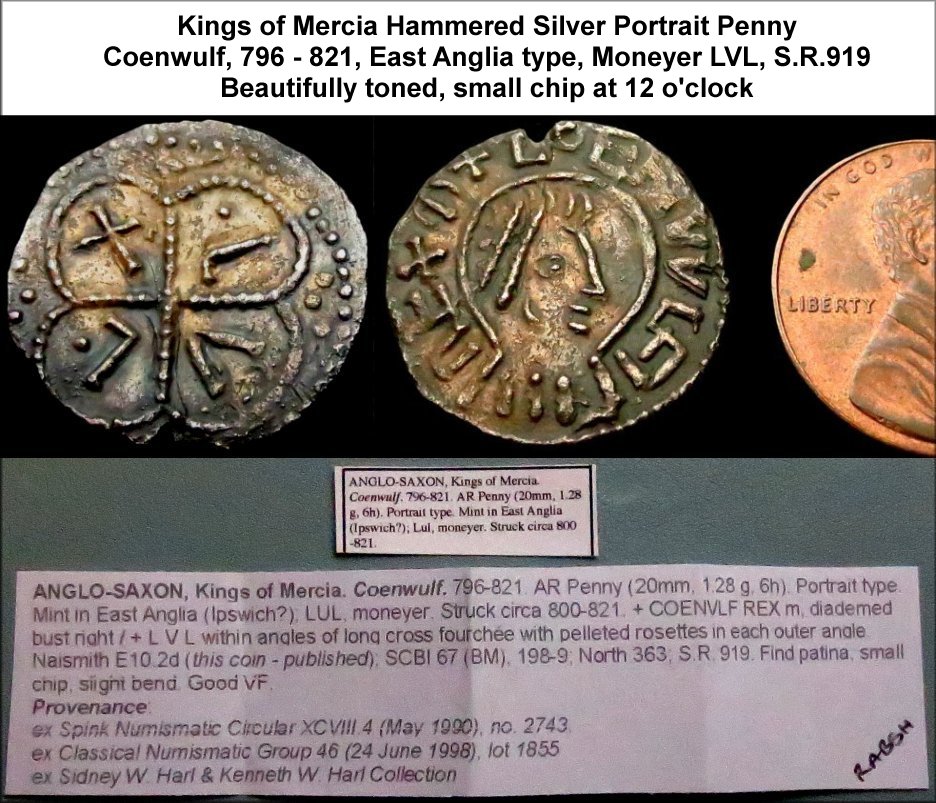
WSax-9414: COENWULF - King of Mercia - Hammered Silver PORTRAIT Penny. Crude diademed bust right,
+COENVVLF REX M. Reverse large
quatrefoil with moneyer LVL on the leaves.
East
Anglia mint (Ipswich?).
Group III, S.R.919, North 363 (listed EXTREMELY RARE). Coenwulf succeeded Ecgfrith, son of Offa, and
successfully preserved Mercian supremacy, so much so that he termed himself
Emperor, the first Saxon king to use that title, even though he did not quite
ever have the authority of Offa. Upon his death in AD 821, it all began to
fall apart thanks largely to the rise of Wessex dominance via King Egbert. Beautifully toned, a small edge nick at 12 o'clock, a minute bend that you would
hardly notice unless it was pointed out, and extremely rare.
SOLD
Provenance:
ex
Spink Circular, May 1990
ex
CNG, June 1998
ex
S.W. & K.W. Harl collection
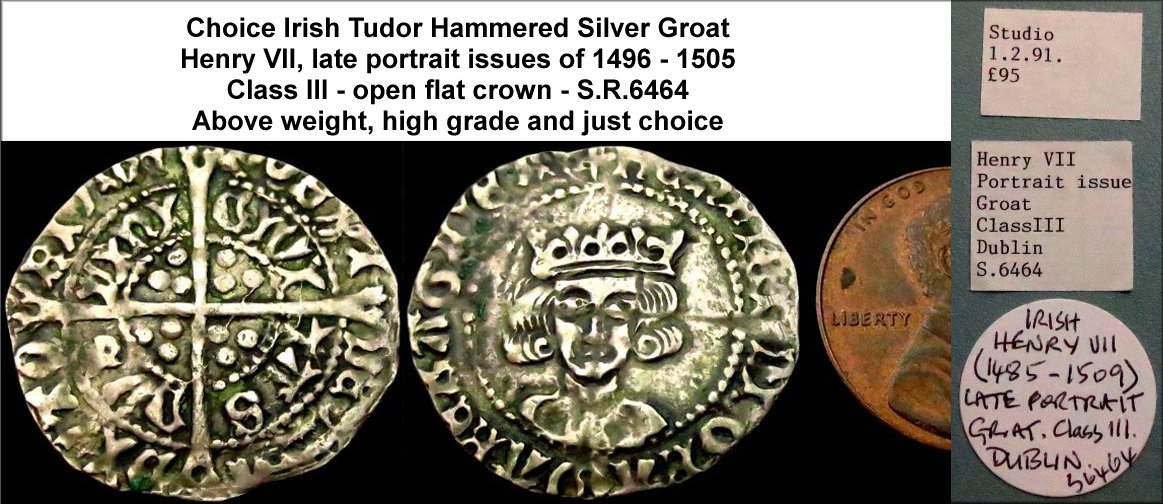
WI-9412: *Choice Grade* Irish Henry
VII Hammered Silver Groat. Late
portrait issue, very much towards the end of the 1496 - 1505 period,
class III, open flat crown, Dublin mint. S.R.6464. Following on from the Henry VII
"Three Crowns" coinage, this issue is very similar in style to the
English counterparts but with the Irish issues being much cruder, and obviously
rarer. This issue was only struck at the
Dublin mint, and occasionally with silver
that was below the standard of the day, which was something of a running theme
with Irish coinage under English control.
The standard weight of the late portrait issues was 32 grains, reducing
to 28 grains after type IIA. This type
III coin is actually above weight at 28.8 grains, highlighting no clipping and
barely any circulation wear. An interesting final Henry VII issue, not to mention a difficult
coin to source in both this weight and this spectacular grade. Choice - just look at the S.R. plate coin and
compare! SOLD
Provenance:
ex Studio
Coins Feb 1991 - x35+ years ago!!
ex
Lloyd Bennet, March 2025 - ticket
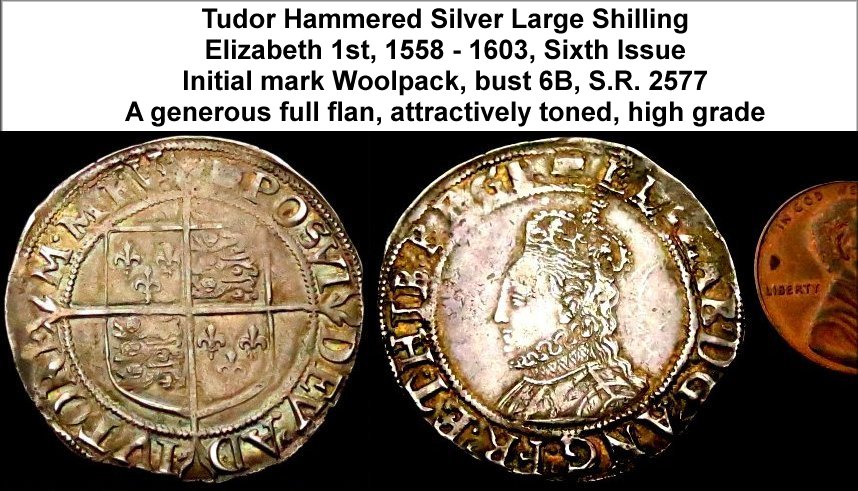
WTH-9383: Elizabeth 1st Hammered
Silver Tudor Shilling. Sixth Issue, Tower (London) mint, initial mark Woolpack, bust
6B, S.R. 2577.
The sixth issue was 1st February 1583 through to 20th
May 1601
with Woolpack being 9th May 1594 to 13th
February 1596,
so just under two years in operation.
The shilling had stopped being struck at the cessation of the second issue
in 24th October 1561, meaning a 22 year hiatus until it
reappeared due to the old shillings from the first and second issues being worn
by this point. Interestingly, towards
the end of the century there was a bad economic depression and as a result, mint
output decreased dramatically, resulting in a dearth of unused dies, although
the shilling was issued right up until the end of the reign. That depression would certainly have been
upon the country at the time of this coin (1594-6) thus the number of coins
leaving the mint, and by association, the number of extant coins today, would
be much lower than the norm. Another
interesting point (well, I find it interesting!) is that in 1593, just a year
before this coin was issued but probably at just about the time this coin's
dies were being sunk, a new engraver took over at the mint. Derick Anthony had
been engraver at the mint for 30 years and in 1589 had brought his son to the
mint as apprentice. Charles officially
took over from his father in 1593. The
son's dies can be distinguished from those of his father's by their more
elaborate and florid style, although it should be pointed out that this was a
gradual deviation from the style of his father.
A large, generous full flan coin with lovely toning as
well as being in excellent grade.
An exceptionally pleasing example. SOLD
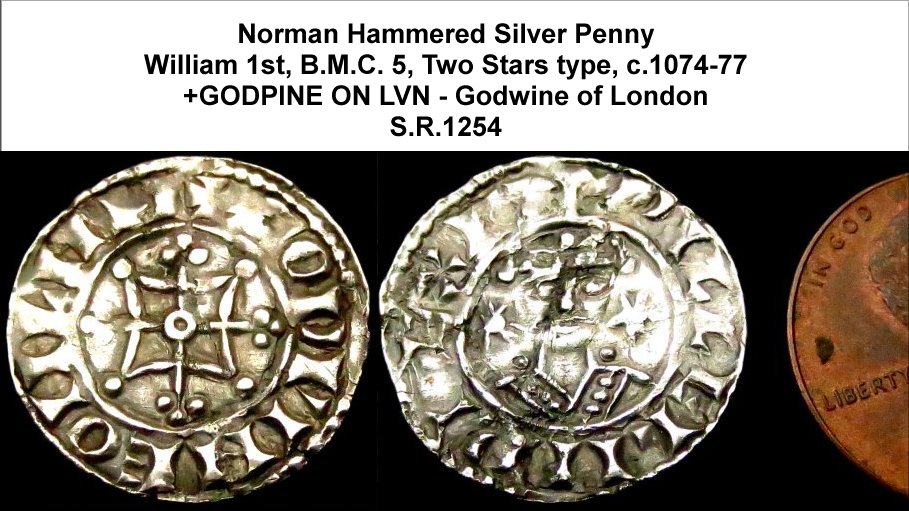
WMH-9172: William 1st Hammered Silver
Norman Penny. B.M.C. V,
Two Stars type: +GODPINE ON LVN – Godwine of London.
S.R.1254. Not a particularly rare
mint or moneyer but a nice, clear example of this much rarer type - obviously
all Norman pennies are much, much rarer than their Medieval and Tudor
counterparts, and in a lot of cases, rarer even than the late Saxon pennies,
but when you do come across a William 1st penny, it's invariably B.M.C. 8. SOLD
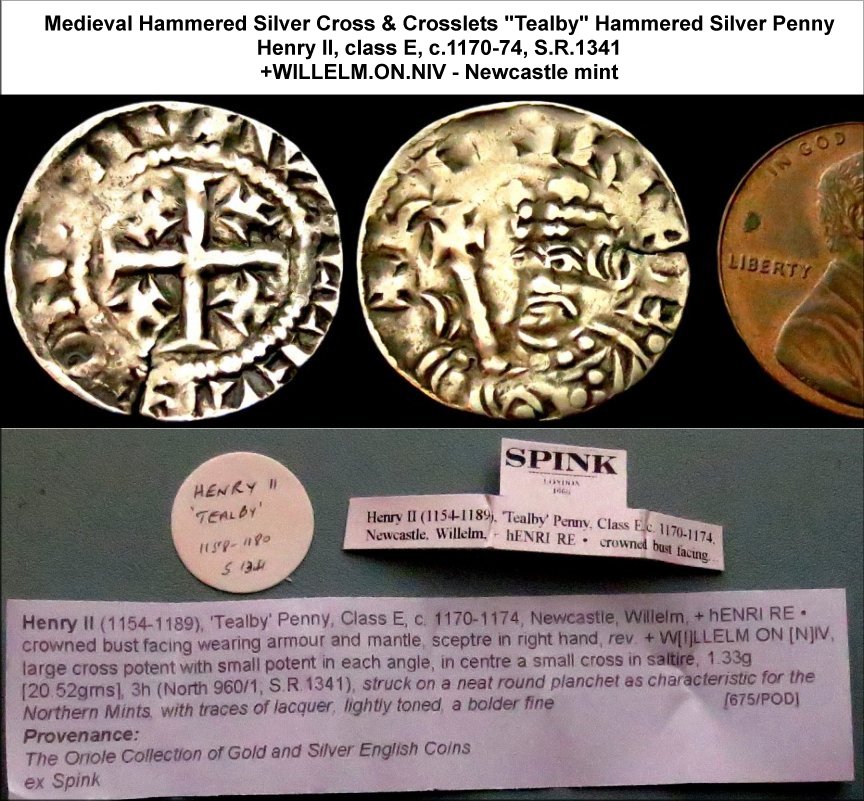
WMH-9352: Henry
II "Tealby" Medieval Hammered Silver Penny. Cross and Crosslets coinage, jewelled collar
- class E, circa 1170-74. S.R.1341. +WILLELM.ON.NIV - Newcastle mint. A fairly unusual mint
signature, ie not the usual NEVCAS or shortened variation there of. A full, round planchet
being good fine, almost VF for issue.
Immediately following on from the reign of Stephen. Henry
of Anjou became Henry II upon the death of Stephen - a monarch who had an
extremely tenuous claim to the throne and who only remained as king because
he'd agreed to let Henry, Matilda's son, ascend the throne upon his death - and
even though an impressive 29 mints were opened to produce coinage, the quality
was just as poor - maybe even worse - as the Stephen coinage. Of those 29 mints, only around a third continued
after Henry's recoinage to the voided short cross and come the later long cross
issues, far fewer than that. This coin
is excellent. SOLD
Provenance:
ex Oriole collection, dispersed...
ex Spink
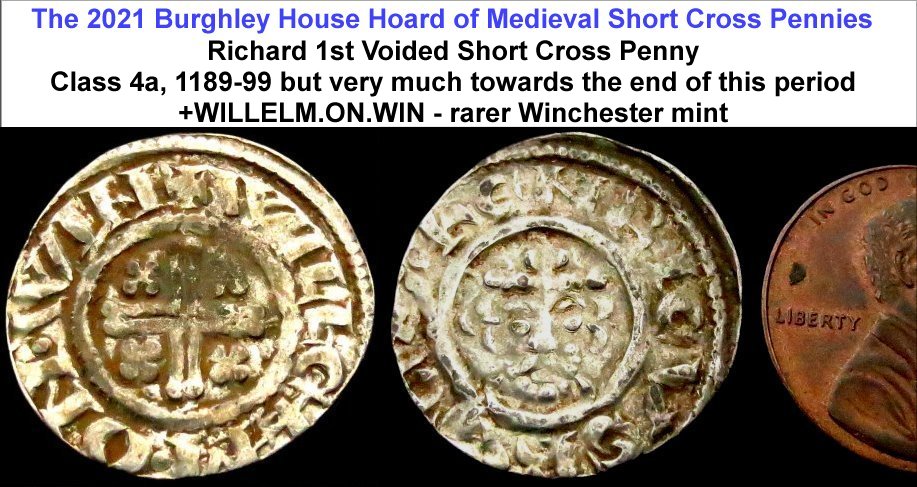
WMH-9343: ** THE BURGHLEY HOUSE HOARD** Richard 1st Medieval
Hammered Silver Voided Short Cross Penny. Class 4a,
+WILLELM.ON.WIN - rarer Winchester mint.
S.R.1348A. In
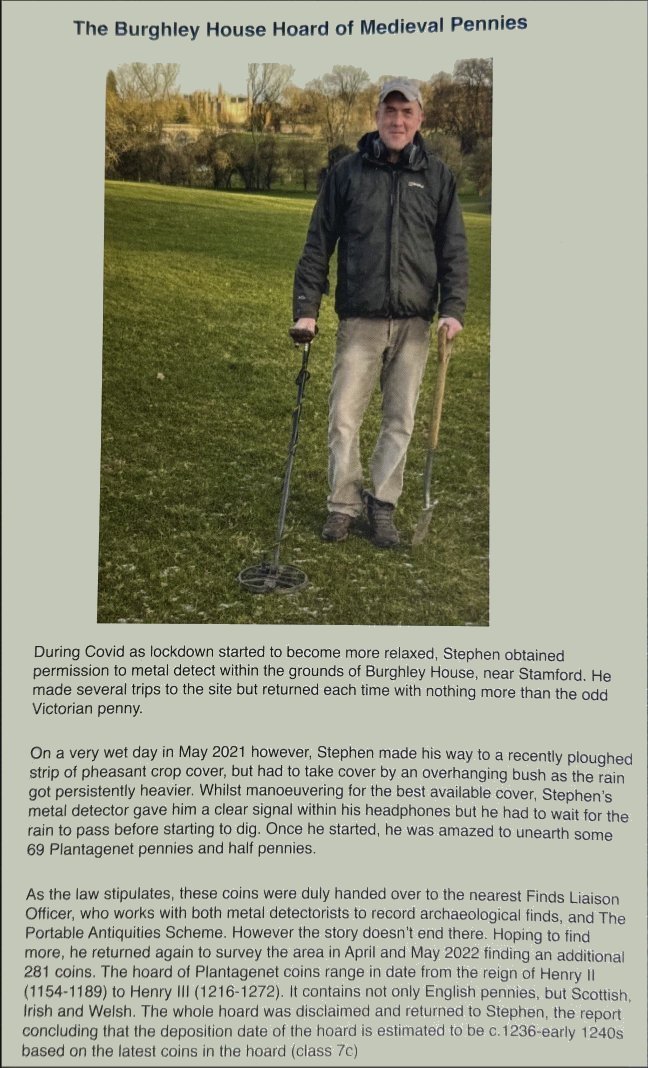
2021, going into 2022, one of the largest hoards of early Plantagenet coinage
was discovered in the grounds of the famous Burghley
House estate - a Grade 1 listed English Country House (resembling a very large
stately home) in Stamford, Lincolnshire. Lord Burghley - David
Cecil, later the 6th Marquess of Exeter - famously won
the gold medal in the 400-metre hurdles at the 1928 Summer Olympics, as
depicted in the film, Chariots of Fire, with extensive training throughout the
1,400 acres of his estate. He famously
got one of his grounds men to lay out his hurdles on the estate with an upright
matchbox on each one, the aim being to not only clear each hurdle, at
full speed, but to just clear each hurdle, at full speed, and further, to just clear each hurdle,
at full speed, at a specific point
on each hurdle with the leading leg with hopefully all matchboxes being
successfully dislodged and hurdles intact!
The
hoard consisted of approximately 350 Plantagenet pennies and halfpennies,
ranging from Henry II to Henry III. The
hoard deposition is estimated to the very early 1240's, based on the latest
coins in the hoard - class 7c pennies of Henry III. The find was handed over to the state via the
PAO scheme. After an inquest, the hoard
was eventually disclaimed and returned to the finder. See here for the story in
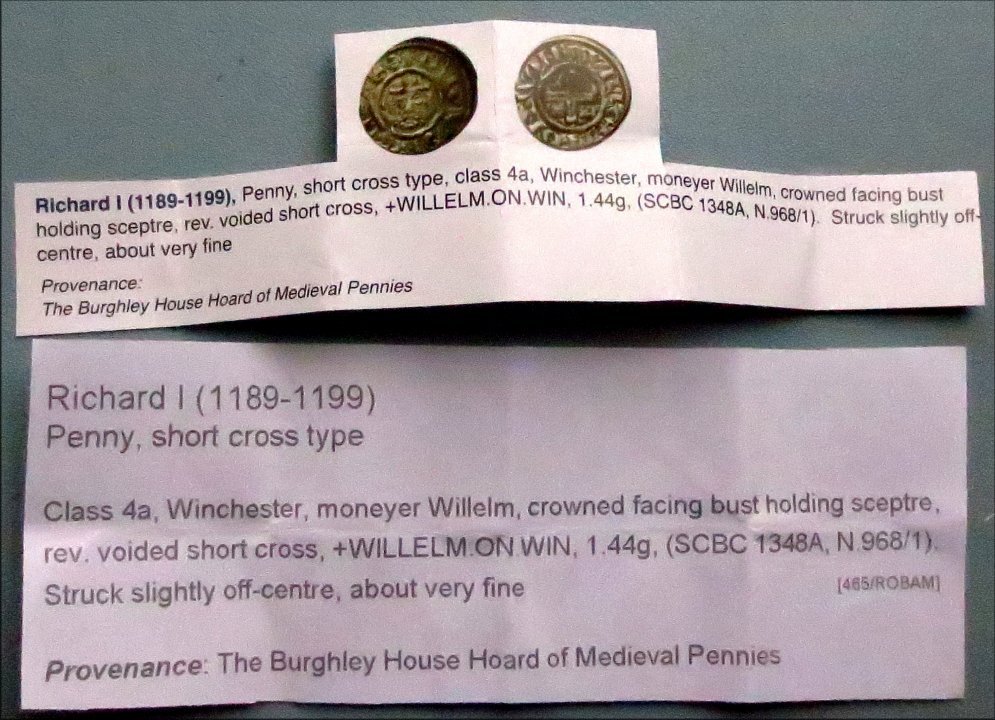
print. Of those 350 hoard coins, the
Richard 1st cohort was a meagre eight coins, illustrating nicely just how rare
this monarch is within the short cross period in general. Tickets
here. A
rare coin from a rarer mint and within a secure hoard context. SOLD
Provenance:
ex Burghley House 2021/2 Hoard
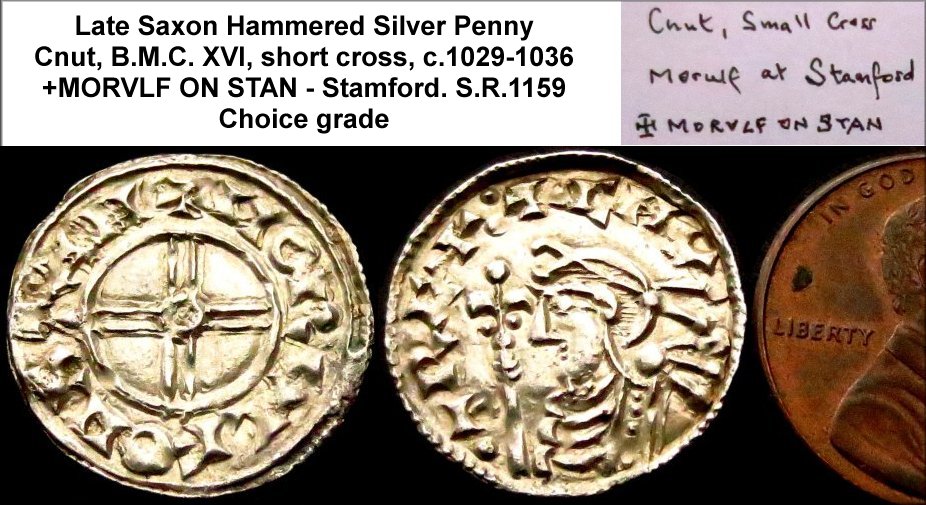
WSax-9402: Choice Grade Cnut Late Saxon Hammered Silver Penny. Short (Small) Cross type, B.M.C.
XVI, circa 1029-1035/6.
+MORVLF ON STAN - Morwulf of Stamford.
S.R.1159. This
moneyer is one of the rarer moneyers for Stamford.
There have been some large hoards of Cnut
pennies, found on both British and Scandinavian soil, of Viking Danegeld origin
- Danegeld (literally "Dane yield") was a tax raised during the ninth
century in England to pay protection money to the
Viking raiders to save a land from being ravaged. This coin is undoubtedly derives from one of
those hoards, probably the 1993 Cambridge Hoard, which accounts for its
"as struck" grade (coinage was literally struck at the mints and
immediately bagged up as Danegeld, having seen zero circulation) and clean
appearance. As a result of these hoards,
we now have a clear picture of who was doing what at each mint, thanks mainly
to the excellent EMC Fitzwilliam database.
Leofwine, Godric, Godwine and even Thorsteinn,
amongst others, were prolific moneyers at Stamford, but not Morwulf
- his output was considerably less than the afore
mentioned. Struck up,
well centred, exceptionally clear legends, problem-free and technically in uncirculated grade.
You will not find a better looking example of any Saxon coin. Choice. SOLD
Provenance:
Likely ex
Danegeld coin hoard (Cambridge, 1993)
No ticket
but accompanied by an annotated coin envelope from a collection
WSC-7692:
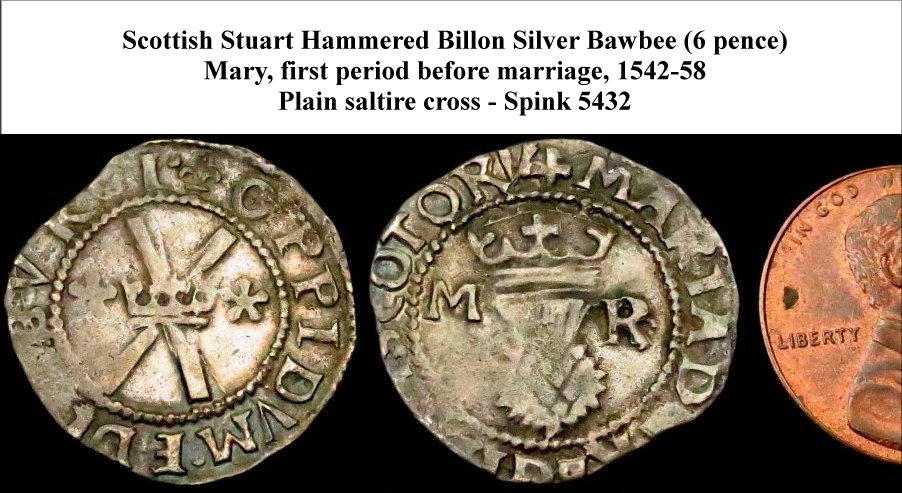
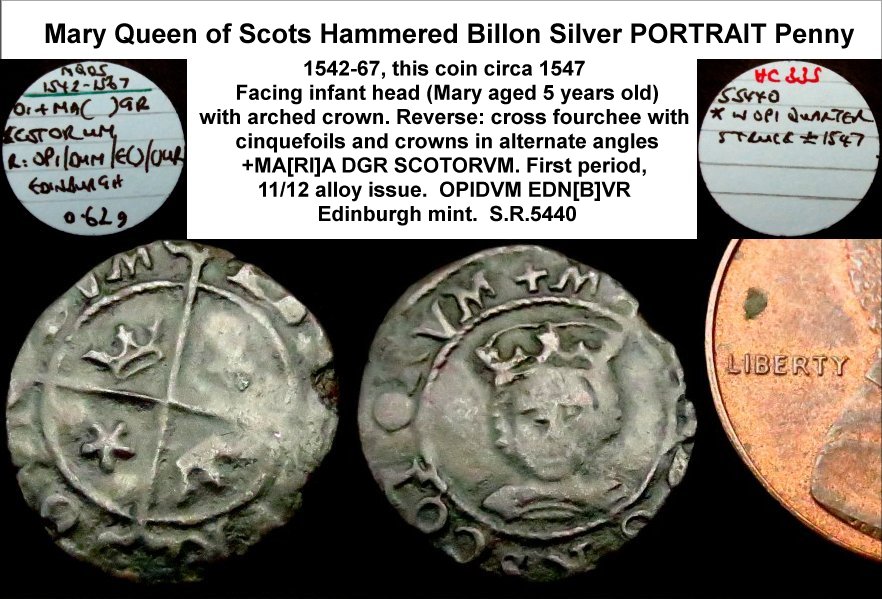
Mary Scottish
Stuart Hammered Billon Silver Bawbee.
First period, 1542-58, before her marriage - remember, Mary was born December
1542. Issue of ¾ alloy
although looking much higher in the hand. Edinburgh mint, plain saltire cross, S.R. 5432.
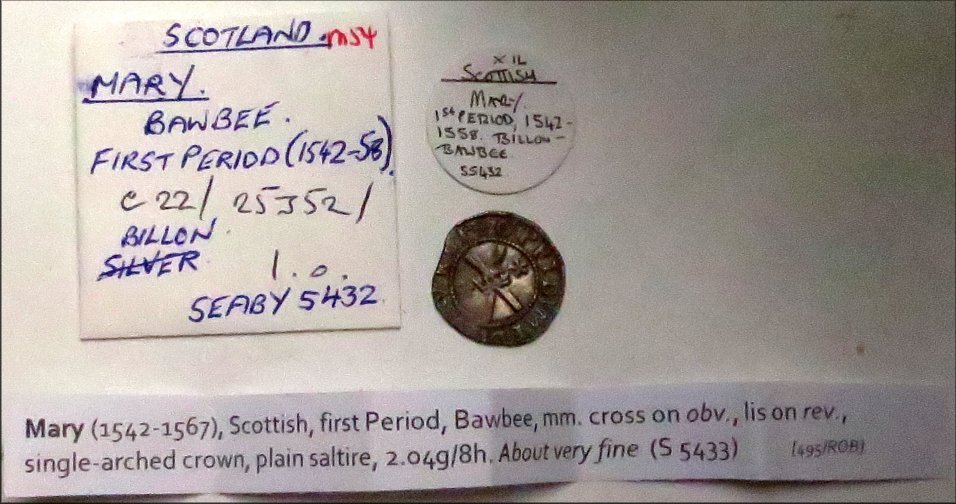
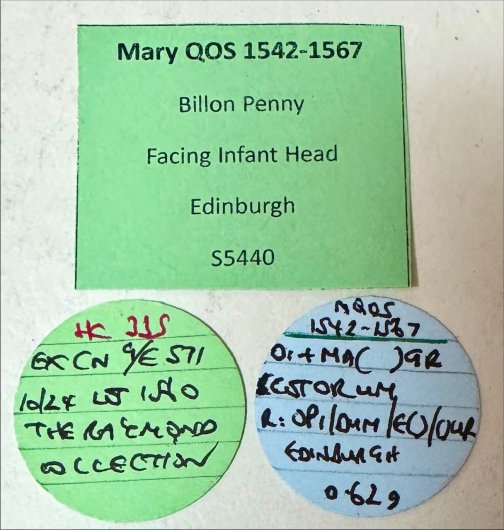
Sold with a couple of old tickets (the most recent giving an incorrect S.R. number) – see here. One of the nicest examples
of this issue that you’re ever likely to find for sale. SOLD
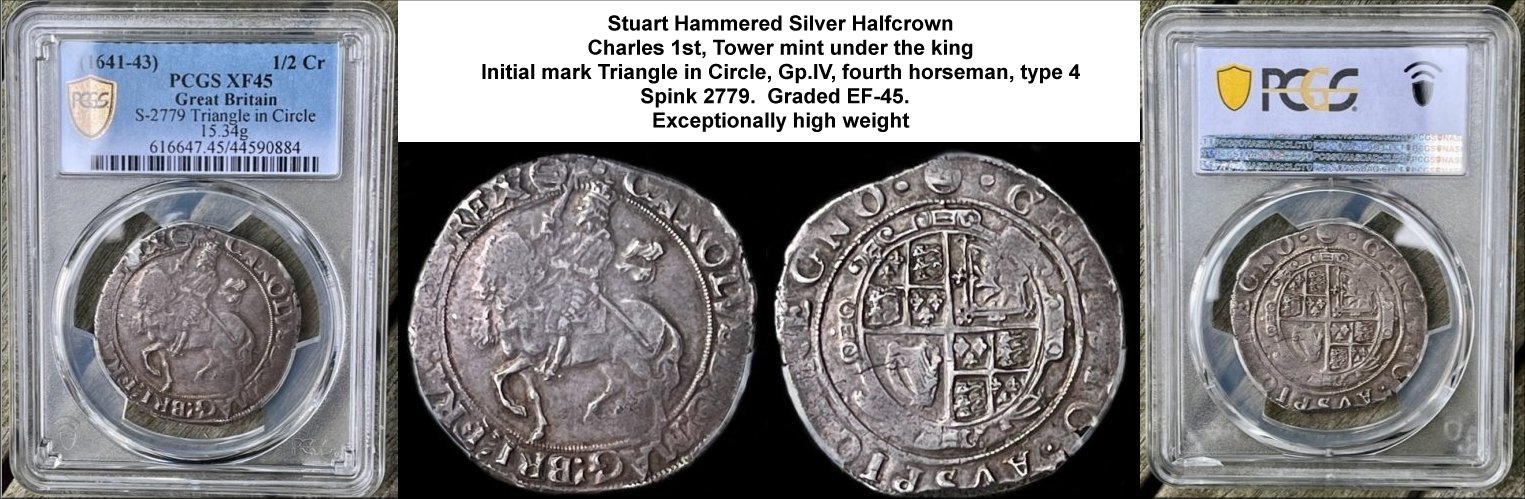
WJC-7921:
Charles 1st Hammered
Silver High Grade Halfcrown. Initial mark Triangle-in-Circle, Tower (London) mint under the king. Group IV, fourth horseman, type 4, foreshortened
horse. S.R. 2779. Slabbed by PSC and graded XF45 which means EF
in the UK. Clearly this
is not an EF coin, even "EF45", whatever that means, but it is still
a remarkably good grade coin in terms of lack of wear through circulation. The grading system was brought about for
milled coinage, specifically milled US (ie virtually everything 1800 onwards
but realistically, 20th century) coinage, and was never designed or intended
for these hammered coins. Re this coin:
Civil War was about to break out in England and as such, the quality of the coinage was nothing
compared to simply rushing coinage out of the mint as a vehicle for paying for
the war. Hastily sunk dies with a
workforce not all at the top of their game, together with the frenetic expeditious
production of coinage leading up to the Civil War resulted in poor quality
currency being dumped into circulation, although it is important to understand
that the silver content was very much up to standard. What is key with
this coin is the remarkable 15.34g weight.
The weight was supposed to be 15g when a halfcrown left the mint. It rarely was (and if it was over, someone
would be in trouble) but whatever the weight, it soon diminished through wear
and tear, albeit only by hundredths of a gram.
To see something of this weight, whilst not entirely unprecedented, is
extremely rare indeed. It must indicate
practically zero loss of weight through circulation. A rare offering indeed. SOLD
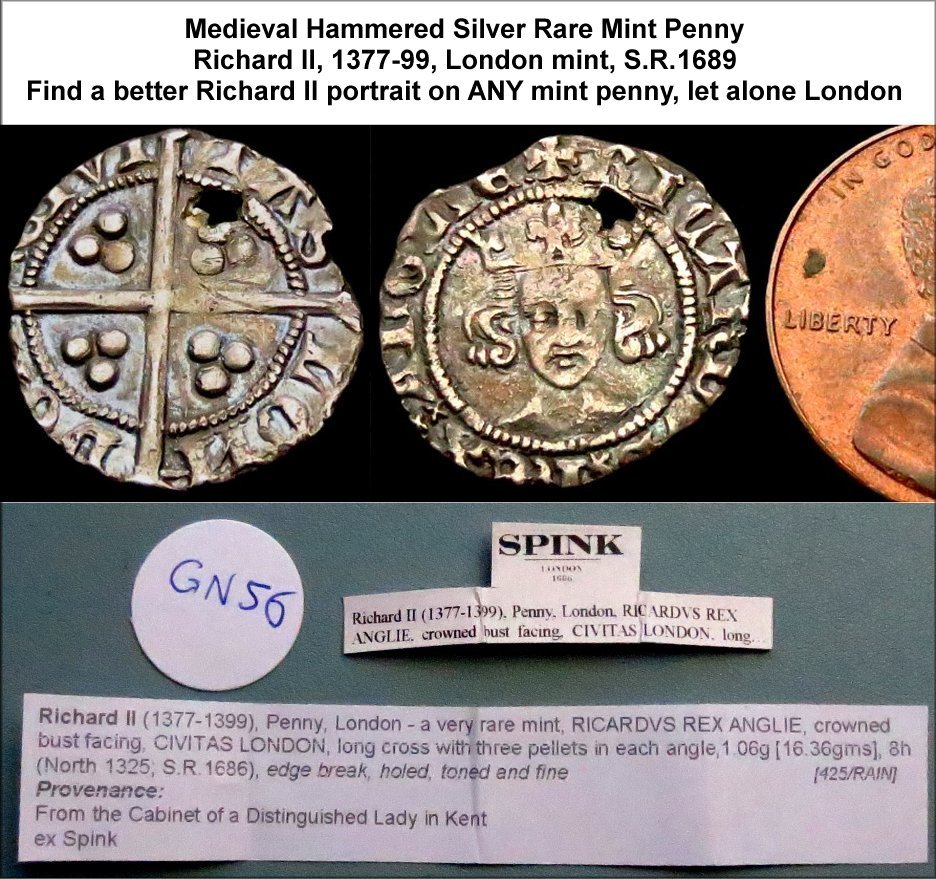
WMH-9399: Richard II Hammered Silver
RARE MINT Penny. Initial mark Cross Pattée, obv:
RICARDVS REX ANGLIE. with double saltire stops and the
French title omitted. The reverse reads
CIVI TAS LON DON
with a saltire preceding CIVI. S.R.1689. Delving deeper into
this coin, the distinctive letter R of RICARDVS is Stewartby
R3, meaning a type II coin. The letter I
is also type II, meaning that this penny was struck during Richard II's second period, 1390-99. Lord Stewartby
describes the first period as "Rare" and the second period as: "London pence of the second period are of
considerable rarity". The only pennies attributable
to the end of Richard's reign are of type IV, both, like the halfgroats,
lacking the French title. No London penny of Richard is known for type
III. Please note,
S.R. types I, II and III do not correspond to the Stewartby
system. In fact, there are only two
varieties of London penny for Richard II - types I and IV. This coin
has been misattributed to S.R. type I when it is, in fact, S.R type III. The dual systems are confusing so in summary,
we have a penny of Richard II, much rarer London mint, much rarer still second
period type IV, S.R.1689. Clearly London pennies are considerably rarer
than York pennies, with Durham even than London.
Many York coins utilised London dies, as well as using local dies as
well, but ask yourself this - when did you last see a portrait of Richard II,
on any penny, as good as this? Even the
groats of Richard II are poor compared to groats earlier and later of the same
reign. The coin is slightly chipped at 11
o'clock
and has a small hole at 1 o'clock.
The latter looks to be more in the manufacture of the planchet rather
than for purposefully placed there for suspension - perhaps an impurity in the
silver? or a very thin area that gave way quickly
after minting? Graded at Fine on the
ticket but bear in mind that grading is for the entire coin overall - without
the issues, being beautifully toned as the coin is, the grade would be better
than VF. As it is, the coin is better
than VF for detail. A
coin with a couple of issues but never-the-less, a coin of great rarity. SOLD
Provenance:
ex
Distinguished Kent Collection
ex
Spink
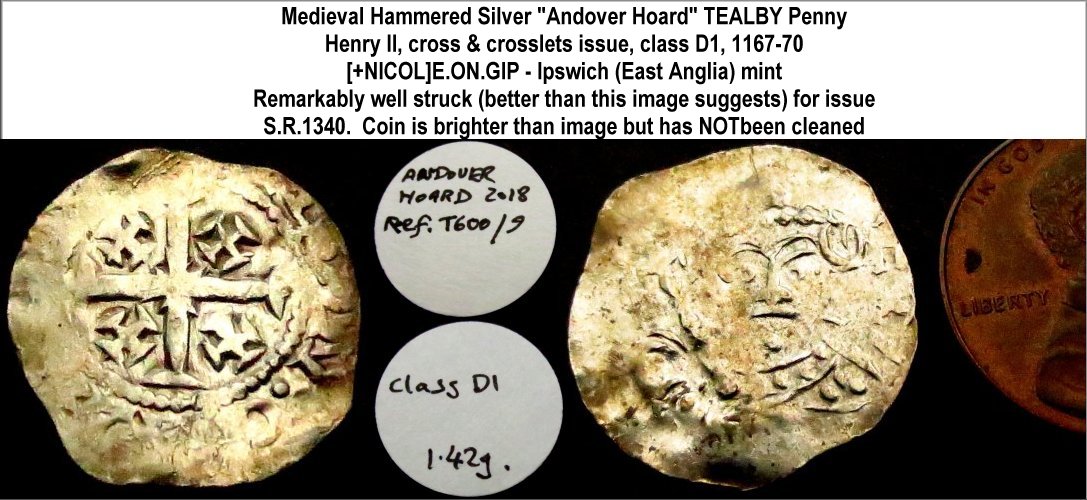
WMH-9398: Henry II "Tealby" Hammered Silver HOARD Penny. Cross and Crosslets issue, class D, circa 1167-70.
[+NICOL]E.ON.GIP.
Ipswich
(East Anglia) mint. S.R. 1340. From the famous 2018 Andover Hoard - x104 Tealby
pennies accompanying a single Henry 1st penny.
The coins went to inquest (ref. 2018T600) and were eventually returned
to the finder. Immediately
following on from Stephen. Henry
of Anjou became Henry II upon the death of Stephen - a monarch who had an
extremely tenuous claim to the throne and who only stayed as king because he
agreed to let Henry, Matilda's son, ascend upon his death - and even though an
impressive 29 mints were opened to produce coinage, the quality was just as
poor, maybe even worse, as the Stephen coinage.
Of those 29 mints, only around a third continued after Henry's recoinage
to the voided short cross and come the later long cross issues, far fewer than
that. A recorded Hoard coin so good
provenance. Class D is perhaps one of
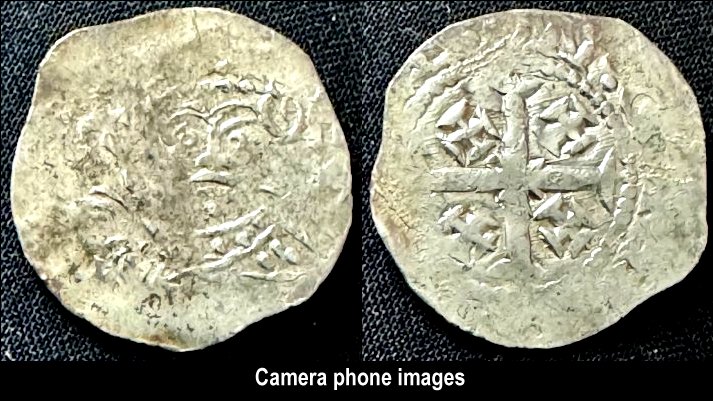
the more difficult classes to source. An exceptionally nice portrait for issue. The coin is much shinier than the main image
suggests - it has NOT been cleaned, it's just the nature of hoard coins - so I've included this low
resolution image here. A rare offering. SOLD
Provenance:
ex
2018 Andover Hoard
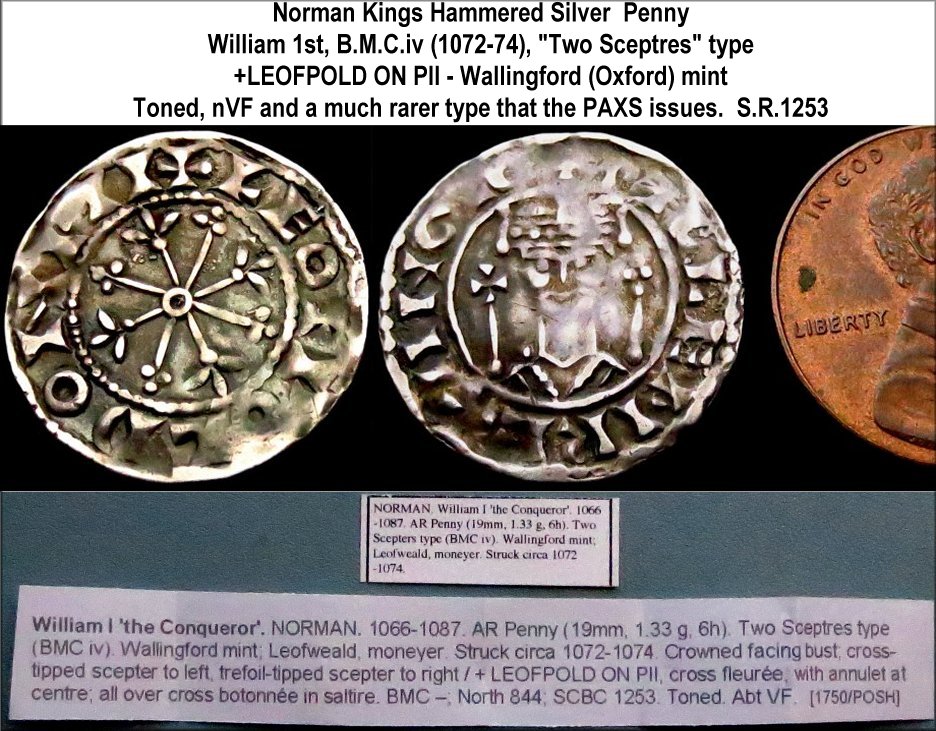
WMH-9397: William 1st Hammered
Silver Norman x2 Sceptres Type Penny.
B.M.C. IV, Two Sceptres type: +LEOFPOLD ON PII –Wallingford (Oxford) mint. S.R.1253. Wallingford for B.M.C. IV is a very scarce
issue with only four examples recorded in totality on the excellent EMC
database. Of that tiny cohort, one coin
is a cut half and another is broken. The
icing on the cake is that Leofwold is an
unrecorded moneyer for this mint and type.
Toned, approaching VF and very rare indeed. SOLD
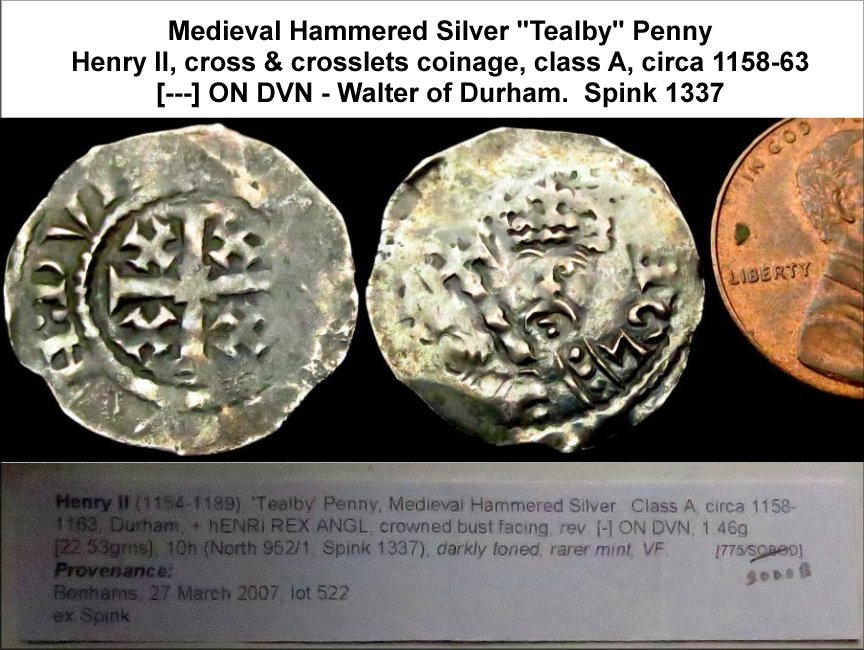
WMH-9101:
Henry II Tealby Hammered Silver Medieval Penny - Rare Mint. Short cross "Cross & Crosslets"
first coinage, [---] ON DVR - Walter (actually WALDHER) of Durham, class A (circa 1158-63) with no
hair or collar. S.R.
1337. Immediately
following on from Stephen. Henry
of Anjou became Henry II upon the death of Stephen - a monarch who had an
extremely tenuous claim to the throne and who only stayed as king because he
agreed to let Henry, Matilda's son, ascend upon his death - and even though an
impressive 29 mints were opened to produce coinage, the quality was just as
poor, maybe even worse, as the Stephen coinage.
Of those 29 mints, only around a third continued after Henry's recoinage
to the voided short cross and come the later long cross issues, far fewer than
that. Dark tone and VF for issue, thus
rare on condition, grade and mint. SOLD
Provenance:
ex
Bonham's Auction House, March 2007
ex
Spink
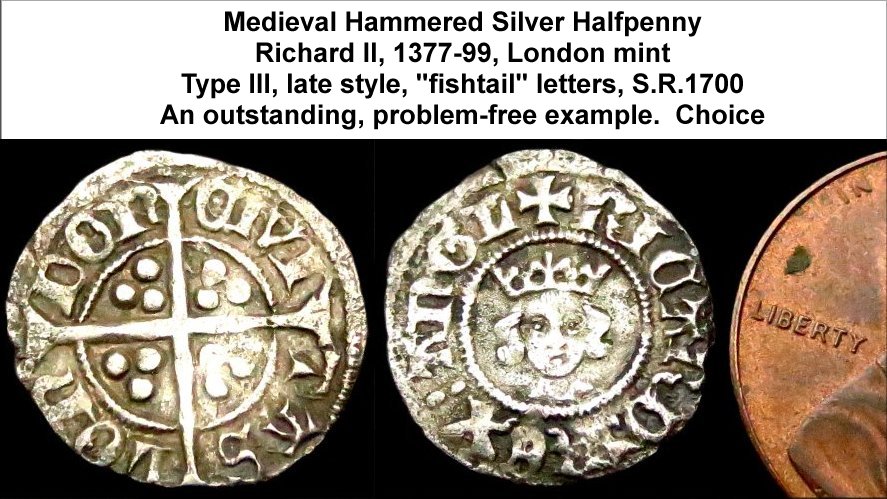
WMH-9177: Choice Richard II Medieval
Hammered Silver Halfpenny. Type III, 1377-99, London mint.
Late style, no marks to the breast and fishtail
lettering - S.R.1700. It is
recorded that the obverse dies used in the production of these halfpennies were
invariably rusted. An
exceptional, high grade example. SOLD
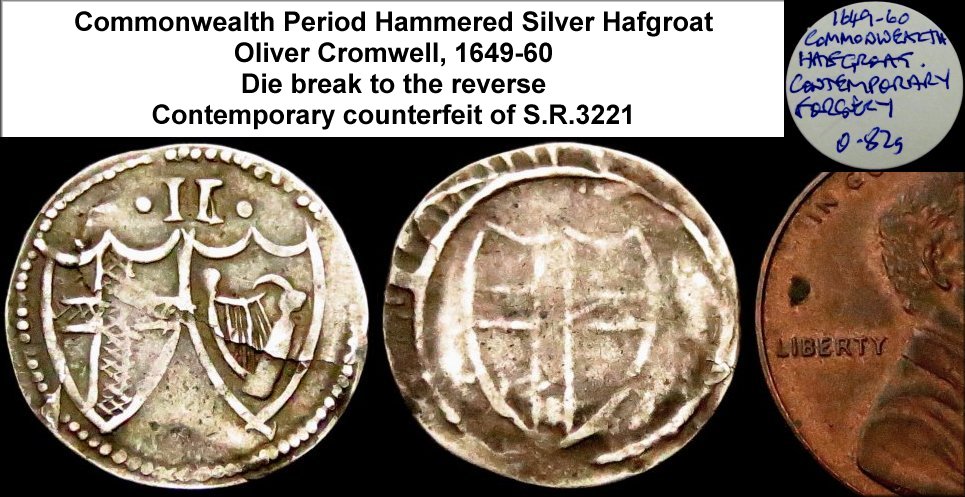
WCom-9390: Fascinating Commonwealth
Hammered Silver Halfgroat. Struck 1649-60. A centrally struck, problem-free attractive coin being much above
average. Fascinating
because although it purports to be S.R. 3221, this coin is in fact a charming
and highly collectable contemporary counterfeit. The obverse die has been sunk very shallow
with blurry detail in order to give the appearance of a worn coin (a clever
device that avoided any kind of scrutiny because the coin looks to have been in
circulation for years) whereas in actual fact, there is very little wear at all
to this coin. The reverse die is the
opposite - very little wear and not pretending to have any. I wonder if the counterfeiter ever intended
these two dies to become bedfellows?!
Looking closer at the reverse, the obvious feature is the significant
die break - this is absolutely not damage to the coin (the crack was and is not
in the coin, rather just the strike) and would not have been an intentional
feature of the coin. The die simply
cracked but the counterfeiters stuck with it to get their money's worth out of
it, which may well answer the question as to why these two disparate dies were used
to make one coin. The cross hatching to
the left shield is rudimentary and naive, yet charming. The harp has x7 strings but again, there's
that appealing childlike crudeness to the design. From the point of view of the individual who
made this coin, with the specific intention of passing it into currency in
order to probably double his outlay, it was a brave move because the penalty
for such crimes in this general period was considerable (if an official moneyer
at the mint was found to be doing something like this, the most extreme
punishment would be the removal of his right hand) and under the Puritans, I
can't see them being any less forgiving!
From the point of view of today's collector, these are now highly prized
- if nothing else, how on earth has this coin survived all the points in its
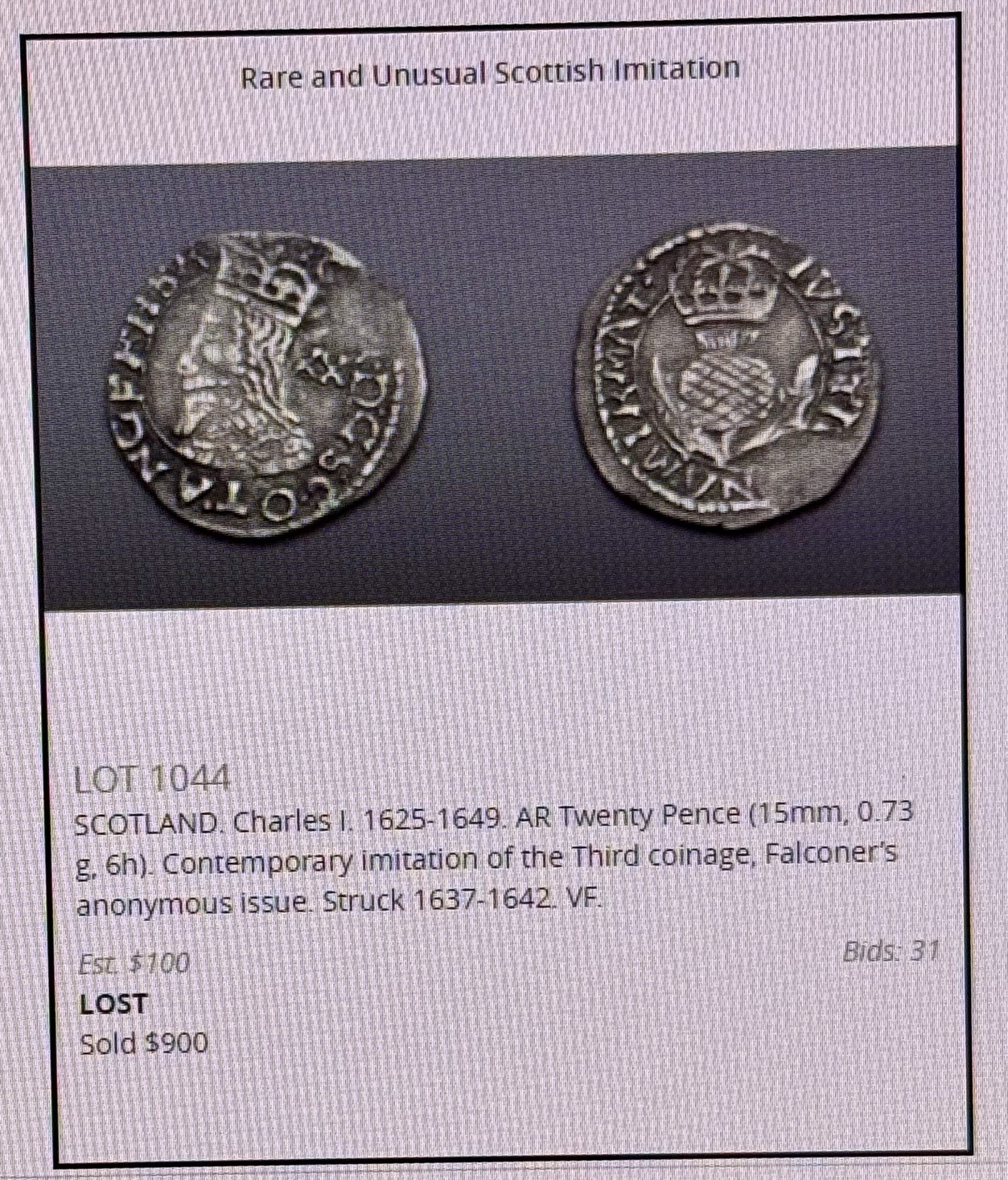
timeline where it should have been removed and destroyed?! This July 2026 US auction
witnessed a contemporary counterfeit of a Charles 1st Scottish twenty
pence. The come-and-get-me $100 estimate
was somewhat exceeded with 31 bids and a final price, after commission, of just
over £900, illustrating just how sought-after these coins now are - much rarer
than the real thing! A very nice coin
from a particularly interesting period of British history and a coin that
someone, in that very narrow date range of 1649-60 (obviously couldn't have
been earlier and who in their right mind would even contemplate putting such a
coin into Royalist Charles II circulation?) was willing to risk the loss of
their right hand to do it. SOLD
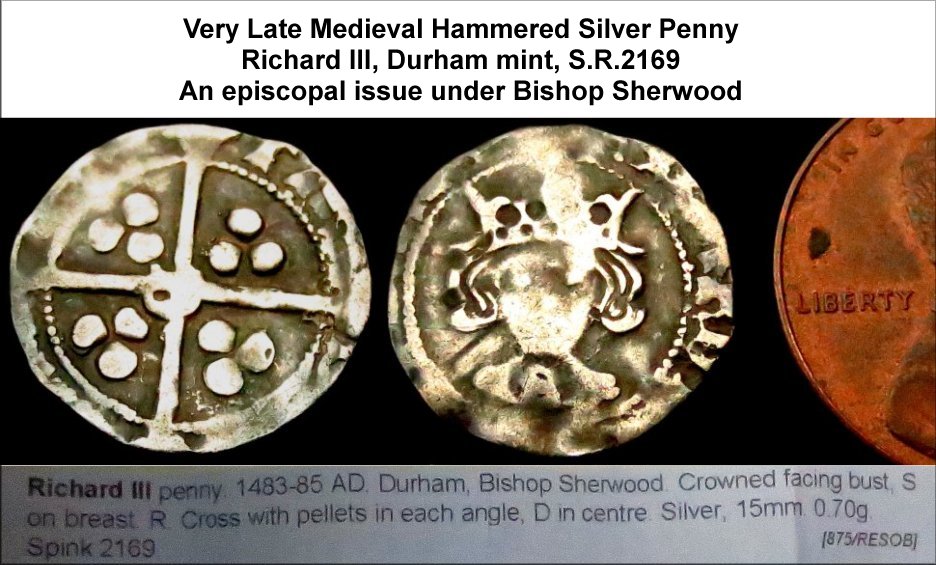
WMH-9174: Richard III Hammered Silver Very Late Medieval Penny. An Episcopal coin struck under Bishop Sherwood of Durham: S on the king's breast, D in the
reverse centre. S.R.
2169. The coin may at first
glance appear to be clipped - [RI]CARD is discernable
from the lower portions of the lettering only - but it probably isn't. Lord Stewartby
(English Coins 1180 – 1551 by Spink, 2009) states: “The flow of ill-struck and
often illegible pence from the northern Episcopal mints continued
unabated. (Archbishop) Thomas Rotherham
of York was literally arrested by Richard
III in June 1483, but was soon released.”
The lower ranked Bishop Sherwood, just 70 miles north up the A1 in Durham, was doing very similar things to
that of Thomas Rotherham. The production
of short flan, underweight coins (ie face value one penny but actual silver
content some way below that) would obviously be financially lucrative for the
person or persons doing it; not so much for the king or the country. These powerful clergymen would appear to have
gotten away with just that as the practice continued throughout Richard’s very
short reign. A decent
portrait of the rather unsavoury Richard III, whose body was recently
discovered in a Leicestershire car park.
Looking at the very few examples of Richard III pennies going through
mainstream auctions this year, they seem to be hammering at about this figure
so with their 30% buyer commissions on top, prices in excess of £1,000. Rare. SOLD
WSax-9336: Anglo
Saxon Silver Sceatta - Excessively Rare SEDE Type. Obverse: SEDE around a cross pattée with
other cross pattées between the letters; reverse: a
serpent coiled anticlockwise, protecting yet another central cross pattée. An Episcopal issue with find spots for the
very few recorded examples from the East Anglia region, namely, Watton, Norfolk and north of Ipswich. Abramson 93-20, listed as Extremely Rare
(this coin being Abramson's
plate coin from his collection - the best and only example he could
source), type 89, formally type 4 var, S.R.---. The coin
appears to have been deliberately cut rather than broken, perhaps indicating a
market-place transaction where the value of the coin was greater than the item
purchased? SOLD
Provenance:
ex Tony Abramson collection, dispersed...
ex Spink
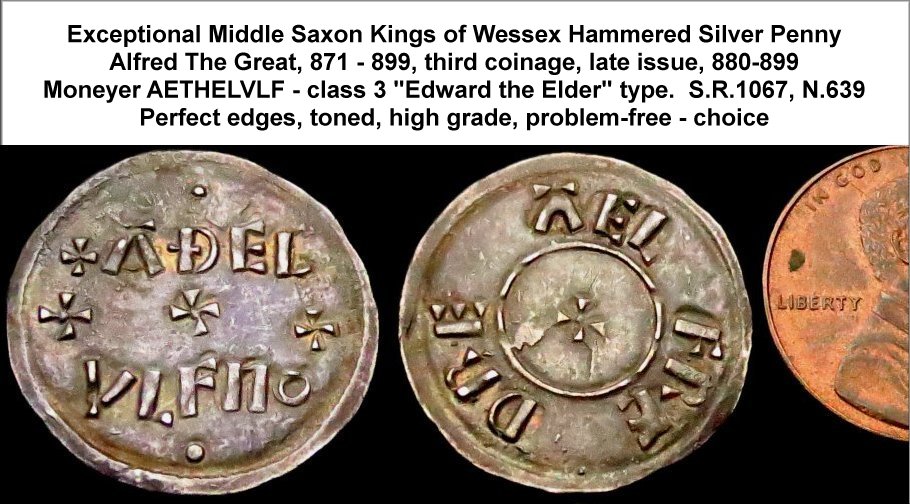
WSax-9380: Choice Alfred The Great Hammered
Silver Post-Guthram Penny. Third coinage, late "Edward
the Elder" type, 880-899 but very much towards the end of the reign, with
the obverse legend arranged in three rather than four groups - AEL FRE DRE
(Alfred Rex or Alfred King). This type is a neater version of the same but
earlier Guthram two line type. In 878, Alfred and Guthram
the Dane divided the country, with Alfred holding all England south and west of the Roman Watling
Street. Alfred asserted
over-lordship of Mercia and London from around 880. This coin would have been struck towards the
end of Alfred's reign. It is interesting
to note that this late "Edward the Elder" type is named after a coin that Alfred's son
issued post 899. The reverse reads AÐEL
/ + / VLF
MO showing the moneyer to be Aethelulf. S.R.1067, North 639. Alfred
the Great was a deeply pious and intellectually gifted ruler, known as much for
his learning as for his leadership. Frequently described by contemporaries as
sickly, he ruled in spite of chronic illness, combining personal humility with
remarkable resilience. Though often styled the Father of England, Alfred was
never King of England itself, but King of Wessex, laying the foundations of a
unified realm through reform, education, and defence. A thoughtful and
reforming mind, his legacy is one of inspiration, scholarship, and enduring
statecraft. A superb
example having perfect edges, wonderful toning, a completely flat planchet and
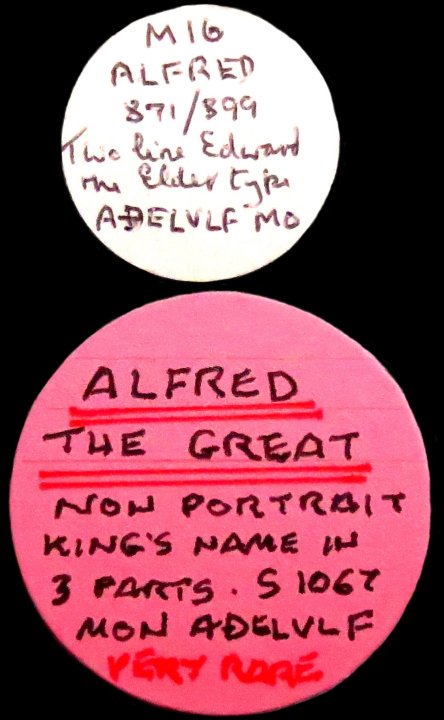
being of high grade. Old
tickets here. Coin Archives shows the Pelton
example (same type but moneyer Wulfred - of similar
grade but sometime cleaned) achieve a price of £5,267 after buyer's
commission. This is overall a better
coin than the Pelton example. You will not find better elsewhere. SOLD
Provenance:
ex Mark Senior (his ticket)
ex Tim Owen (his ticket
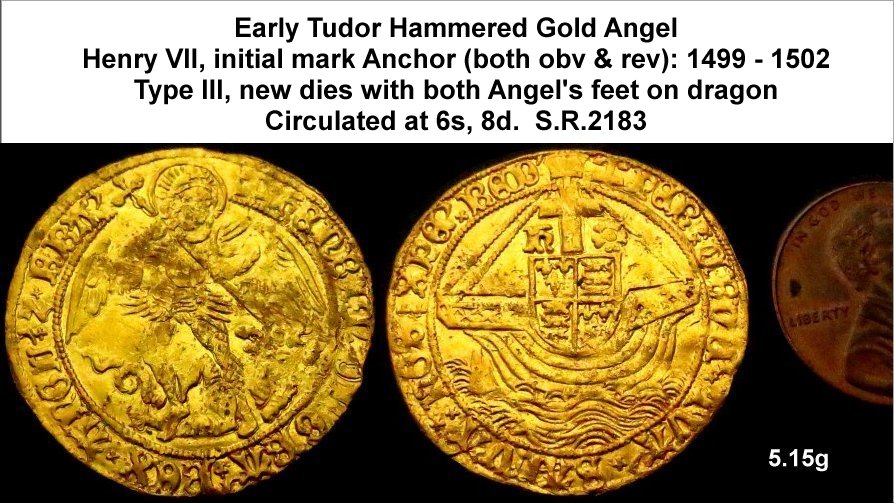
WAu-9296: Henry VII Tudor Hammered
Gold Angel. Type III with new dies -
the angel has both feet on the dragon. Initial mark Anchor, 1499 - 1502. The angel, which circulated
at 6s.8d, was a medieval coin but under this first Tudor monarch, was restyled
with St Michael - about to symbolically thrust the devil into the pit - no
longer adorned with feathers, rather clad in armour of Renaissance style. S.R.2183. SOLD
Provenance:
A field
find from around the Horncastle / Skegness area of Eastern England.
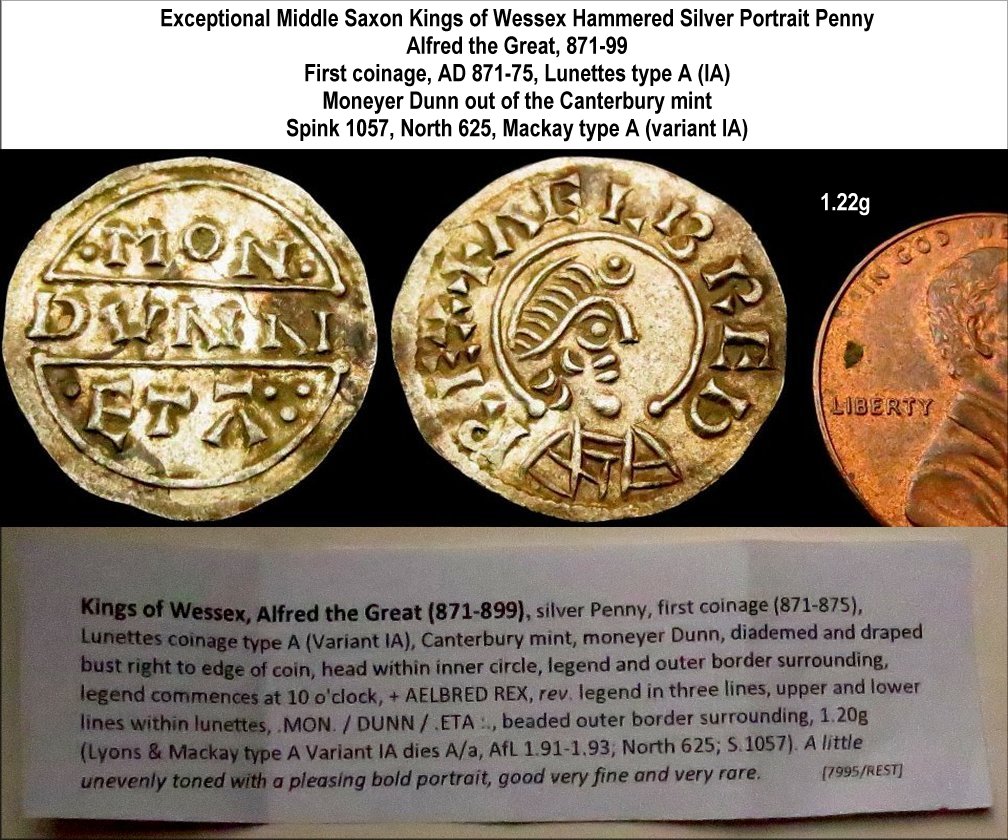
WSax-7819:
Choice Alfred
the Great Middle Saxon Hammered Silver Penny. Kings of Wessex Lunettes type, first coinage,
AD 871-75. Lyons & Mackay type A but a variant thereof being IA with dies A/a. Moneyer Dunn, Canterbury mint - MON DVNN
ETA. Diademed and draped bust
right, +AELBRED REX. 1.22g. S.R. 1057, North
625. A little unevenly toned but other
than that, by far the best example I've ever seen with a good, strong no issues
edges and a grade rapidly approaching EF.
Find better! SOLD
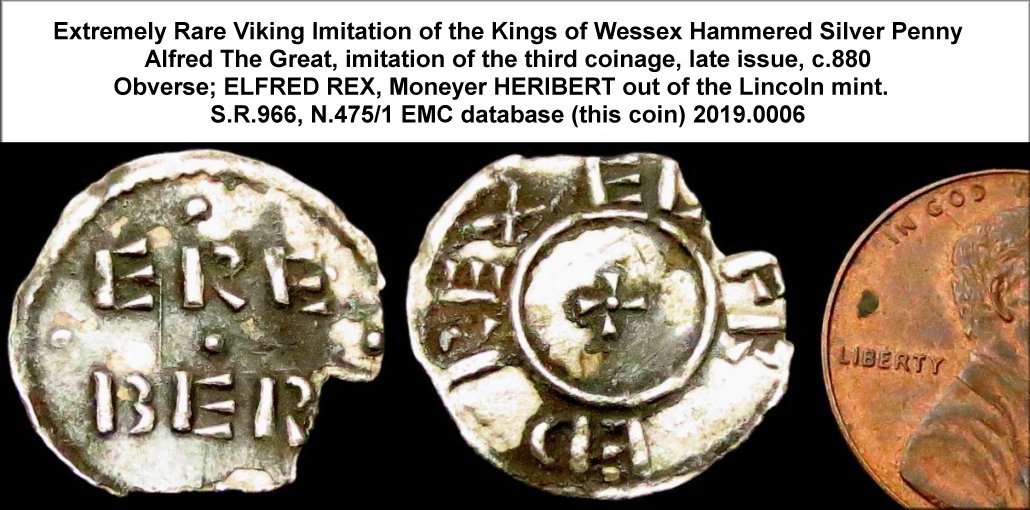
WSax-9381: Very Rare Alfred The Great Hammered
Silver VIKING IMMITATION Penny. Danelaw type - struck by the Vikings. In 878, Alfred
and Guthram the Dane divided the country, with the
Viking invaders gifted control of Eastern Mercia, including all territory east of
the Roman Watling Street.
Alfred asserted over-lordship of Mercia and London from around 880. Coinage issued in this area immediately after
this ceding in 880 imitated the Wessex types of Alfred. Independent Viking coinage was issued from
the early 880's, thus this Viking imitation of Wessex coinage was a very short-lived
affair. Obverse ELFRED
REX, with reverse Moneyer HERIBERT out of the Lincoln mint.
S.R.966, North 475/1, EMC database (this coin)
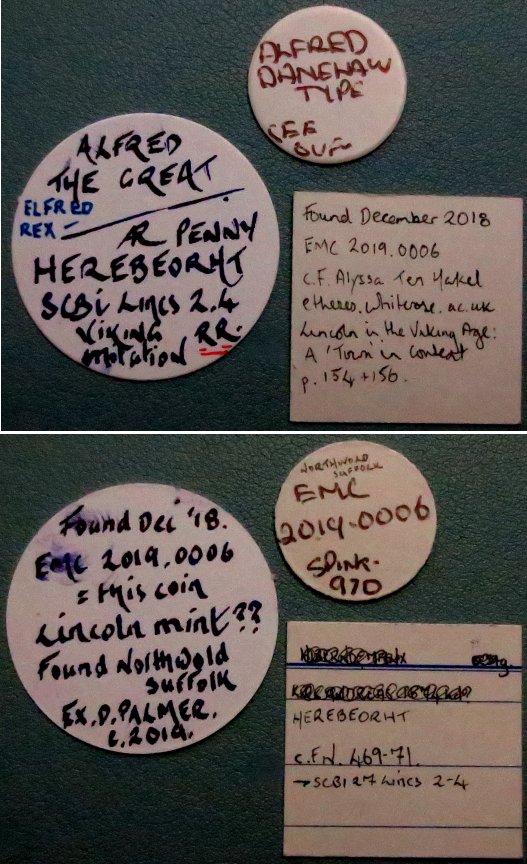
2019.0006, found Northwold, Suffolk in December 2018. Old
tickets here. The EMC entry gives North 475/1 as an
attribution, presumably based primarily on appearance (ie a two line coin) and
then the fact that although HERIBERT is not recorded under the list of North
475/1 moneyers, die sinkers also used genuine Wessex moneyers, either verbatim or
blundered. One or two Wessex moneyers would perhaps fit that
blundered conjecture - HEREFERTH, HEREMOD, HEREMVND, etc. However, we have firm research that HERIBERT,
the Danelaw moneyer on this coin, was working out of
the Lincoln mint (see North 469-470). Neither of those examples fit this coin but
perhaps this coin is a part of that wider family? To further muddy the waters, there are
several examples of North 475/1 on the EMC database with HERIFERÐ
as moneyer. Whilst this coin clearly has
a B where the HERIFERÐ has an R, might this be one and the same moneyer? A most interesting coin,
not to mention incredibly rare.
Find another! SOLD
Provenance:
Found Northwold, Suffolk in December 2018
Recorded
EMC database very early 2019
ex P.Palmer collection
ex Jon Mann, the excellent numismatic researcher (his
ticket along with x2 others)
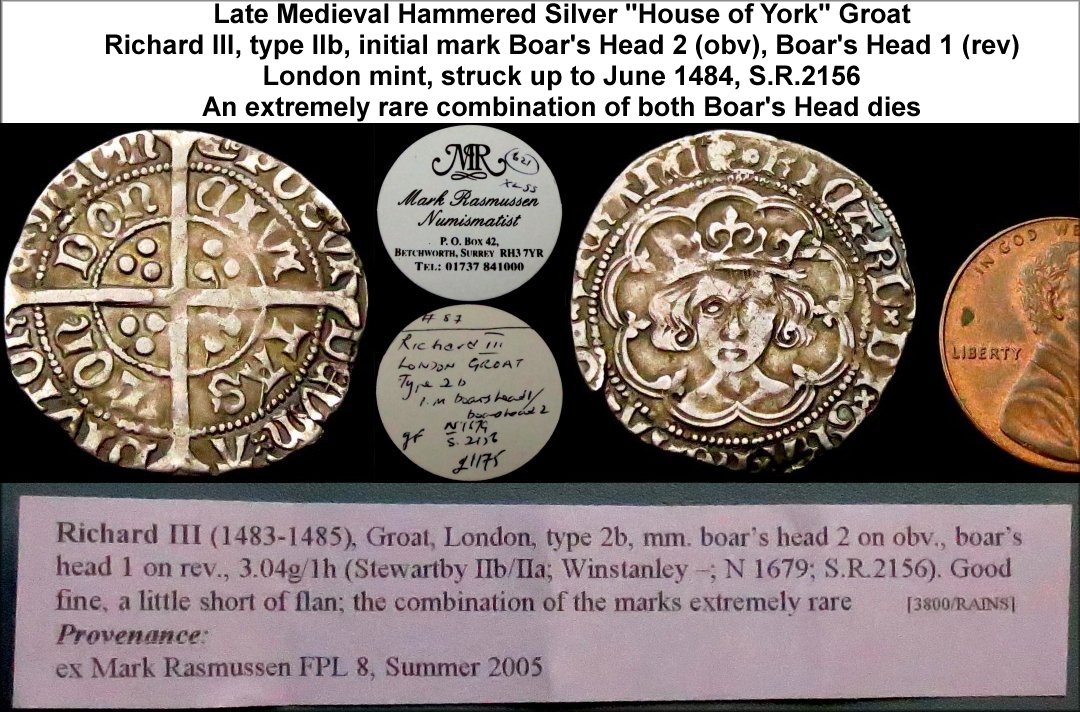
WMH-9379: Desirable Richard III *BOARS HEAD* Medieval Hammered
Silver Groat. Class 2b, 20th July 1483 to June 1484, London mint, initial
mark Boar's Head 2 on the obverse with Boar's Head 1 on the reverse.
Spink 2156.
The Boar's Head initial mark (the White Boar was the personal device or
badge of Richard III and dear to his heart) was introduced 20th
July 1483
by mint master Robert Brackenbury, just a month after
Richard took the crown. It is
interesting to note that chronologically, it is accepted that BH1 preceded BH2
(see Tim Webb-Ware's seminal article on Richard III groats in the BNJ - the
well respected and extremely knowledgeable Ivan Buck [Medieval English Groats,
published Greenlight Publishing in 2000], confirms
this chronology), meaning that this coin was struck under BH2 with an old,
random reverse die off the shelf, in this case a BH1 reverse. Whilst mules are not uncommon - it is
postulated that old dies, with some life still left in them, were stored in
something akin to an open box - this BH2 / BH1 die combination is really quite
rare. Lord Stewartby
[English Coins 1180-1551, published Spink, 2009], lists only BH2 both sides for
class 2b with BH1 being nearly always overstruck on SR1 for the earlier class
2a where they were clearly recycling the old class 1 dies. Very clear regnal name (often lacking on
Richard III groats thanks to the clippers as well as the offset nature of many
coins) and equally clear initial marks - the Boar's Head mark is highly sought
after amongst collectors. Richard III was the last of the medieval monarchs,
losing to Henry Tudor on Bosworth
Field, or as is now the
current thinking, on a field a few short miles from that famous location. He was an unsavoury character - Shakespeare
was certainly no fan! Whist Richard was no saint (I think some poor
decisions and a ruthless streak that they all had at that time - could you even
be an effective monarch back then without such a streak?! - was about as bad as
it got), he probably wasn't a ‘child killer’, ‘murderer’, or ‘usurper’, at
least no more than any other medieval monarch.
Perhaps don't believe all that Shakespeare tells you!! Ex Mark Rasmusson, 2005 for £1,175, which
might seem an unusually low price, even taking into consideration that it was
more than 20 years ago now (today, £5,000 is not an uncommon price for nice
grade, regular groats - this coin being far from regular with BOTH boar's head
initial marks), but it should also be remembered that our understanding of the
coinage was not quite what it is now, thanks in no small part to Tim
Webb-Ware's published research, nor was the wider interest which blossomed upon
the discovery of the body of Richard III in a Leicestershire carpark in 2012. In
summary, here we have a Richard III groat with everything clear, including the
sought-after, all important Boar's Head initial marks, the king's name AND not
just Boar's Head 1 but Boar's Head 2 as well, all within a very good grade coin
indeed. SOLD
Provenance:
ex Mark Rasmusson (Summer 2005 FPL 8 list, sold for
£1,175)
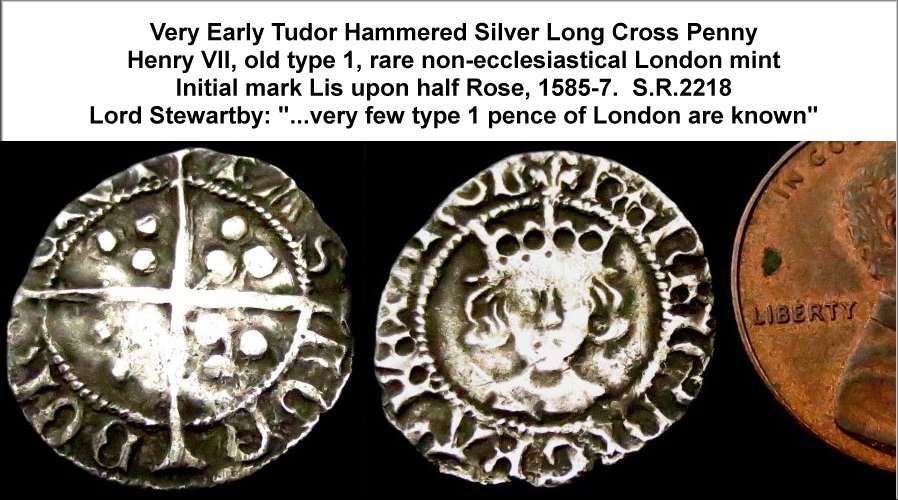
WMH-9378: Excessively Rare Henry VII
Tudor TYPE 1 Hammered Silver Penny. Front facing depiction of
Henry VII, being very much a continuation of the Medieval pennies of Richard
III, Edward IV, etc and in essence, unchanged in style since Edward 1st. Initial mark Lis upon half Rose, London mint, S.R. 2218. Struck 1585-1587 only.
A new era - the House of Tudor - and a radical change of coinage to mark
the occasion: Sovereign pennies, profile images of the king, a new Testoon denomination and even the coinage they decided to
not change right away, the front-facing groats and halfgroats, were given
strikingly different crowns.
Understandably, this all took time to plan and execute. A rather unusual decision was taken by the
Tower mint during this hiatus: it was decided that enough older pennies were
already in circulation from earlier reigns (and indeed there was but the late
Medieval pennies of Edward IV and Richard III were shocking; intentionally
struck by northern ecclesiastical mints on short flans, clipped and generally
poorly struck) and thus until the planned move towards Sovereign pennies in
March 1489, only a trickle of pennies would be issued from the London mint;
essentially the old style pence but obviously with Henry's name. The thought process behind this was partly
continuity for the man in the street, partly getting the new king's name out
there but primarily it was just making sure the mint was seen to be doing
something under the new monarch whilst they got their heads around the very
complex and intricate Sovereign penny design - this had previously only been
attempted on the largest gold coin and was literally abandoned on the groat
after a momentary experiment. Lord Stewartby in his seminal publication, "English Coins
1180-1551", published by Spink in 2009, states, "Smaller silver with
the open crown of type 1 is all rare.
Very few halfgroats or pence of London are known."
Interestingly, the ecclesiastical mints of Canterbury, York and
Durham - the latter two church-run mints being the very ones
primarily responsible for the lack of quality of late medieval pence still in
circulation when Henry inherited the throne - struck and issued substantially
more old style pence than London. An incredibly rare coin,
literally bridging the transition from Medieval to Tudor coinage. Very, very few examples in private
collections, in fact I don't know of a single example anywhere else, private or
institutional. SOLD
Provenance:
ex Nigel Mills
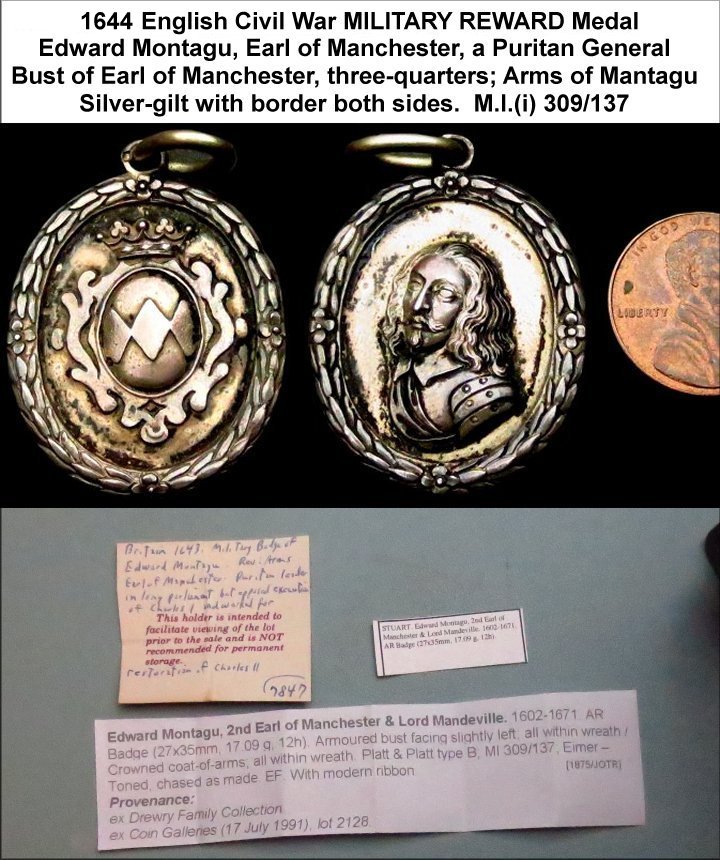
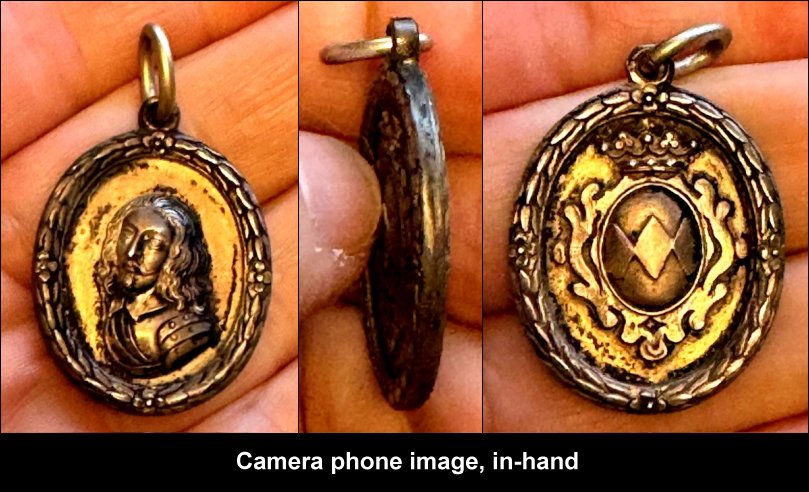
WJC-9230:
1644 Oliver
Cromwell MARSTON MOOR Military Reward Silver-Gilt Medal - Earl of Manchester;
General. Obverse: bust of the Earl of Manchester (inherited his
title in 1642, previous to that he was Edward Montagu,
Lord Manderville, eldest son of the first Earl of Manchester),
three-quarters, with bare, long hair falling on the collar, wearing armour,
scarf across the body. Reverse: the Arms
of Montagu in a garnished shield with the Earl's
coronet above. Wreathed border both
sides. Medallic Illustrations (i) 309/137, unlisted in Eimer. Extra
image here.
A military reward, issued by the General to his men during the Battle of
Marston Moor on 2nd July, 1644. The Earl of
Manchester's troops, in union with those under Tomas Fairfax and Scottish
troops under the command of the Earl of Leven
(although Manchester was commander-in-chief at Marston
Moor), defeated the Parliamentary forces under Prince Rupert. The Battle of Marston
Moor was a seminal conflict in what was the first of three English Civil Wars,
not counting the one between Stephen and the Empress Matilda a few centuries
earlier). An extremely important
historical artefact from one of the most interesting and bloody periods of this
country's history! SOLD
Provenance:
ex Drewry family collection (through decent)
ex
Coin Galleries (1991)
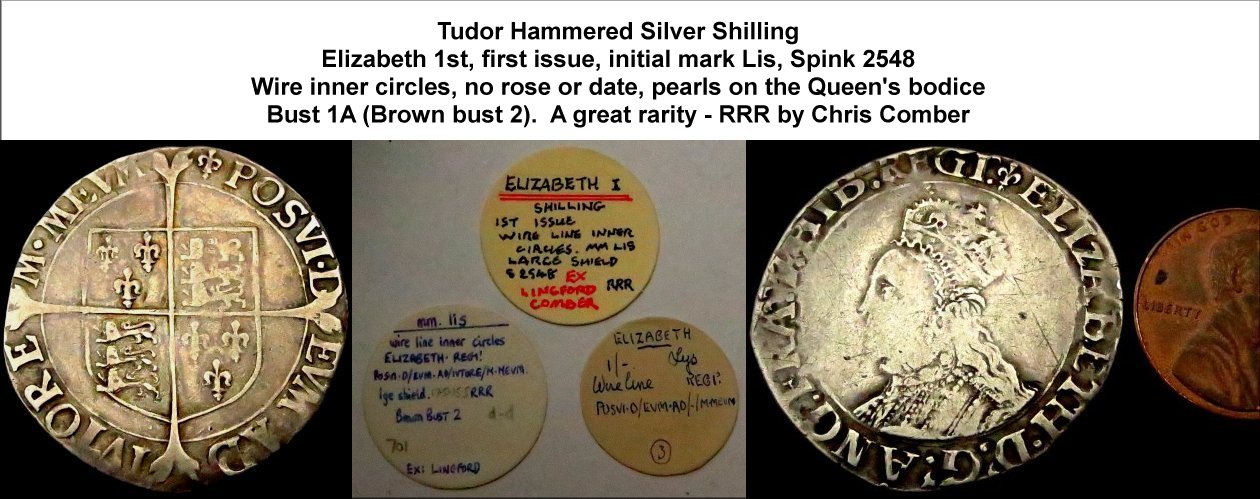
WTH-8991: Very Rare Elizabeth 1st
Hammered Silver FIRST ISSUE Shilling.
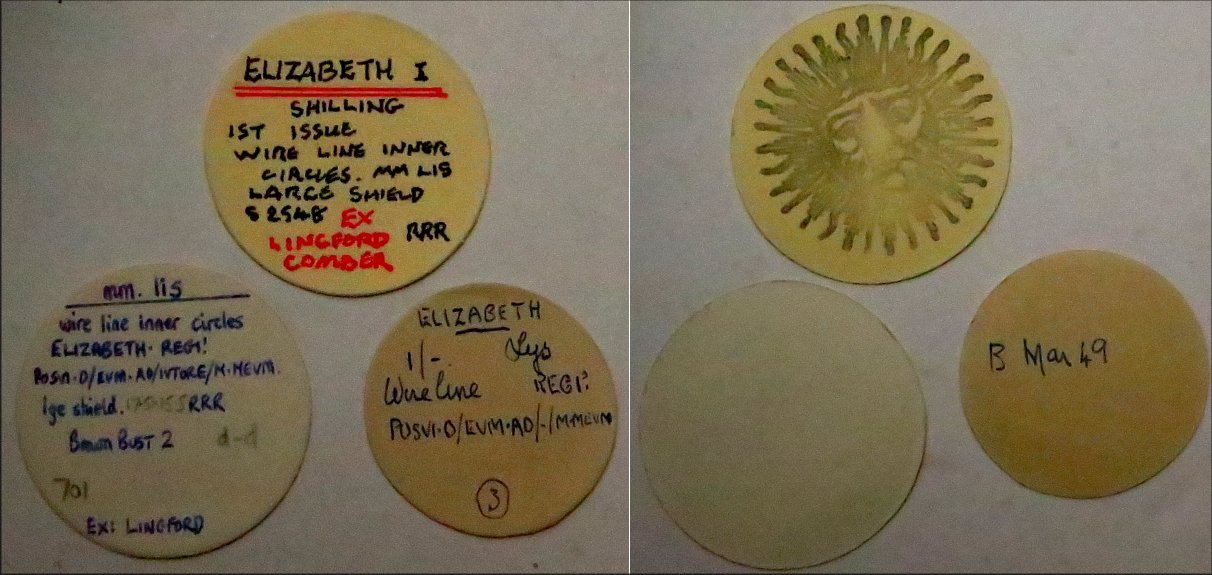
Wire inner circles only, bust 1B (Brown bust 2), initial mark Lis: 1st January 1559 to the Spring of 1560. S.R. 2548. A great
rarity in the series and one that when it des turn up, which is hardly ever,
invariably has issues, or at the very least is much worn through a combination
of a poor obverse die (ie insufficient definition / depth on the portrait) and
much circulation. This coin is one of
the best known examples, being part of the famous Lingford
collection in 1949 and Chris Comber's impressive, more recent collection
(dispersed DNW 2018), to which he was constantly upgrading but this coin he
simply could not better. Old
tickets here. Chris Comber gives this RRR rarity which is
only one less R than the fabled undated sixpence to which he gave a rarity of
RRRR. An extremely
rare coin, particularly so in this grade. SOLD
Provenance:
Ex
Herbert Muspratt Lingford
collection (purchased March 1949)
Ex
Chris Comber collection
Ex
Tim Owen
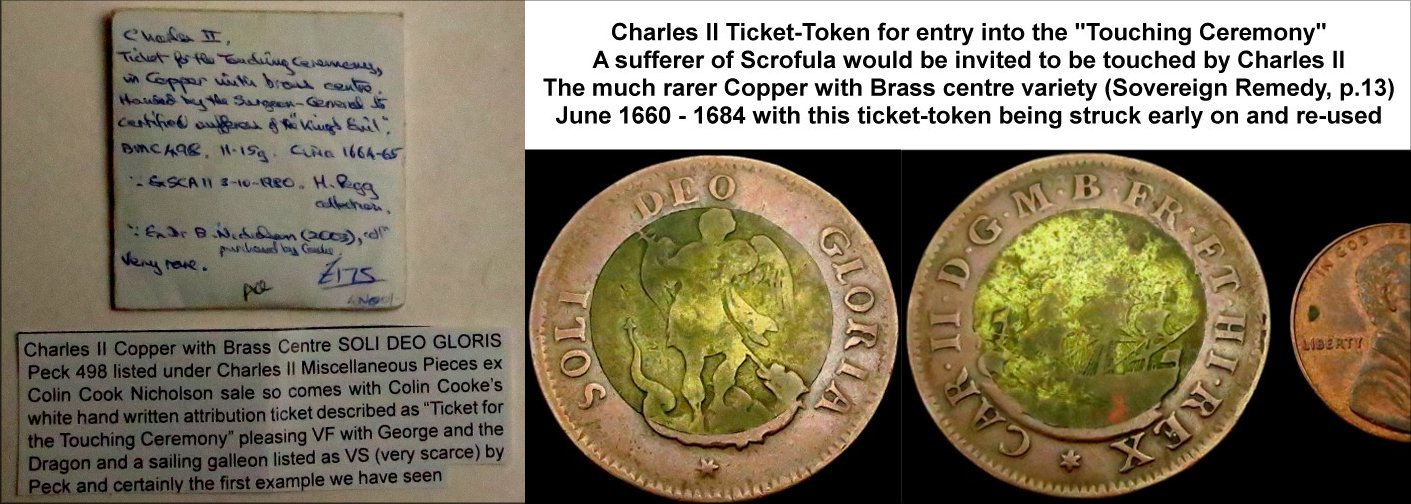
WCA-9207: Charles
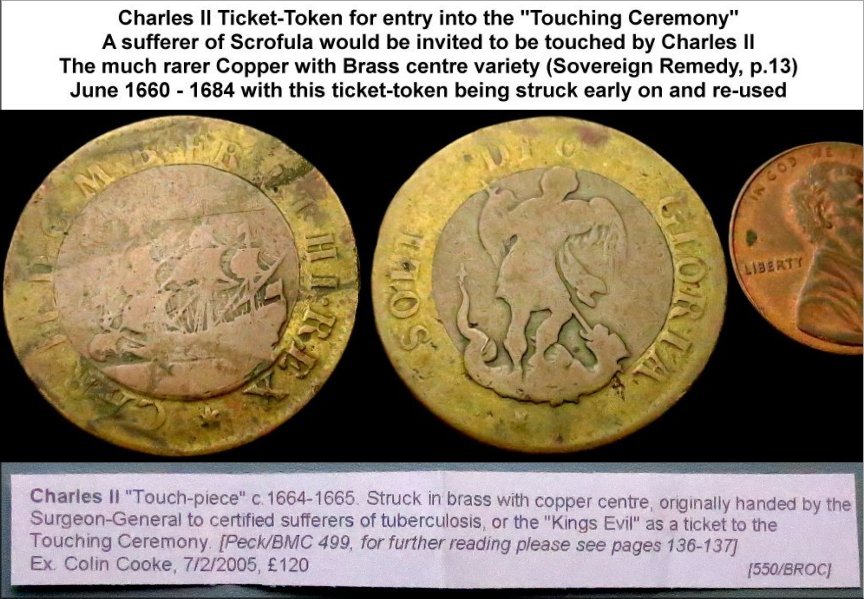
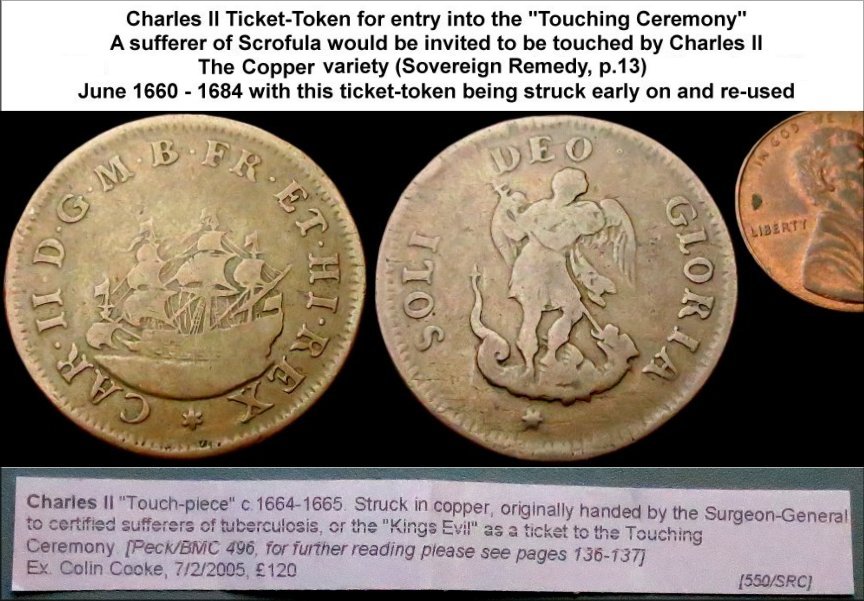
II Bi-Metallic Ticket-Token for the Touching Ceremony. Copper surround, brass insert. Obverse: a three-masted
ship in sail to left with a six pointed star below. Toothed border. CAR.II.D.G.M.B.FR.ET.HI.REX. Reverse: St Michael piercing the
dragon with a six pointed star below. Toothed border. SOLI
DEO GLORIA. “Touching Ceremonies” was
where the monarch of the day, in this case Charles II, personally gave out gold
touch pieces to sufferers of Scrofula (tubercular infection, to which it is
estimated that 1% of the London population suffered) in order to cure
them. Charles II personally attended
these ceremonies, acting as God's own emissary upon the earth - Charles
personally touching the Touch Piece was effectively God touching it. Sufferers were invited and issued with an
official Ticket-Pass to admit them to the ceremony. You gave your Ticket-Pass in at the door,
entered the ceremony, got touched by the king and hopefully left as a cured
individual. These Ticket-Tokens were
collected and re-issued for the next Touching Ceremony. 105,000 people were Touched
by Charles II with around 360 sufferers being admitted to each ceremony.
However, the officials used three designs of Ticket-Tokens: brass, copper or a
combination of both. To prevent fraud,
officials alternated the type of Ticket-Token used. The bi-metallic copper & brass
Ticket-Tokens are much rarer than the other two types. It is interesting to note the wear on this
Ticket-Token: although resembling a copper halfpenny, this Ticket-Token could
not have entered circulation as currency for two reasons. Firstly, it’s not wholly copper. What was on the coin in those days mattered
very little, but that it was copper was essential. Secondly, it is inconceivable that a
recipient sufferer would have forfeited his or her chance of being cured by the
king for a mere halfpence. The officials would not have let this
Ticket-Token out into circulation either so we can deduce that the wear on the
Ticket-Token is down to it having been issued many times so it likely to be a
piece from early on in the reign of Charles II.
Incidentally, officials issued the bi-metallic passes in order to make
it extremely difficult for someone without scrofula to fake a pass in order to
get a free gold coin. Peck 498 and
listed as Very Scarce. SOLD
Provenance:
ex Dr Basil Nicholson collection, dispersed...
ex Colin Cook (2003), sold for £175
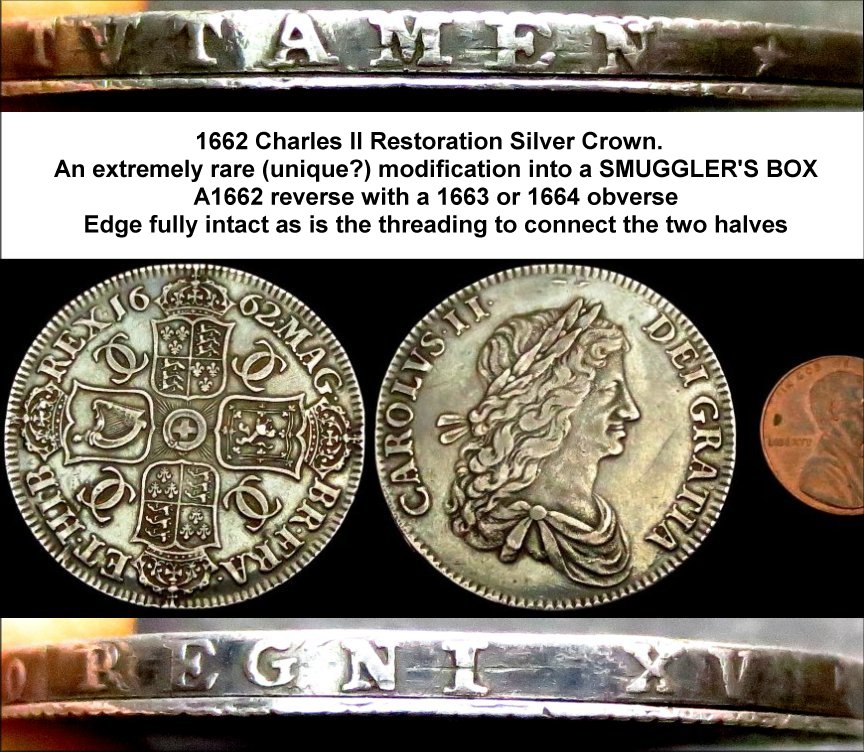
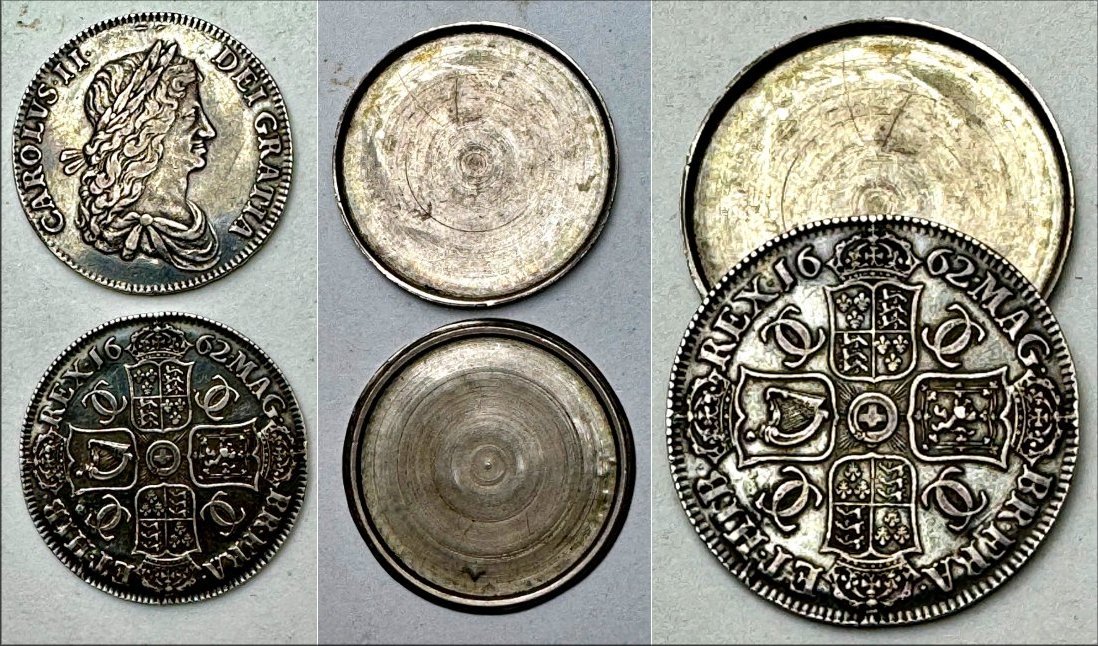
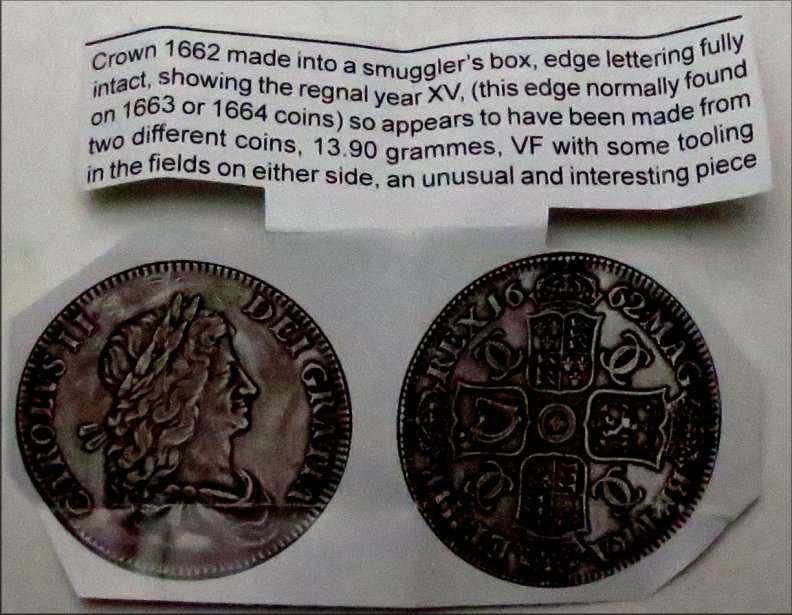
WCA-9049: 1662 Charles II Silver Crown
- Fashioned into a SMUGGLER'S BOX. A
great rarity! A standard 1662
Restoration milled crown, albeit in high grade, modified into a Smuggler's Box,
exactly as we see on the later 1797 Cartwheel twopences and very occasionally
the smaller Cartwheel pennies. Two coins
were needed here in order to have one half with the rim intact - incidentally
the rim, attached to the obverse, has a regnal year of XV, meaning it was
originally a 1663 or 1664 crown. You may
well be wondering how in the year 1663 or 1664 Charles could possibly have been
king for 15 years, considering Charles II (29 May 1630 – 6 February 1685) was
King of England, Scotland, and Ireland from the 1660 Restoration of the
monarchy until his death in 1685. The
answer lies in succession: when Charles 1st died, Charles II was king,
irrespective of the Commonwealth. At
least that's how the Royalists saw it. I
imagine the Parliamentarians, even after the Restoration of the monarchy, saw
things quite differently. Extra images here and here. I have never seen another silver coin
fashioned into a smuggler's box before, of any denomination. Remember, to do this you were effectively
throwing away ten shillings, which was a considerable amount of money back
then. These were often apprentice
pieces; a medium for the worker's skill to be displayed. Who could afford to waste ten shillings doing
that?! As already pointed out, a great
rarity! SOLD
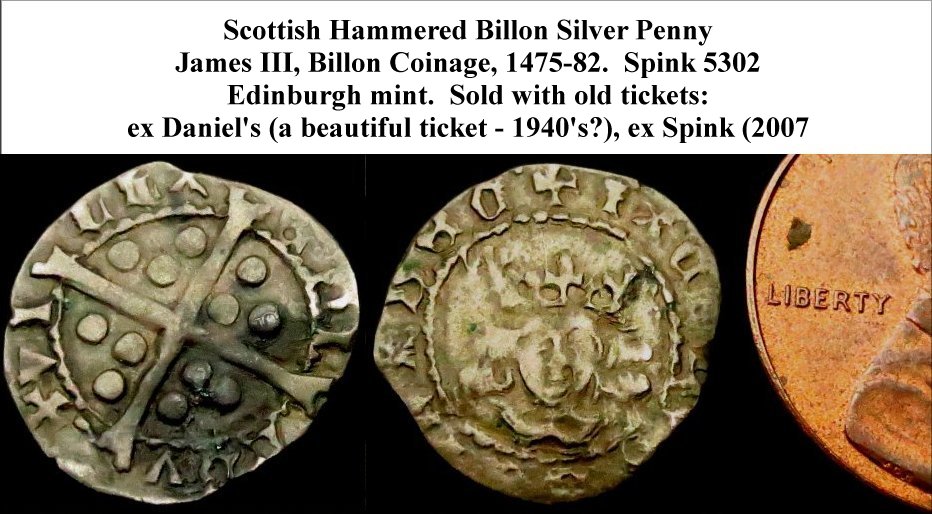
WSC-7722: James III Scottish
Hammered Billon Silver Penny. Billon coinage, 1475-82, Edinburgh mint. Facing bust with three fleurs to the crown – S.R. 5302. Although only Fine, this is probably one of
the top grade extant examples. The S.R. example (similar for type)
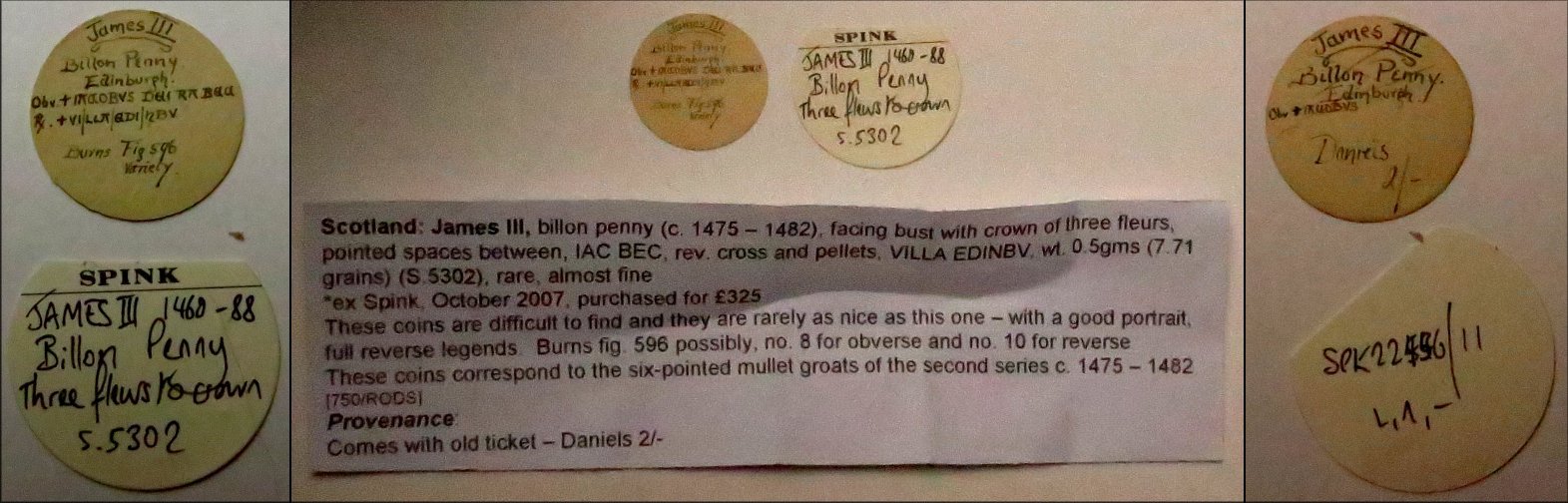
is outstanding but this is a rounder coin with more detail overall. Sold with old tickets
– ex Daniels (a remarkable ticket), purchased 1940’s? for
2 shillings, ex Spink, 2007, £325 + commissions, ex Phil Higginson
collection. A very
rare coin in this grade. SOLD
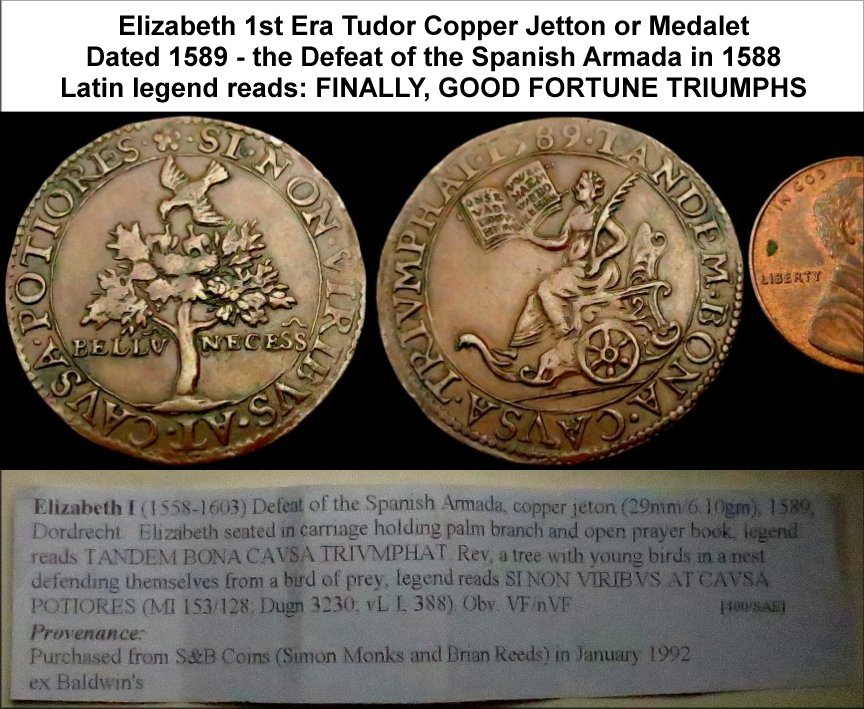
WTH-9110:
1589 Elizabeth
1st Jetton or Medalet - DEFEAT OF THE SPANISH ARMADA. As ever, much imagery: a pious Elizabeth 1st,
seated, holding a prayer book, and a reverse suggesting that England is an innocent green tree
supporting young, nesting birds whilst being attacked by the hawkish
Spanish. Medallic Illustrations 153/128,
Dugn 3230, Peck 63.
May 1588 witnessed a Spanish fleet consisting of about 130 ships with
about 8,000 seamen and possibly as many as 19,000 soldiers leaving Lisbon en route for England.
It was a formidable attack force - they termed it the Invincible Armada
- which was four years in the making but which ultimately failed. Julius Caesar's two invasions of Britain in 55 and 54 BC failed mainly
because of the weather but whilst the Spanish Armada failed in part due to bad
weather, it was bad tactics with bad luck that defeated the Spanish Armada. It's quite surprising that it took a year to
prepare the dies and even longer to get the medals out to the public. CNG (July 2026) auctioned a variation on the
DEFEAT OF THE SPANISH ARMADA medal, again in copper. M.I.147/146, Eimer 60 (rated virtually the
same in Eimer). Hammer price was $1,200
so $1,500 after buyer's commission. The
coin on offer here is a high grade example - remember,
this was struck in soft copper, centuries ago during the reign of Elizabeth
1st. Further, it is but a fraction of
the cost of the CNG example! SOLD
Provenance
ex S & B Coins (Simon Monks & Brian Reeds)1992
ex Baldwin's
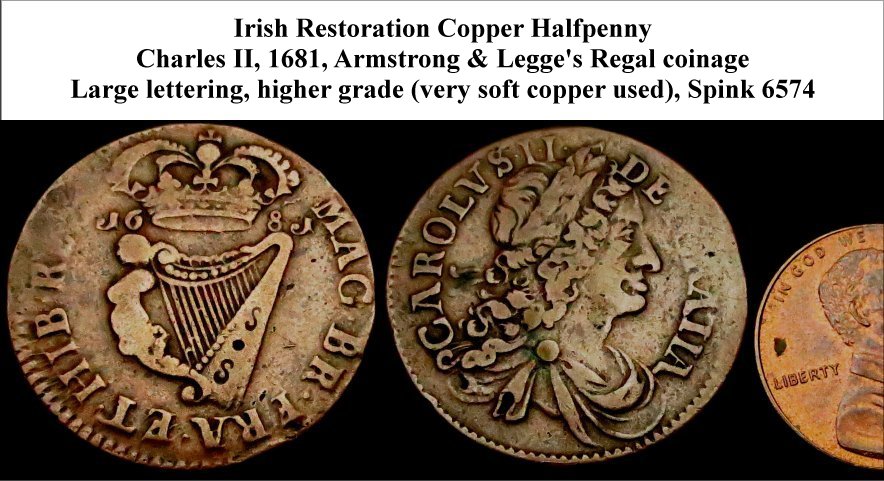
WI-7211:
1681 Charles II
Copper Irish Halfpenny. An excellent
grade coin, especially so when you appreciate just how soft the copper
was. Armstrong & Legge’s regal coinage. Interestingly, pre 1680 (the first Armstrong
& Legge date), Ireland had nothing but old (and terribly
worn) hammered coins, small (worn) traders tokens and foreign coins in
circulation. S.R.
6574. Sir Thomas Armstrong and
Col. George Legge were granted a twenty one year
licence which was ultimately so successful that it drove out all the old
currency – great at the time but problematic several years down the line when
this coinage was reduced to much worn copper discs. SOLD
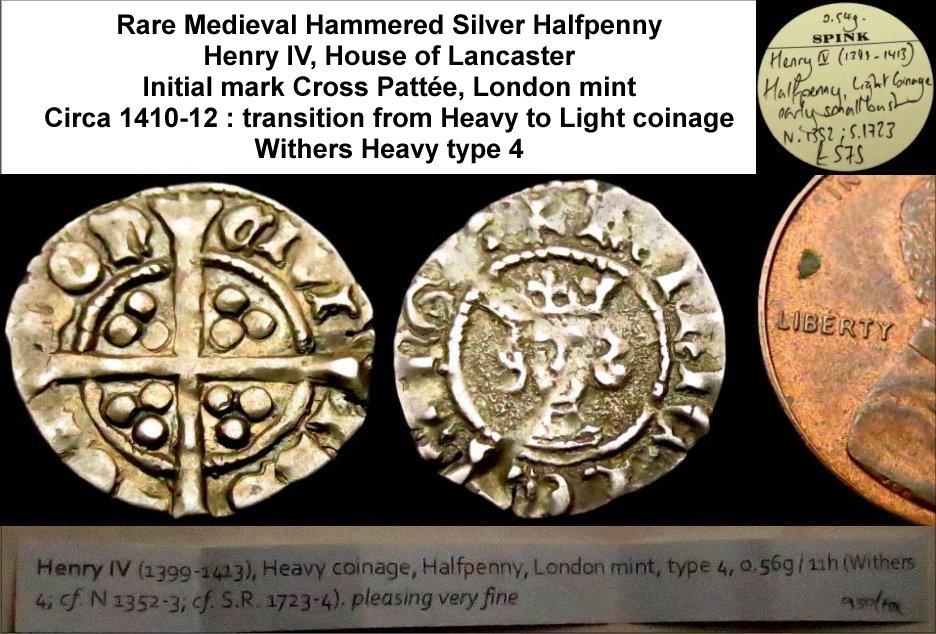
WMH-9205: Henry
IV Medieval House of Lancaster Hammered
Silver Halfpenny. Heavy coinage, 1399-1412, London, the smaller
bust with inconsequential shoulders - touching the latter part of that date
range. Technically not listed in S.R. or North
because this coin transitions the Heavy and Light coinages, lying after the
Heavy S.R.1724 and before the Light S.R.1737 issues. Now more accurately
described as Withers type 4, a transition issue. The coin is remarkably full of flan, weighing
8.2 grains. Heavy issue halfpennies were
struck at 9 grains but in the x12 specimens observed by Withers, which was all
that was available in both institutional and private hands in 2023, those coins
started at 6.79 grains. Incidentally,
the Withers' plate coin, the best example extant, has a stronger portrait but
is clipped and weekly struck on the legends whereas the legends on this coin
are infinitely better, as is the fullness of the coin. Light issue coins were struck at 7.5 grains. During the entire reign of Henry IV, but
particularly the Heavy Coinage, gold was in short supply (just £45,000 bullion
for this 13 year period) but silver coinage was much more seriously impacted
with only £1,750 of silver being available up to Michaelmus
1408, with nothing thereafter. Further,
not only was hardly any Heavy Coinage silver issued, but what was issued was
literally worth more than its face value and so ended up on the Continent where
it was melted down. This imbalance
straddled the very tail end of Edward III, continuing up to and including the
first issue of Henry V, although the Henry IV period, particularly the Heavy
Coinage, was the worst affected. As good
an example of any Henry IV halfpenny as you'll see with both strong legends and
portrait. The rare transition element
further elevates the rarity of this coin.
Very rare and collectable. SOLD
Provenance:
ex Spink (sold 2023 £575 before the all important
reattribution)
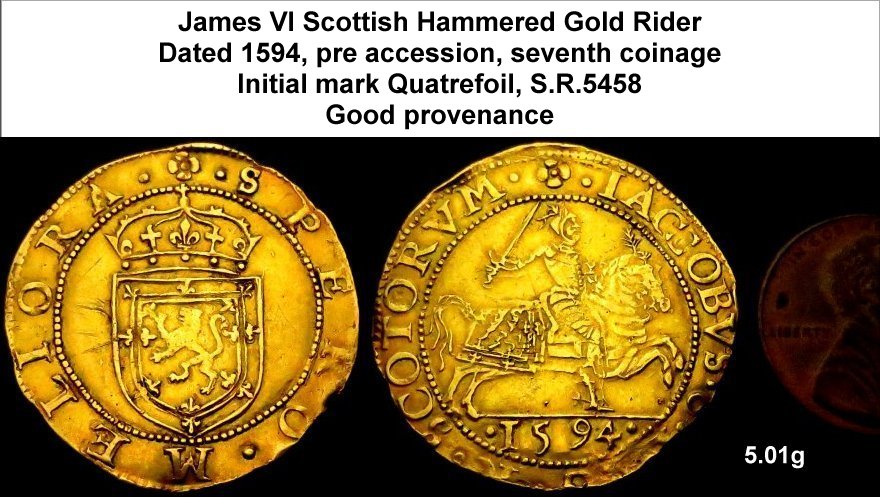
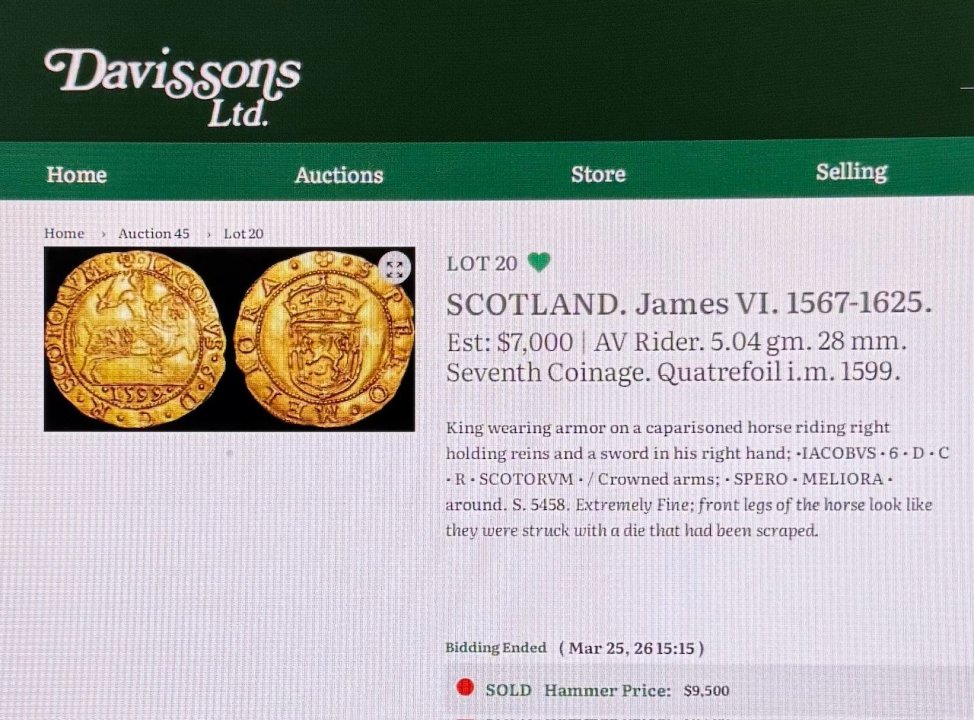
WAu-9294: 1594 James VI Scottish
Hammered Gold Rider. Seventh
coinage, pre accession - circulated at 100 shillings. Initial mark Quatrefoil,
pellets by the 1594 date.
Obverse: the king in armour with a sword, on a galloping horse, right;
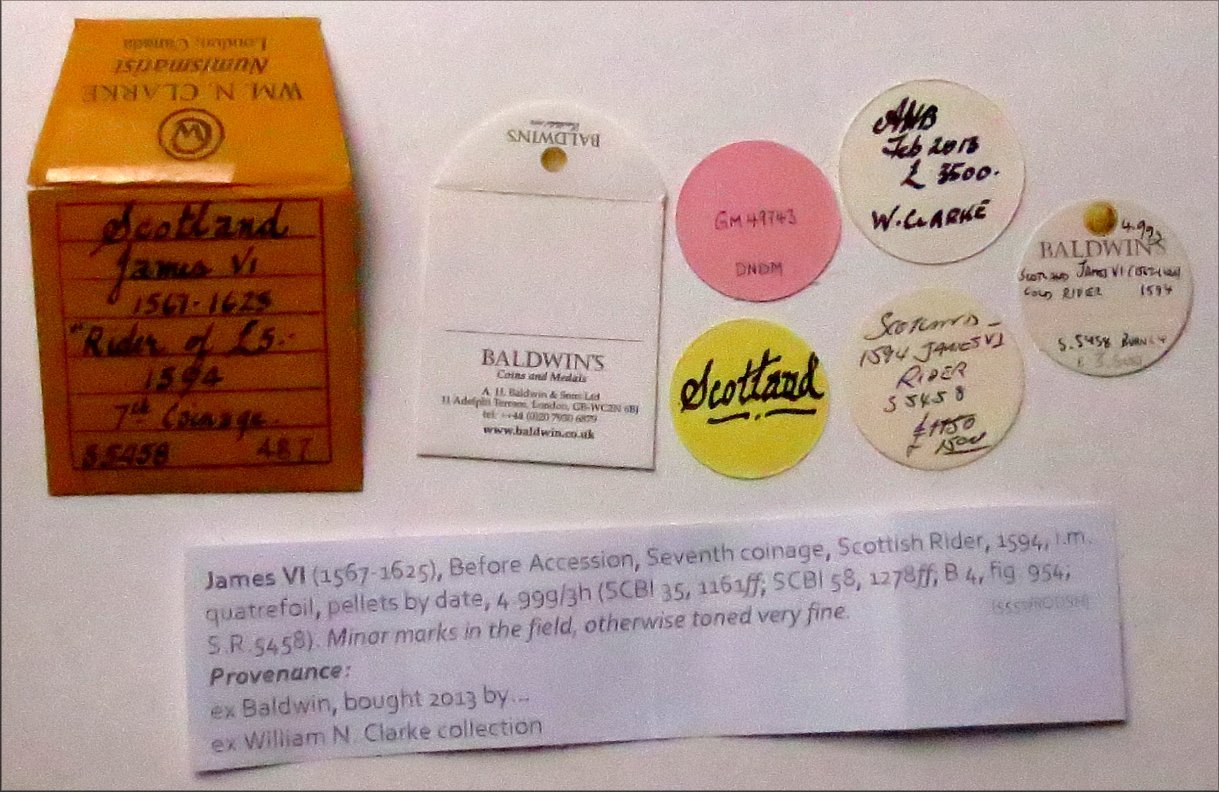
reverse: crowned shield. SCBI 58, 1278ff; B4, fig.954, S.R.5458. Good provenance with a
great amount of tickets. Minor marks
to the left of the shield otherwise a nicely toned VF grade. We note the March 2026 Davisson's
auction example of similar date rarity achieved a hammer price of US $9,500
with associated add-ons. The coin on
offer here is of comparable grade and, unlike the Davisson
example, actually has its front legs prominently on view! SOLD
Provenance:
Old
ticket, marked at £1,750 reduced to £1,500
ex Baldwin, November 2012, ticket market at
£3,500, sold to...
ex
William N. Clarke collection, many tickets
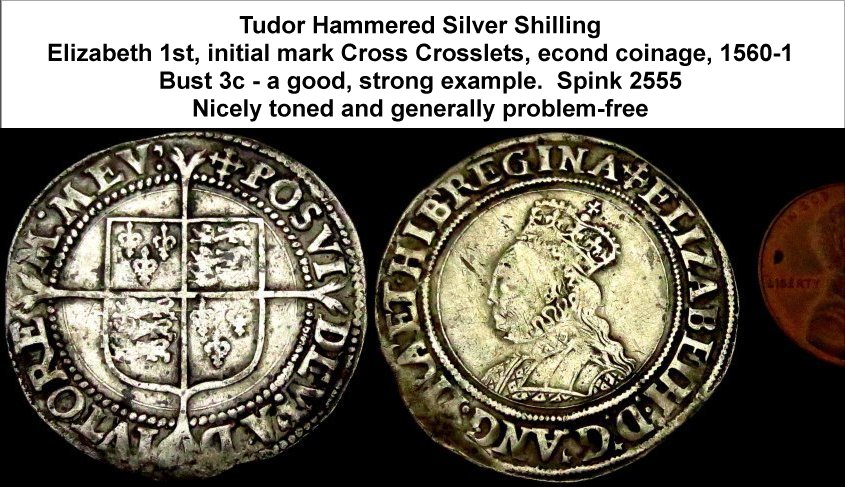
WTH-7905:
Elizabeth 1st Early
Hammered Silver Shilling. Initial
mark Cross Crosslet, bust 3C, second issue, S.R. 2555. Second
issue Cross Crosslet hammered shillings were only struck for a total of 10
months
(1st December 1560 to 24th October 1561) – interestingly, there was
a 20 odd year hiatus before shillings were once again issued under Elizabeth
1st. Minimal wear on this coin -
shillings upwards were extremely hard to prepare dies for. The legends bit was relatively easy but to
cut a die with a view to getting a portrait onto a large piece of silver, using
the hammering process, what a remarkably difficult undertaking and one that
perhaps defeated the die sinkers most of the time. SOLD
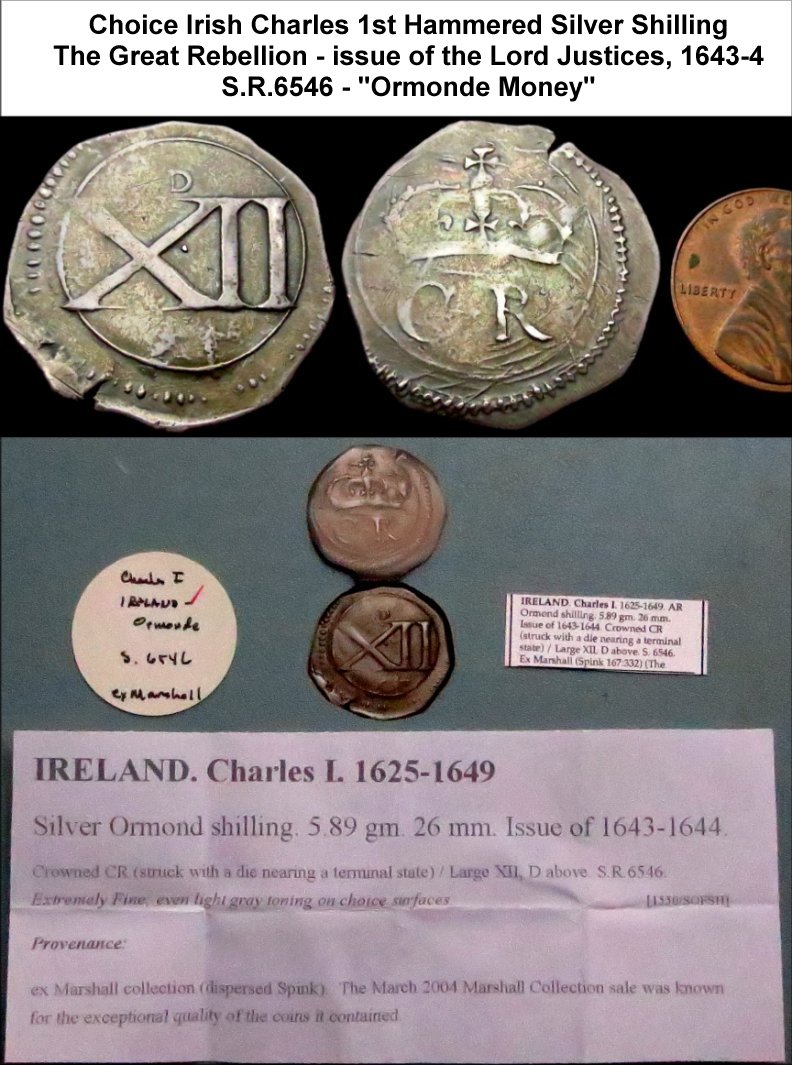
WI-9364: **Choice**
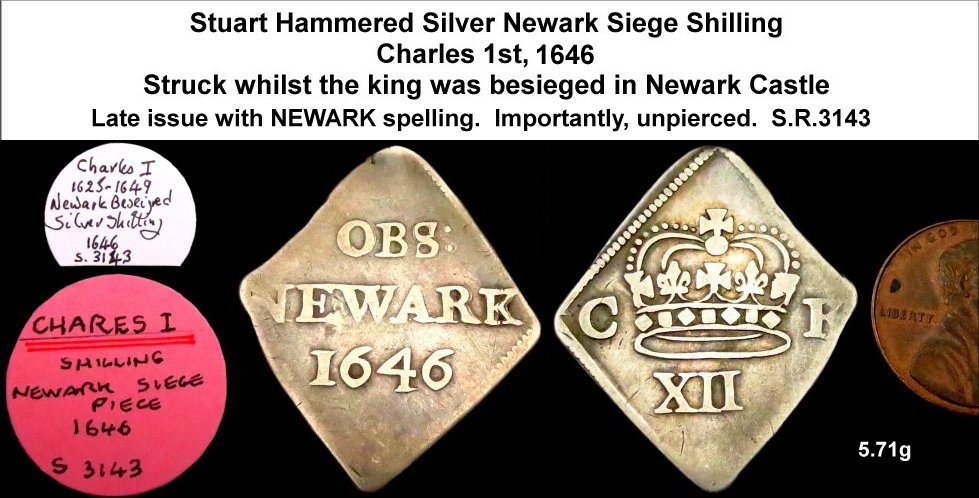
Charles 1st Irish Hammered Silver Ormonde Money Shilling. The Great Rebellion in Ireland.
Issued by the Lords Justices at Dublin and termed Ormond Money due to the
Earl of Ormonde being appointed Lieutenant of Ireland in 1643. This was the final coinage of the rebellion
period to be issued. This issue
demonstrated allegiance to the monarch by incorporating the king’s crown on the
obverse. Issued
1643-1644. Obverse: a large C•R
with a non flourished R, crown above; all within a linear and beaded border / reverse:
a large X.II with a small D above (12 pence); all within a linear and beaded
border. S.R.6546. Very
much along the lines of the English Newark, Pontefract, Carlisle etc siege
pieces; the Ormonde Money was crudely cut from flattened silver plate and
hammered with the die. These dies were
not engraved to anywhere near the quality of regular coinage, resulting in a
coin far from what we might expect a professional moneyer to produce working
out of an official mint. As a result,
Ormonde coinage is usually poor, as ever summed up eloquently and concisely by
Coincraft: "This [shilling] issue, whilst scarce, is obtainable but rarely
found in better than Fine condition." Emanating from the famous Marshall collection, renowned for the
exceptional quality of the coins it contained.
Enthusiastically graded to EF on the old, accompanying
ticket, but still a solid VF for issue.
Choice. SOLD
Provenance:
ex
Marshall Collection, dispersed...
ex
Spink, 2004
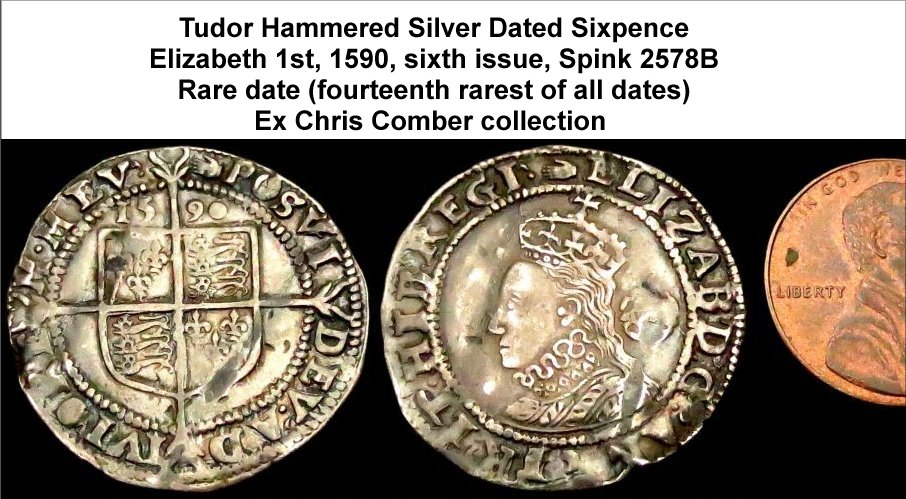
WTH-8121: High Grade 1590 Elizabeth 1st
Hammered Silver Tudor Sixpence. Sixth
issue, initial mark Hand, S.R. 2578B. 1590 as a date represents a frequency of 1.0%
for the 2,716 recorded single finds of Elizabeth 1st coins and 1.2% for all
5,588 recorded Elizabeth 1st hoard coins.
1590 is the
fourteenth rarest of all forty two dates. Outstanding grade for a
coin so late in the series. Ex Chris Comber collection.
SOLD
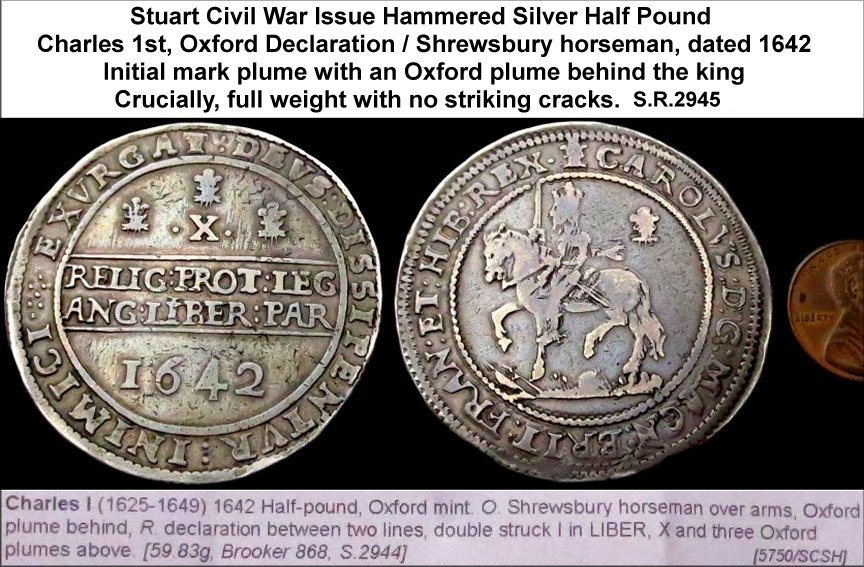
WJC-9327: Impressive
1642 Charles 1st Oxford Declaration Half Pound. Early Civil War large
denomination piece - ten shillings.
Initial mark Plume. Obverse die depicting the Shrewsbury horseman with an
Oxford plume behind.
The second iteration of the Oxford half pound. The accompanying ticket suggests this coin
utilises a Shrewsbury reverse die (S.R.2944) but in
reality, the reverse die is Morrison A-2 with a group of x7 pellets at 3 o'clock, very much an Oxford die. S.R.2945, Brooker 867 and 868 (die
duplicates). Excellent weight, an even
strike both obverse and reverse, good solid toning and most importantly, no
striking cracks whatsoever - to get any kind of impression on such a
large lump of cold silver (far from being a soft metal at room temperature)
required not only considerable skill but a great deal of focused force, which
invariably caused planchets to crack or split open at the edges. Here we have none of that. As stated at the start, a most impressive
coin. SOLD
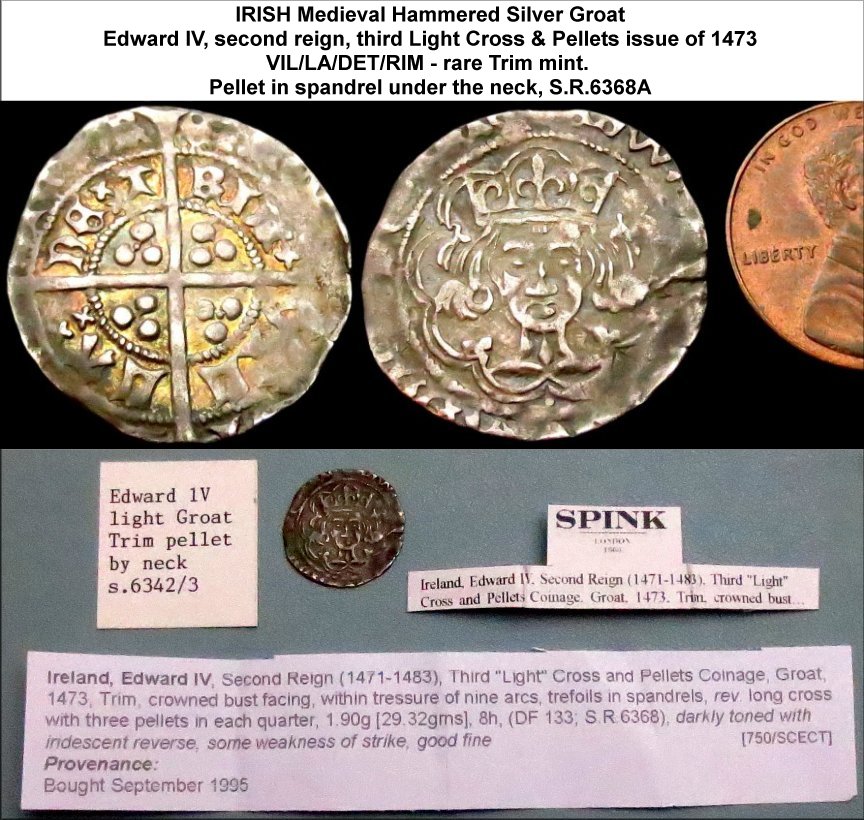
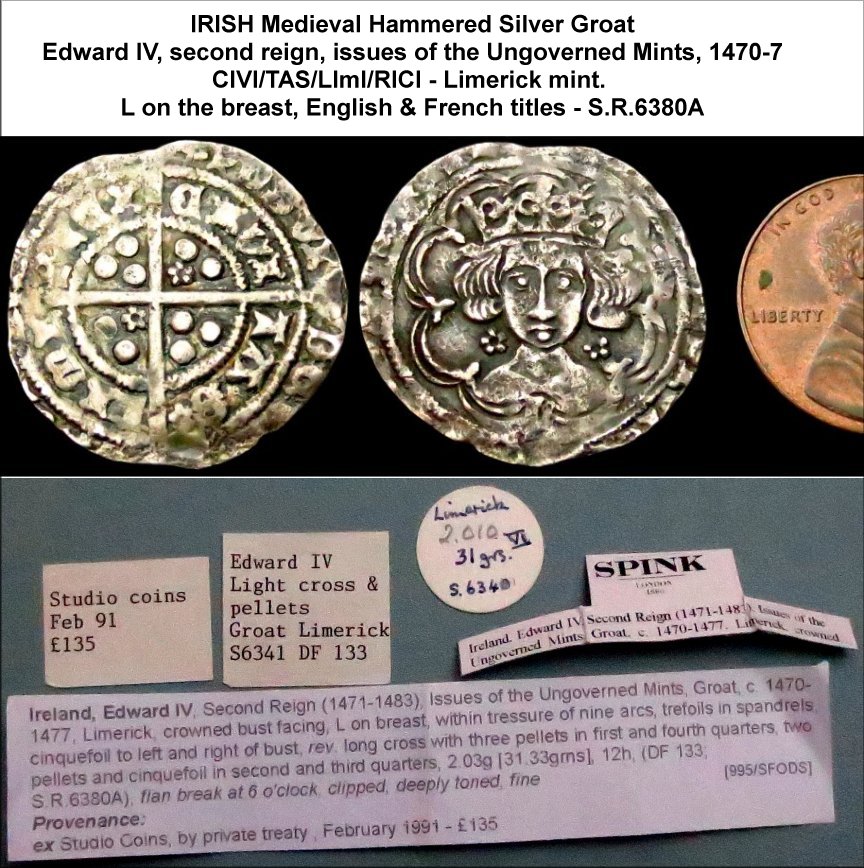
WI-9271: Irish
Edward IV Rare Mint Medieval Hammered Silver Groat. Second reign, type VII -
third Light Cross & Pellets coinage of 1473 only. VILLA DE TRIm - Trim mint. Nothing on breast with just a single pellet
in the 6 o'clock spandrel; it's usually a pellet in some spandrells with one at 12 o'clock OR a pellet just at 12
o'clock. S.R.6368A. Weight at 1.92g - some clipping but
also struck on an undersized flan. There
is evidence showing that at least one mint-master, Germyn
Lynch, was indicted in 1472 for, "...making light groats at Drogheda". With that in mind, the ticket grade of good
fine appears somewhat undercooked. For
issue, overall I'd grade this as abt VF.
Rare mint and high grade for issue. SOLD
Provenance:
Bought
September 1995 (original ticket)
ex
Spink
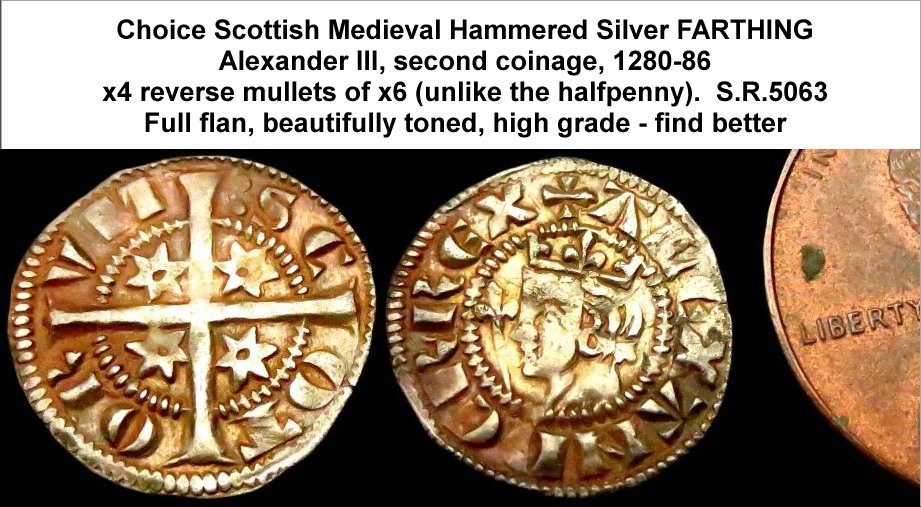
WSC-9263: Choice Alexander III
Scottish Medieval Hammered Silver FARTHING.
Second coinage of 1280-86. This farthing was the first to be seen in Scotland. Four mullets, each of x6 points, as per the
penny, but with a reverse legend reading an abbreviated
:SCOTORVM. S.R.5063. It is interesting
to note that the halfpenny, obviously lying in between the penny and farthing
in value, differentiated itself by only having two mullets, each of x6
points. Actually a jolly good idea but
it put the pressure on the die sinkers to create a coin so small but having
virtually the same legends as the penny, bar just three letters. The obverse is a similar story - a reading of
ALEXANDER REX as opposed to ALEXANDER DEI GRA on the penny so again, we're only
talking about losing three letters and one of those is an I,
so would take up minimal space.
Incidentally, there is a variety of farthing having the full penny
obverse legend, although I've never seen one.
Some of the early contemporary Edward 1st English farthings have dies as
accomplished as those on this coin so I suspect there was some sort of
collaboration either side of the border in terms of personnel.
The reign of Alexander III was notable for
three major events. Firstly he was to succeed where his father, Alexander II,
had failed in ridding the Western Isles of Scotland of Norse influence.
Secondly, he was to make one Scottish family - the MacDonald clan - so powerful
that they would be a rival to the future kings of Scotland in influence. Thirdly,
dying with no heir was to plunge Scotland into a succession
crisis that would ultimately lead to war with England. It was an unfortunate death - he rode his
horse over a cliff in the dark - and an inopportune death in that his wife, who
was pregnant with the heir to the throne at the time of Alexander's death, gave
birth to a still-born child. After those
tragic events came John Baliol, Robert the Bruce and
the English ... and the rest is history.
Alexander III farthings are seldom encountered
but here, we have one that is full flan, perfectly centred obv
& rev, full and clear legends, strong portrait and beautifully toned. Clearly choice and easily the best example
I've seen, and by quite some margin. SOLD
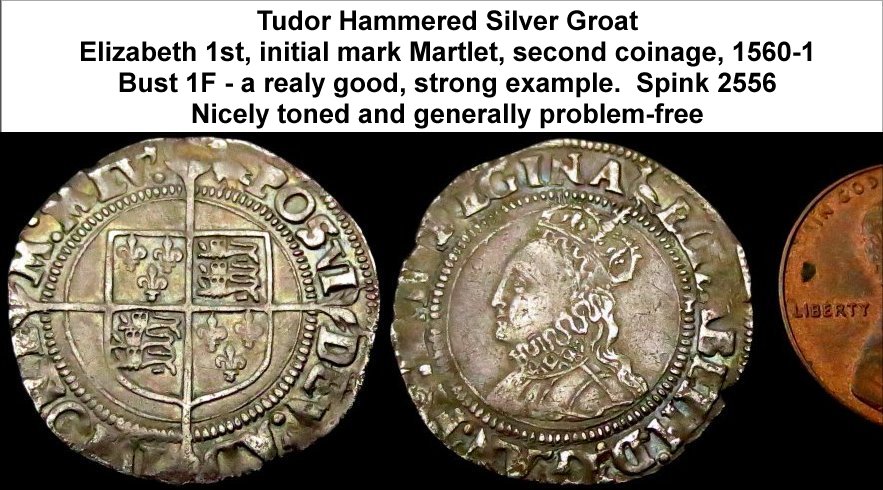
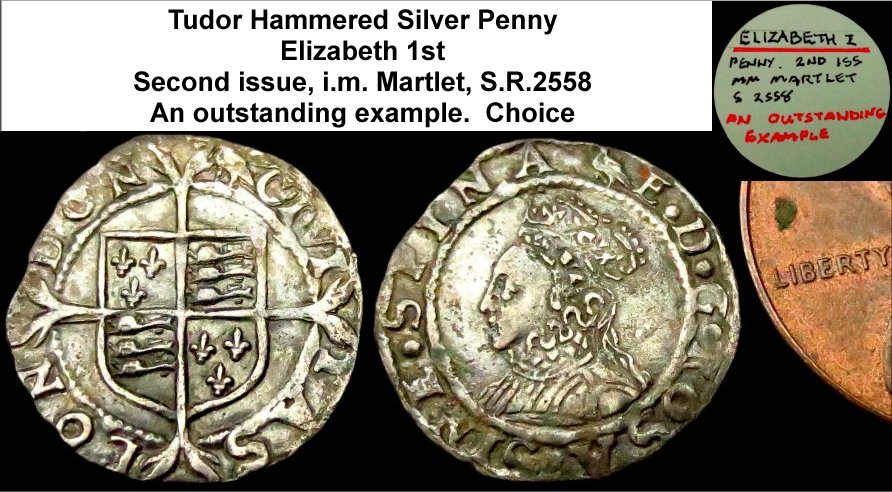
WTH-7904:
Elizabeth 1st
Early Hammered Silver Groat or Fourpence. Initial mark Martlet, bust
1F, second issue, S.R.
2556. Second issue Martlet hammered groats were only
struck for a total of 10 months (9th December 1560 to 24th October
1561) – interestingly, the Martlets and Cross
Crosslets were the last hammered groats issued under her reign, even though
Elizabeth reigned for a further 40+ years.
This is a beautiful coin, being excellent grade, centrally struck,
attractively toned, etc etc. SOLD
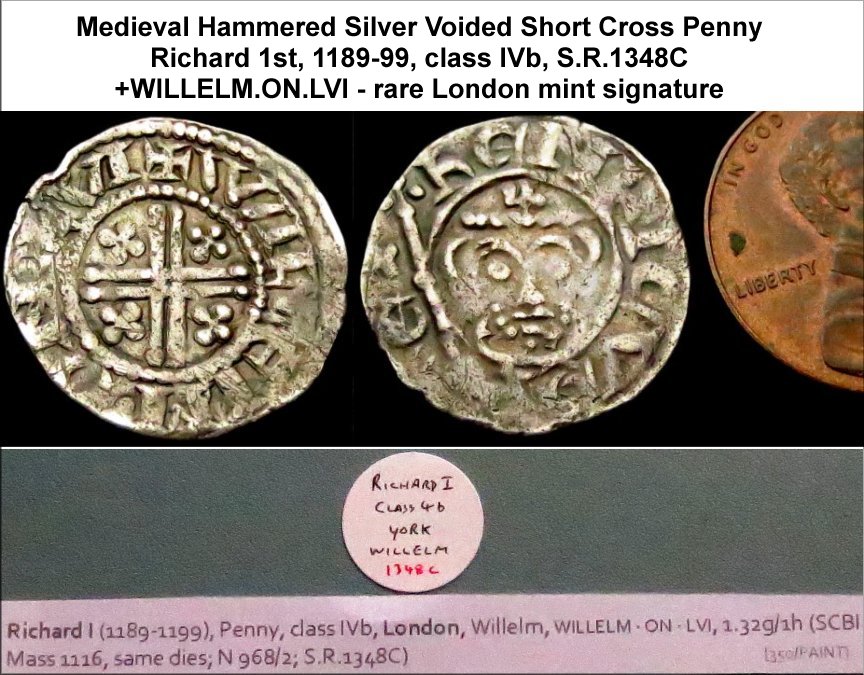
WMH-9318: Outstanding
Richard 1st Medieval Hammered Silver Penny. Voided short cross, class IVb,
+WILLELM.ON.LVI - London but a much rarer mint signature
(see The Short Cross Coinage 1180 - 1247 by C.R. Wren). S.R.1348C.
Collectors will be all too aware that Richard 1st pennies as an issue
are invariably poor, being by far the worst of the x4 short cross
monarchs. This coin is an exception to
that rule. Rare thus,
especially with the mint signature.
SOLD
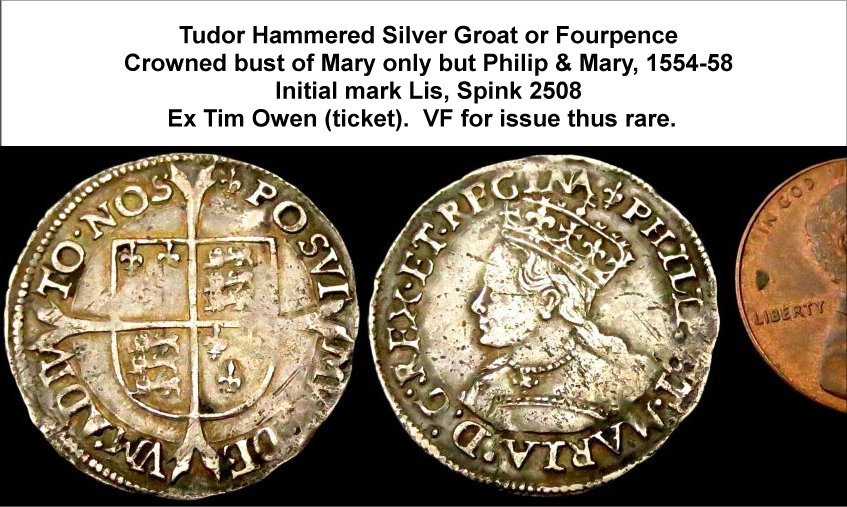
WTH-9076:
Mary and Philip Hammered
Silver Tudor Groat in High Grade. Initial mark Lis, 1554-58, S.R. 2508.
A single portrait, left, of Mary but with the legend PHILIP ET MARIA
indicating this coin is 1554-58, after Mary married Philip of Spain. Mary was the only child of Henry VIII (her
mother was Catherine of Aragon) to survive to adulthood. Mary quickly and efficiently disposed of Lady
Jane Gray – proclaimed Queen when Mary’s younger brother Edward VI, died at age
9 – by beheading her, a process not unfamiliar to her, being the daughter of
Henry VIII. Interestingly, all the
silver denominations of this joint reign, higher than a groat, had busts of
Mary AND Philip but groats and below only had Mary's bust. This may well be a result of lack of space on
a smaller flan but bearing in mind the vast majority of the general population
at the time would only ever handle these smaller denominations, the crown was
perhaps missing a trick in getting out the message to the populace (and coinage
was really the only way of doing this) that Philip was here. Or perhaps this was a calculated act on
behalf of the crown in an effort not to upset the apply cart?! A terrific example of this
usually worn and problematic issue.
SOLD
Provenance:
ex Tim
Owen
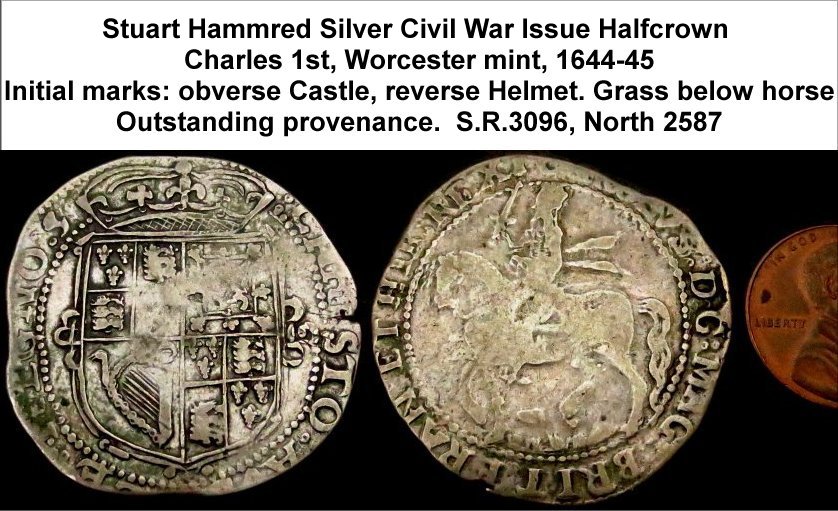
WJC-9234:
Charles 1st
Hammered Silver WORCESTER Civil War Halfcrown. Clear initial marks of a slender Castle (obv) and a Helmet (rev).
Worcester mint. Grass under the
king's horse / an oval shield topped with a crown on the reverse. S.R. 3096. Worcester is not quite the definitive
attribution for this group of coins that you might think. Some coins within the family have a
"W" below the horse which was previously accepted as Weymouth, a Devonshire coastal town. T. F. Dymock in the
1861 Numismatic Chronicle first postulated this theory. Weymouth was indeed held for the King from
August 1643 to 17th June 1644 when it finally surrendered but
the declaration halfcrown from this family is 1644 which would have meant the
entire coinage would have to have been crammed into just two and a half short
months before surrender, a highly unlikely scenario. In 1981, George Boon, the then Curator of the
National Museum of Wales, wrote an article suggesting that the attribution
should not be Weymouth but instead Worcester.
This was included in the John Brooker Collection of Charles 1st Coins
book, published by Spink in 1984. That
attribution was based on the above difficulties with Weymouth, the fact that
leaving Oxford on the night of 3rd June
1644 with approximately 7,000 men, Charles 1st did pass through Worcester with
his troops early in June, but, predominantly,
on the evidence suggested by the location of coin hoards - the Worcester
surrounding area being rich in such finds (the 1982 Telford Hoard being one
such example - x367 AR coins, £26 8s face value. 6d.; L: Sun 2/6 (10),
1/– (1). R (all 2/6): Shrewsbury 1642 (1); Oxford 1642 (3), 1643 (3); 1644 (1), 1645
(2), 1646 (2); Bristol 1644 (2), 1645 (2); A 1645 (1); W/SA
group (9); HC (1). S: James VI 30/– (1). ECWCH, 23–32)
and Weymouth being almost, if
not completely devoid of any such finds from this family of coins.
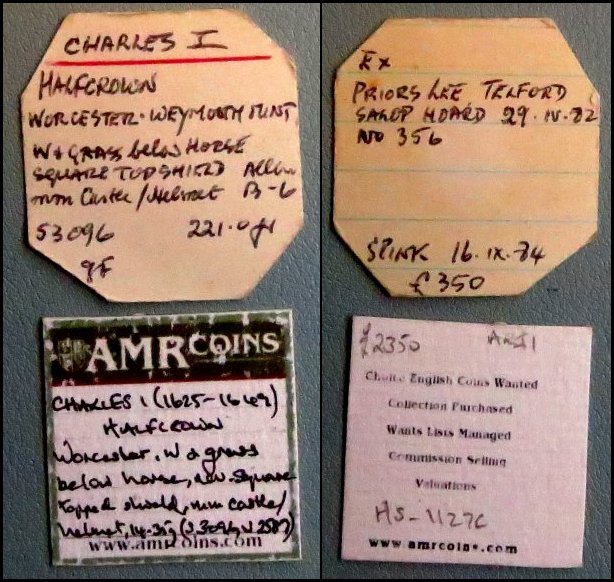
This coin was part of that famous and provenance-defining 1982 Telford
Hoard: see old
tickets here and Provenance below. Of good weight (14.35g - the Brooker examples
being 14.04g, 13.86g, 15.23g & 13.73g) and being very well centred. The reverse is particularly pleasing with the
obverse, whilst not suffering from worn dies (they simply did not strike enough
coinage to come even close to wearing out the dies), does show a degree of lack
of definition as a result of either shallow obverse dies or the manor of the
strike, as occasionally happens with this provincial issue - see Brooker plate coins
1141-1144. A rare coin
with outstanding provenance. SOLD
Provenance:
ex
PRIORSLEE hoard: Telford, Shropshire, 29th April
1982 -
hoard discovered on a mechanical excavation during construction work on M54
motorway.
ex Spink, purchased after hoard inquest, sold September
1984 for £350 to...
ex Dr John Hulett (died 4th March 2017 aged 87), collection dispersed by DNW Auctions
between September 2017 and October 2020, purchased by...
ex AMR Coins (sold 2019 for £2,350)
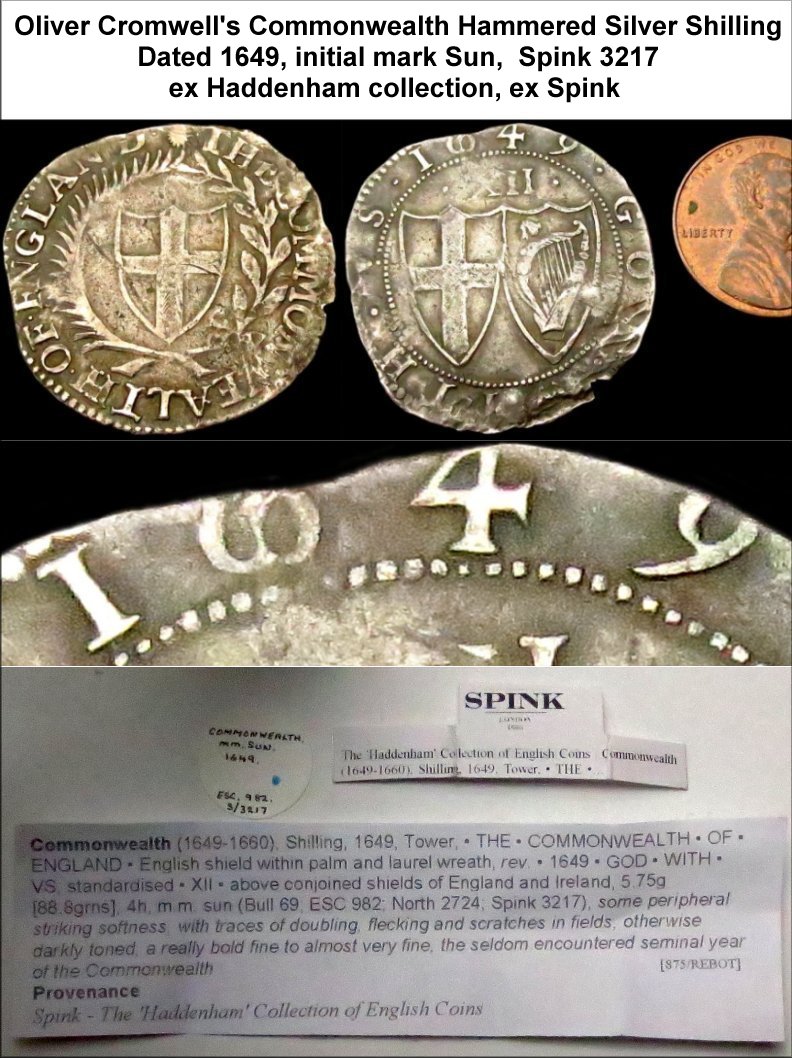
WCom-8154:
1649 Commonwealth
Hammered Silver Shilling. Initial mark Sun, S.R. 3217. The very first date in the Cromwell Commonwealth period. An apparent
eight strings to the harp and, most importantly, a sideways 6 in the date which
is entirely unrecorded, both in ESC and the excellent Sun&Anchor.com. The date itself is wide, indicating a late
1649 reverse die. Whilst this coin is
not part of the famous Blackfriars' Hoard of 1995 (some 1500+ coins all found
on the Thames' Foreshaw), you may be interested to
learn that of that hoard, only x2 were 1649 shillings (there were x72 1653
shillings to give you some context). If
you look at the cross hatching on the shield, you'll note that it isn't up to
much. The new regime, following on from
the very different Charles 1st coinage, found it incredibly hard to get this
cross hatching right. It was one of the
main reasons why 1650 didn't happen for silver coinage - they were busy
perfecting their dies. 1651 bore the
fruits of their labour, especially on the silver crowns. S.R.
grade this coin to almost VF. Rare thus. SOLD
Provenance:
ex Haddenham collection
ex Spink
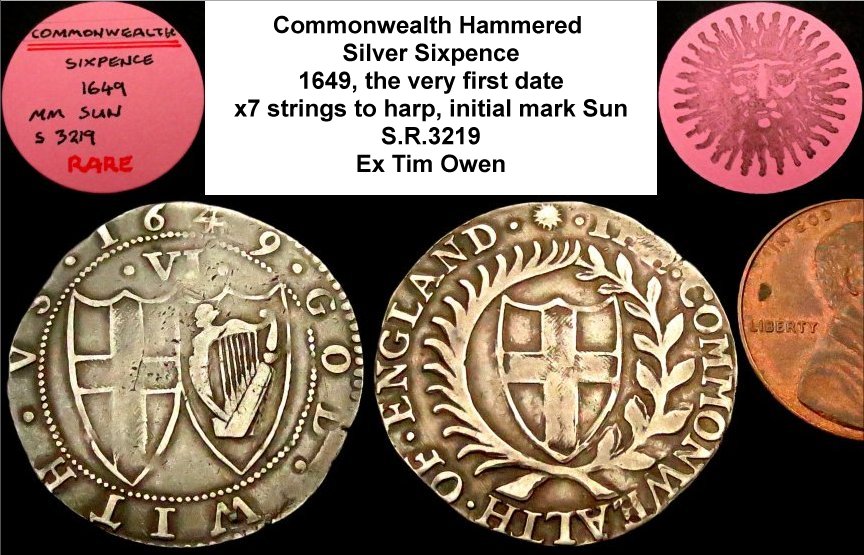
WCom-9196: 1649 Commonwealth Hammered
Silver Sixpence. Initial mark Sun, S.R. 3219. The very first date in the Cromwell Commonwealth period. Seven strings
to the reverse harp with the sate obviously not an overdate although
interestingly, the 4 of 1649 has been struck or entered twice compared to once
for the other digits. If you look at the
cross hatching on the shield, you'll note that it isn't up to much, ie it's
worn but you can see from what remains that it had a very low definition
courtesy of the die. The new regime,
following on from the Charles 1st coinage (I wonder what the public would have
made of this coin, following on from very different style that had been the
norm for 100 years?) found
it incredibly hard to get this cross hatching right. It was one of the main reasons why 1650
didn't happen for silver coinage - they were busy perfecting their dies. 1651 bore the fruits of their labour,
especially on the silver crowns which were clearly harder to get the design off
the dies and onto the planchet. A sought-after first date - 1649 being rarer in its own right
anyway - on a problem-free good flan in very collectable grade. SOLD
Provenance:
ex Tim Owen (his iconic ticket)
WJC-9346: (14) Edward V : 1616-38
Silver Simon de Passe Token. Machine-pressed silver tokens or counters
depicting the monarchs of England, issued in sets (thought to be thirty six),
composed either of pieces of different monarchs or repetitions of the same
type. Thought to be
primarily used as markers or counters "for reckoning and for play". The dies were very cleverly sunk to give the
impression of a hand-engraved silver token.
Some of these counters were executed early in the 1616-38 period by
Nicholas Hilliard, jeweller; goldsmith and engraver to Elizabeth 1st and
afterwards to James 1st. In 1617,
Hilliard received a patent granting him the monopoly for twelve years of all
the engraved portraits of the King and the Royal Family. He subsequently sold licences to other
engravers to execute these counters, one of which was to Simon de Passe and his brother, both of whom excelled in the art of
engraving. This sub-licence to the de Passe brothers was issued late in the reign of James
1st. Collectively, these tokens are all
termed De Passe tokens for convenience. SOLD
Provenance:
From a collection put together over a
great many years; dispersed by Spink.
WJC-9094: Stuart De Passe Token - James 1st with Charles 1st. Circa 1625 -
1629/30. From a series
of Medalets issued by Simon van de Passe (1595-1647) depicting the kings and queens of England.
It is generally accepted that they were issued as gaming tokens. The dies were cleverly sunk to imitate a
hand-engraved appearance and indeed, the uninitiated even today will readily
state hand-engraved when asked. They
were not; they were machine-pressed.
There is a commoner Charles 1st De Passe token
with his wife, Henrietta Maria, on the reverse but this token, issued when
Charles 1st was on the throne, is unusual in that it
depicts two monarchs. Mitchener 4784. Rare. SOLD
WSC-9209: James V Scottish Hammered Silver Stuart
Groat.
Second coinage (the first was just gold), 1526-39. Type IIIc, S.R. 5378. Holyrood Abbey Mint. James ascended the throne
aged just one year old. Coincidentally, upon her father's death, Mary
(the future Mary Queen of Scots), James's only legitimate heir, was only seven
days old when she ascended! You'd be challenged to source average or
lesser grade James V groats for under £1,000 these days - this coin is
definitely not one of those. A high grade example of one of the most
attractive hammered silver coins ever to be issued, not just in Scotland but in the entire British Isles. SOLD
Provenance:
ex Brian
Reed - his old ticket (1997)
ex Baldwin's
WI-9254: A
Superb Irish Edward VI Hammered Billon Silver Sixpence. Issued under Edward VI but struck
in the name of his father, Henry VIII.
Struck at 0.250 fine, being groat sized but
very much a sixpence. Dublin mint, the rarer and more desirable
type II with the large facing bust of "local style" as opposed to
Tower dies, S.R. 6486. It gets better -
initial mark BOAR'S HEAD, and then there's the grade! It is interesting to note that this entire
issue was struck in Henry's name, not because Edward was a mere child (he was
only 15 when he died in 1553), rather because the ministers in England wanted to deceive the Irish
public. The state of coin in Ireland under Henry VIII was dreadful, as
it was in England, although Ireland was worse. The plan was to "clean up" the
Irish coinage along the lines of the English 1551 "Fine Silver" issue
but to finance that, the Irish would be fed a further several years of little
better than base coinage purporting to be silver. To issue this coinage in Edward's name would
be to red-flag what the ministers were not just plotting but literally doing,
but to suggest that the new coinage was actually not new, rather old Henry VIII
coinage, might just pull the wool over the Irish eyes. Bad enough,
you might think, but when you consider that the next monarch, Mary, issued
Irish coinage at 0.583 fine (the English 1551 Fine Issue was 0.925 fine), the
following (Mary & Philip) at 0.250 fine, and even Elizabeth 1st until 1561
at 0.25 fine, you realise that the Irish had it bad. In 1561, Elizabeth 1st finally upped the silver
content, not to 0.925 but to a respectable 0.916 fine). Coincraft states that this local, S.R. 6486
issue is really only obtainable in lower grades with examples tending to be
"...poorly struck" and "...often rather dull due to their low
metal [silver] content". A rare coin, an interesting history behind it, and in excellent
grade for issue. SOLD
Provenance:
ex Tim Owen
WTH-9246:
Rare Edward VI
Tudor Hammered Silver HALF Penny. Struck under his father, Henry VIII, 1547-51. York mint, billon silver - inherited
from the latter part of the Henry VIII reign, finally dispelled in 1551 under
the Fine Silver issues - S.R.2428.
Edward was crowned on 20 February 1547 at the age of just nine years of age. He was the only surviving son of Henry VIII by
his third wife, Jane Seymour. Sadly,
Edward died in July of 1553 aged just 15 years old. It was a very strange decision to keep
Henry's name and portrait on some of the currency once he'd died, and then for
x4 years, considering that from April 1547, just x2 months after Henry VIII
died, Edward's First Period coinage, with both Edward's name and portrait,
including pennies and even halfpennies, was issued into everyday currency. Good provenance (see old tickets here)
and outstanding grade for issue. These
halfpence denominations are rare coins indeed.
SOLD
Provenance:
ex R.A. Shuttlewood collection
Dispersed by Spink 2001
ex J.P. Rosen collection
Dispersed DNW 2003
WTH-9156:
Rare Type Henry
VII Hammered Silver Tudor Halfpenny.
Facing bust issue, the only York halfpenny issued under Henry VII,
circa 1502-4. An Episcopal issue under
Archbishop Savage with an arched crown which actually breaks the pellet
circle. A very large
and extremely clear key below the bust.
S.R.2249. The York Episcopal
issues, including up to halfgroats, under Edward IV (second reign), Richard
III, Henry VII and Henry VIII favoured a variety of devices for inclusion on
the obverse or reverse, being mainly letters but sometimes keys (upright or
slanted), trefoils, crosses etc. It
seems bizarre that on the tiniest York denomination struck, they decided
to place a huge horizontal key underneath the bust, thereby pushing the
portrait higher up on what was already a challenging small space. However, different is nearly always good in
numismatics - that unusual decision presents us with a coin which stands out
from the crowd as much as the second issue Henry VIII farthing and, although
not quite in the same league, the later Charles 1st declaration issues. I believe I'm correct in saying this is the
only example I've had in all the decades of handling coins! SOLD
Provenance:
ex Tim
Owen (his older ticket)
WTH-9166: Extremely Rare 1566/5/4
Elizabeth 1st Machine Pressed Silver Sixpence. "Milled" coinage, initial mark Star,
dated 1566. Not quite as rare as either
of the later 1570 issues but contrary to what the reference books suggest,
there's not too much in it. Be under no
illusion here - this is an incredibly rare date in the milled series. London coins has seen but a single example in 20+ years and for me
personally, this is the first example I've ever seen in the flesh. S.R.2598A. When you consider that “85% of Mestrelle’s
meagre experimental machine-made coins were sixpences dated 1562. This leaves 15% for all the other
Screw-Pressed sixpences, shillings, groats, threepences, halfgroats, threefarthings and the gold coinage”, you
gain an insight into just how rare all non 1562 milled coins are. Queen Elizabeth 1st herself
visited both mints (Upper & Lower Houses) upon the occasion of the near
completion of the recoinage on 10th
July 1561. She met with Eloye Mestrelle and viewed his machinery. The visit was reported to be six hours in
length. Eleven years later, Eloye Mestrelle was dismissed
from the mint in 1572 and just six years after that,
he was executed (hanged) for counterfeiting.
An extremely rare date that will not be represented in
the vast majority of both private and institutional collections throughout the UK and beyond.
Sold with an old Bermondsey Coins ticket together with
a large, old coin envelope with much annotation. SOLD
WTH-9117:
Extremely Rare Elizabeth
1st Hammered Shilling. Initial mark Martlet, second issue, 1560-61. What makes this a very rare coin indeed is a
combination of grade and the fact that this coin is a contemporary
counterfeit. The base metal core of the
coin is evident where blistering over the centuries has occurred, as well as on
the edge. This would have been laminated
with a decent silver plating, but obviously the
combined metal value would have been much lower than an actual shilling, which
is where the counterfeiter would have made his money. I've seen two or three of these over the
years and without exception, the extant silver plate is virtually non-existant. This coin
retains 98% of the original silvering.
Better still is the die with which they struck the prepared blank to
create the actual coin. Clearly this
would have been a non-official, hand-made die, copying the official 3C bust,
but the workmanship is truly outstanding - astonishing, in fact. This would fool many people today, bar the
base metal blisters, and would surely have fooled everyone back in the
day! I have never seen the like before,
both in the quality of the die used and also in the almost unbelievable grade
of the coin, not just in the 1560's, when this coin would have hit the streets
of London but today, 460 years on! I can't remember the last time I came across
a coin that excited me, was in exceptionally good grade, and was relatively
inexpensive. SOLD
WTH-9281: 1572
Elizabeth 1st Tudor Cast Silver Medal -
"Defence of the Kingdom". A crudely cast
silver medal, undated but circa 1572.
Obverse: Elizabeth 1st facing left, a portcullis before her face, a rose
to the right / Castle on a mount or hill, dividing ER, a globe below.
Medallic Illustrations (i)
120/57, Eimer 48A. Very similar in style to the milled coinage of Elizabeth's reign.
The absence of a date suggests no one specific event was being
commemorated, rather simply how well things were going in general with the
country, although usually when that happens, things are far from "going
well"! The reverse, clearly showing
the British
Isles on
top of the world, has an interesting legend: "What is this without
weapons". This alludes to the
fortification of the kingdom at around this time in response to the anticipated
threat of attack from the Roman Catholic powers of Europe.
A very rare medal, it being the first I've ever seen, let alone
owned. SOLD
Provenance:
Unidentified old (detailed)
ticket
ex British Hammered Coins, £475, sold to ...
ex "collection of a gentleman"
ex Spink
WTH-9111:
1585 Elizabeth
1st Jetton or Medalet - ASSISTANCE TO THE UNITED
PROVINCES. As ever, much imagery:
Elizabeth 1st, enthroned, gives roses to two deputies - "THE SOUL IS SLAIN
BY THE NECTAR OF THE (ENGLISH) ROSE".
The reverse depicts two Spaniards eating hay along with a donkey and an
ass: "I DESPISE AMBROSIA; I EAT HAY".
Medallic Illustrations 133/86, Dugn
3044. Europe asked England to step in and help, which she
did, and successfully - the Rose of England is compared to the immortalising
nectar of the gods. The Spaniards, who
refused the Ambrosia of England, were reduced to absolute want, being glad to
obtain even the food fit only for cattle.
A high grade example - remember, this is 1585 and copper is a soft
metal. SOLD
Provenance
ex S & B Coins (Simon Monks & Brian Reeds)1995
ex Baldwin's
WTH-9112:
1586 Elizabeth
1st SILVER Jetton or Medalet - ASSISTANCE TO THE
UNITED PROVINCES. As ever, much
imagery: Elizabeth 1st, enthroned, attended by Leicester, presenting English swords to two
attendants from the United Provinces.
The Earl of Leicester was a staunch Protestant and was close to the
queen. The reverse shows a sword piercing
the clouds, meaning that no matter how good the sword of Elizabeth, a reliance
upon the word of God must be their mainstay.
Medallic Illustrations 133/87, Dugn 3096. Europe asked England to step in and help, which she
did, and successfully - the Rose of England is compared to the immortalising
nectar of the gods. The Spaniards, who
refused the Ambrosia of England, were reduced to absolute want, being glad to
obtain even the food fit only for cattle.
A high grade, rare silver example - remember,
this is 450 years old. SOLD
Provenance
ex S & B Coins (Simon Monks & Brian Reeds)1997
ex Baldwin's
WTH-8139:
Edward VI
Hammered FINE Silver Sixpence; the Great Re-coinage of 1696! Fine silver issue of 1551-3,
initial mark y, London mint, S.R. 2483. A pleasing example
of this attractive and sought after issue which is rarer than the shillings
and, just like the shillings, often presents as problematic - damaged, bent,
worn etc. Some damage is undoubtedly down
to a very sceptical public in 1550 who had lived
through 50+ years of debased coinage thanks to Henry VIII. They would be disbelieving of these fine
silver coins and so would bite them and bend them to test they weren't fakes. This coin is centrally pierced but this was
not a product of a wary public, rather it was pierced intentionally at the
mint, under the governance of Sir Isaac Newton himself, in 1696 at the Great
Re-Coinage. Hammered coinage in England was phased out at the restoration
of the monarchy in 1660 and was officially ended in 1662 with the introduction
of Charles II milled silver coins.
Whilst no more hammered coins were minted post 1662, the old hammered
coinage was still legal tender; hammered and milled running side by side,
although much of it was battered and bruised through shear over-usage, not to
mention seriously underweight through clipping.
In 1696, although hammered coinage was still popular with the public, it
was decided that enough was enough – all circulating hammered coinage was to be
assessed by the mint. Anything
substandard was to be exchanged for the new milled coinage and anything in high
enough grade and, most importantly, of the correct weight, was allowed to
circulate for a few years more. This
latter cohort was identified as “of still legal tender” by the addition of a
central punch or piercing administered by the mint. There were problems, as one would perhaps
expect with such a huge national undertaking:
1. Due to the mint’s promise of a like-for-like
value replacement, regardless of condition, many enterprising individuals,
before submitting for exchange, clipped their hammered coinage further still,
retaining the silver shavings to be utilised for effectively what was free
money later on.
2. As a direct result of this extra clipping,
together with the high cost of minting the new milled coinage, the government
lost a great deal of money – nearly £3 million.
3. The timing was appalling – the new milled
money was not ready in time for an exchange.
Riots threatened and there was great public unrest until the government
bridged the period by issuing paper notes.
4. The infamous Window Tax, of which we’re all
still cognisant of today, was introduced specifically to pay for this near £3
million financial black hole. There have
been some bad government taxes over the years, but a window tax?!
Bearing in
mind there were not actually that many hammered coins that passed the grade in
1696 (the process was actually 1696-99), together with the fact that post 1699,
whenever a pierced hammered coin passed through the hands of officialdom, it
would inevitably be withdrawn, it’s perhaps easy to see why these coins are
rare. You really don’t see than many of
them. Georgian and Victorian gentlemen
collectors would not be interested in pierced coins (for goodness’ sake, these
were the people who mutilated the Cromwell crowns by smoothing over the
infamous die flaw because they couldn’t live with them as they were!!), which
is another reason why these extremely interesting coins are so rare. SOLD
WTH-9109:
Significant 1551
Edward VI Hammered Silver Sixpence. Third period, "Fine Silver" issue. London mint, S.R. 2483. Initial mark y so
one of the very first coins struck (circa 1551). This issue, coming on the back of decades of
Henry VIII coinage that didn't look like silver - and actually didn't contain
much silver - took the populace by surprise.
Many were suspicious at handling this unfamiliar looking coinage, often
biting and bending it to test the silver.
However, much more interesting than all that - this
coin is a rare survivor of the 1696 Great Recoinage. The Great Recoinage was the first part in a
two part process to remove all the old fashioned hammered coinage, most of it
clipped, worn and underweight, from British circulation. The entire point of a coin back then was that
the silver content represented the actual value, so a badly
clipped silver hammered penny was actually not worth a penny anymore in real
terms. Milled currency, featuring milled
edges as proof against clipping, had started some 30 years earlier at the start
of the Restoration. However, the earlier
hammered coinage had been around for many, many centuries and thus couldn’t be
removed overnight. In 1696, all hammered
currency had to be assessed. Coins that
were still “full weight, of a presentable nature, with a piercing that conforms
to the Act – central, no metal loss; signs of having been in circulation for at
least 50 years” (this last criteria presumably to protect against
counterfeits), were certified and allowed to circulate freely alongside the new
milled coinage post 1696. All other
hammered coins were removed from circulation by exchanging them for the new
milled currency. The sting in the tail
was that the old hammered currency was exchanged by weight, not value! In actual fact, the majority of hammered
coinage was effectively withdrawn from circulation under this process. This was, however, only a temporary stay of
execution as under George II, just a few decades later,
all hammered coinage was removed from circulation and legally made
non-currency. There are no exact
surviving records of numbers for this process but it was generally considered
to be far from a success economically for the state. Many centrally pierced hammered coins
probably ended up melted down as later collectors probably assumed the hole was
merely damage, making these few survivors even rarer. Sixpences turn up less frequently than shillings,
especially in this VF grade. That,
coupled with the Great Recoinage association, makes this an extremely important
and desirable coin. SOLD
Provenance
ex Baldwin's
WSC-9148:
1633 Charles 1st
Scottish Hammered Silver Six Shillings.
First coinage, Edinburgh mint.
Initial mark Thistle. Burns 5 (fig. 999), SCBI Scotland 70:163-164, S.R. 5543. Interesting in that Charles 1st, being on the
throne since 1625, was still using the image of his father, James 1st of
England or James VI of Scotland, on a coin eight years on from that date! A very similar looking issue to both the
English James 1st sixpences and the Scottish James VI six shillings and being
equally poorly struck from badly made dies.
The penultimate Scottish six shillings date for this dated first
issue. The Ashmolean Museum in Oxford has only a 1626 and a 1631, both
quite poor. The Hunterian Museum in
Glasgow has only a 1626 and a 1632 - the former being as bad as the two Ashmolean
examples; the latter being better but absolutely not as good as this 1633
example. I think this illustrates just
how rare a coin this is? Slabbed by PCGS
and graded by them as VF35 making it a "Top Pop" coin. This is such an impressive coin in both
rarity and grade - you might think that you can find better elsewhere but I'll
wager you can't. I certainly can't! SOLD
Provenance:
ex
Dolphin Coins, circa 1990
ex
Richard August collection
WI-9269: 1601
Irish Elizabeth 1st Hammered Copper Penny.
Third issue, initial mark Star and on a generous
planchets. Most of these coins
come out of the ground (it is interesting to note that examples have been
unearthed from the Jamestown site in America, along with later James 1st
hammered silver coinage although far from the condition of this coin) and as a
result the copper corrodes. The entire
Third Issue of Irish coinage, 1601-02 only, was an emergency issue brought
about by the need to pay the large numbers of soldiers who were in Ireland.
Their role was to defeat the “independent and warlike” Irish of the
North, under the leadership of O’Neil, and to expeditiously “Shire” Ireland and bring it under English rule,
basically making Ireland an extension of England.
The Earl of Essex was in command of the English troops but was recalled
to England where he was duly executed. His replacement, Mountjoy,
somewhat motivated by the fate of his predecessor, did a much better job. Virtually as struck with just a few flat
strike areas. Better
than the S.R. plate coin. SOLD
WI-9270: 1602
Irish Elizabeth 1st Hammered Copper Penny.
Third issue, initial mark Martlet and much the rarer
of the two dates. Most of these
coins come out of the ground (it is interesting to note that examples have been
unearthed from the Jamestown site in America, along with later James 1st
hammered silver coinage although far from the condition of this coin) and as a
result the copper corrodes. The entire
Third Issue of Irish coinage, 1601-02 only, was an emergency issue brought
about by the need to pay the large numbers of soldiers who were in Ireland.
Their role was to defeat the “independent and warlike” Irish of the
North, under the leadership of O’Neil, and to expeditiously “Shire” Ireland and bring it under English rule,
basically making Ireland an extension of England.
The Earl of Essex was in command of the English troops but was recalled
to England where he was duly executed. His replacement, Mountjoy,
somewhat motivated by the fate of his predecessor, did a much better job. Virtually as struck - I've never seen better
- and as such, choice. SOLD
WMH-9245:
Choice Edward
IV Medieval Hammered Silver Penny.
The more desirable second reign of Edward IV, 1471-83. York Episcopal mint, struck under
Archbishop Neville whist he was suspended in the period 1472-5. An E and a Rose by the king's neck with a
Quatrefoil on the reverse long cross.
S.R.2128.
George Neville was the brother of the Earl of Warwick, the Earl
being largely responsible for Edward becoming king. Unfortunately, Archbishop Neville was
arrested for Treason in April 1472 and promptly despatched to France, thereby being
"suspended". The E by the neck
alludes to York. Lord Stewartby in his seminal numismatic publication, English
Coins 1180-1551, states that, "Pence attributed to Neville's long
suspension in 1472-5 are relatively scarce." Further, this entire second reign period,
going right through to the demise of Richard III, was a period in which the
Northern mints, ultimately under the control of the Church, issued hugely
underweight coinage in order to make money - Archbishop Rotherham of York was
literally arrested by the crown as, "....The flow of ill-struck and often
illegible pence from the Northern Episcopal mints continued unabated". This coinage was always short of flan, giving
the perception of clipping. You simply do
not see well-struck pence from this period... apart from this coin. Obviously on a short flan (as already alluded
to, they all were) but a truly exceptional portrait for issue. I don't recall ever seeing a better second
reign penny. Choice
for issue. SOLD
WMH-9201:
Extremely Rare
Mint Edward 1st Medieval Hammered Silver Penny. Unusually, no star or pellet on breast -
class 9b, circa 1299-1300. VILL' KYN GES TON - the very rare Kingston upon Hull mint. There were three reverse dies: VILL, VILL'
and VIL' so this would be the second die, class 9b2. The no star or pellet on breast obverse die
is by far the rarest. Chester, Kingston-upon-Hull and Exeter are the rarest of all the Edward
1st provincial mints (Kingston-upon-Hull and Exeter also being the only Edward 1st
pennies issued over a single class). Out
of the 12,236 pennies found in the Aberdeen Hoard of 1886, over 12,000 were
English with only 2 being from the Chester mint (both class IIIg),
a single coin from Kingston (IXb) and only two
from Exeter (IXb).
To give some context, Bristol is far from common and yet there
were x52 Bristol mint coins in that hoard; London was well over 5,000 coins. The few coins you do see from these three
rare mints are nearly always worn. This
is a particularly good example with provenance back to 2016. An extremely rare coin, more so with grade
and rarer obverse die. SOLD
WJC-9268: 1627/6 Charles 1st
Hammered Silver Stuart Sixpence. King in ruff & armour.
Tower (London)
mint under the king, group B, second bust, type 1a1. An overdate is 1627 over 6 with the initial
mark is a Castle over an African Head.
Although pierced, this is a rare variety and a key date. SOLD
WJC-9265: Rare Variety Charles 1st
Hammered Silver Civil War DECLARATION Shilling. Bust of Charles 1st, left, mark of value to
tight, nothing left. Reverse Bristol Declaration, dated
1645. Initial mark BR
reverse only - S.R.3018. Some
light clipping, indicated by being 0.6g underweight at 5.39g. S.R.3018. This is one of the rarest Bristol
Declaration shillings, being the last to be struck there. Incidentally, the well respected and
extremely comprehensive Brooker collection of Charles 1st coinage had but a
single example of this late type - a fabulous full flan, well centred, high
grade coin. It was 5.7g.
This coin
has been centrally pierced as part of the 1696 Great Re-coinage, largely
overseen by Sir Isaac Newton at the mint.
Hammered coinage in England was phased out at the restoration of the monarchy in
1660 and was officially ended in 1662 with the introduction of Charles II
milled silver coins. Whilst no more
hammered coins were minted post 1662, the old hammered coinage was still legal
tender; hammered and milled running side by side, although much of the former
was battered and bruised through shear over usage, not to mention underweight
through clipping. In 1696, although
hammered coinage was still popular with the public, it was decided that enough
was enough – all circulating hammered coinage was to be assessed by the
mint. Anything under-weight was to be
exchanged for the new milled coinage and anything of the correct weight was
allowed to circulate for a few years more.
This latter cohort was identified as “still legal” (crucially, these
hammered coins were not legal currency, rather they were officially
sanctioned to pass as lumps of bullion only, so technically still actual money,
but not legally) by the addition of a central punch or piercing administered by
the mint. There were problems, as one
would perhaps expect with such a huge national undertaking:
1. Due to the
mint’s promise of a like-for-like value replacement, regardless of condition,
many enterprising individuals, before submitting for exchange, clipped their
hammered coinage further still, retaining the silver shavings to be utilised
for effectively what was free money later on.
2. As a direct
result of this extra clipping, together with the high cost of minting the new
milled coinage, the government lost a great deal of money – nearly £3
million.
3. The timing was
appalling – the new milled money was not ready in time for an exchange. Riots threatened and there was great public
unrest until the government bridged the period by issuing paper notes.
4. The infamous
Window Tax, of which we’re all still cognisant of today, was introduced
specifically to pay for this near £3 million financial black hole. There have been some bad government taxes
over the years, but a window tax?!
Bearing in mind there were
not actually that many hammered coins that passed the grade in 1696 (the
process was actually 1696-99), together with the fact that post 1699, whenever
a pierced hammered coin passed through the hands of officialdom, it would
inevitably be withdrawn, it’s perhaps easy to see why these coins are
rare. You really don’t see than many of them. Georgian and Victorian gentlemen collectors
would not be interested in pierced coins (these were the people who mutilated
the Cromwell crowns by smoothing over the infamous die flaw because they
couldn’t live with them as they were!!), which is another reason why these
extremely interesting coins are so rare.
In summary, not just a Stuart
Charles 1st Civil War Declaration shilling, and not just one of the rarest
types; all of that and a shilling of the 1696 Great Recoinage to
boot. History In
a Coin! SOLD
WJC-9257: Extremely
Rare 1630 Dated Charles 1st Hammered Silver Sixpence. Group B, second
bust, type 1a2 with the reverse having no cross fourchee,
initial mark Plume over Heart, although under a lens, unlikely as it may seem,
the obverse at least looks very much like Heart over Plume.
Tower
mint under
the king. S.R.2808. Very few examples
of this late date exist in collections, either institutional or private, 1630
being very much the key date. Collectors
will be fully cognisant of this, together with the fact that the entire dated
issue (1625-30) is nearly always problematic (poor strikes / dies, double
strikes, flans, legend issues etc) as a result of the dies / minting
process. Museum
reference number of "5446" to the right of the shield. You'll have waited ages for an example to
turn up but rest assured, unlike busses, you'll not see another of these any
time soon! SOLD
Provenance:
ex Ian Davison
WI-9253: A
Truly Exceptional, "As Struck" Irish Charles 1st Hammered
Silver “BLACKSMITH’S” Halfcrown. The
Great Rebellion - issue of the Confederate Catholics, circa 1642. Struck at Kilkenny. Initial mark Cross Pattee (obv), Irish Hark (rev). Struck shortly after 15th November 1642, very much in
the style of the London Tower issues but from
crude dies, hence "Blacksmith". A very clear reverse initial mark Harp (this
image being taken in natural light, via a camera phone and actually being much
more representative of the actual coin itself). Obverse initial image is a Cross. 13.41g, 8h, and 35mm. Bull 30, D&F 335, CC IC1HC-030, Spink
6557A. An unusually high
grade example of this excessively rare, usually poor issue and rare thus. Coincraft states: “...struck in Kilkenny, this issue was very
crude in both style and production…” I
dug out my (very) old listing of a previous Blacksmith halfcrown in which I'd
stated: "If you’re waiting to acquire something resembling an English
Charles 1st half crown for your collection, even in Fine or less grade, save
yourself an indeterminate wait as they do not exist". I was perhaps a little hasty in that
statement because apart from the obvious crude nature of the dies and the
angled strike, this coin is actually as good, and better, than a lot of English
Charles 1st halfcrowns! Imaged here are the
only other two examples of this issue that I have owned and sold over many
decades. Moving on to the Coincraft
plate examples (S.R.6557 and 6557A), both show decent reverses but both
obverses are blurred / wishy-washy; an indication as to just how hard it was to
get these Blacksmith dies up to muster - or perhaps this was an intentional
feature by the moneyer as worn coins attract far less attention, something to
be coveted if you're issuing non-Regal coin!
The S.R. plate coins are quite good examples (as you'd expect, those
plate coins probably being the two best grade examples extant), but even there,
the level of detail for Charles 1st is not a patch as to what it is on this
coin. The dies were not only crude but
were made with perhaps not intentional built-in wear, but in a way that made it
nigh on impossible for a quality coin to be produced from said dies. Those of you familiar with this issue will
appreciate just how good an example this coin actually is, albeit minted with a
very angled strike.
The silver content of this coin in particular would easily have been
good enough to sit alongside all the other eclectic coinage of the day as
general currency in 1600's Ireland.
Only 4,000 of these coins were struck, using at least two different
obverse dies, which is a tiny number - I recently came across some research by
the excellent Chris Comber, Walter Wilkinson and David Brown which stated that Elizabeth
1st sixpences had a current-day survival rate of between 4-10 coins per die. Now although slightly earlier in date,
Elizabeth 1st sixpences are clearly going to be greater survivors that Irish
Blacksmith halfcrowns struck during the tumultuous period of the English Civil
War, so by those figures, 20 extant Blacksmith halfcrowns would be exceedingly
optimistic! Note the regnal name together
with the king's upper half - beautifully toned and getting on for EF in grade,
which is frankly amazing. In view of
what I wrote above [... dies were not only crude but were made with perhaps
not intentional built-in wear, but in a way that made it nigh on impossible for
a quality coin to be produced from said dies], I'd suggest a Blacksmith
halfcrown could never be minted in high grade, no matter how good the dies
were, UNLESS the strike was angled, such was the nature of the dies themselves,
together with the "Blacksmith's" undoubted skill at making horseshoes
but perhaps not so much at minting coins!
A fabulous and excessively rare coin. Find better!!
SOLD
WSC-9260: 1553
Scottish Mary Portrait Testoon. First period, 1542-58, before
marriage. Type 1 with crowned bust, right and a crowned
shield on the reverse with a cinquefoil both sides. Edinburgh.
c.f. S.R.5401.
In 1553, Mary would have been just 11 years old. Struck in lead from official dies, presumably
to fool nobody, rather to be used as an official pass or ticket (see
http://www.HistoryInCoins.com/A.29-7-23-1.jpg for a similar concept), perhaps
to allow entry into and out of Edinburgh?
For me, I think that of all the varied and different coinage from this
reign, including the gold left facing portrait issues, and even the later
portrait testoons where Mary adopts the same
fashionable high hair line as Elizabeth 1st (they never met although Mary
pushed hard for such a meeting over many years, so I wonder if this later
depiction was some sort of homage to Elizabeth?), this is the one that most
captures the essence of who Mary really was, or at least who I think Mary really
was - the history books are sometimes less than accurate on such matters,
especially those written south of the border!
A very interesting coin and with a price tag of
£20,000+ for the silver issue coin in a similar grade to this one, a very
attractive alternative. SOLD
Provenance:
Unknown collection (old coin
cabinet ticket)
ex Spink
WJC-7474: 1642 Charles 1st
Shrewsbury Declaration Civil War Pound of Twenty Shillings. King on horseback, plume
behind; Declaration between two straight lines, three Shrewsbury plumes
above, five pellets to the left of the declaration. S.R. 2917, North 2361, Brooker 796. A
most interesting (unique?) coin struck in lead alloy, but being almost of the
correct weight (or at least it would have been if the silver plating was still
intact) of the silver example, which it needed to be in order to pass as the
real thing. However, lead is nearly 10%
heavier than silver, so there must have been some clever metallurgical manipulation
of the alloy in order to get this so precisely to just under 120g with the
correct diameter (54mm) and thickness (5mm)!
Sold with an old auction information slip as well as a
collector’s cabinet ticket. I
have never seen anything like this before – it was certainly an ambitious
undertaking by the counterfeiter. SOLD
WJC-9324: Charles
II Bi-Metallic Ticket-Token for the Touching Ceremony. Copper surround, brass insert. Obverse: a three-masted
ship in sail to left with a six pointed star below. Toothed border. CAR.II.D.G.M.B.FR.ET.HI.REX. Reverse: St Michael piercing the
dragon with a six pointed star below. Toothed border. SOLI
DEO GLORIA. “Touching Ceremonies” was where
the monarch of the day, in this case Charles II, personally gave out gold touch
pieces to sufferers of Scrofula (tubercular infection, to which it is estimated
that 1% of the London population suffered) in order to cure them. Charles II personally attended these
ceremonies, acting as God's own emissary upon the earth - Charles personally
touching the Touch Piece was effectively God touching it. Sufferers were invited and issued with an
official Ticket-Pass to admit them to the ceremony. You gave your Ticket-Pass in at the door,
entered the ceremony, got touched by the king and hopefully left as a cured
individual. These Ticket-Tokens were
collected and re-issued for the next Touching Ceremony. 105,000 people were Touched
by Charles II with around 360 sufferers being admitted to each ceremony.
However, the officials used three designs of Ticket-Tokens: brass, copper or a
combination of both. To prevent fraud,
officials alternated the type of Ticket-Token used. The bi-metallic copper & brass Ticket-Tokens
are much rarer than the other two types.
It is interesting to note the significant wear on this Ticket-Token:
although resembling a copper halfpenny, this Ticket-Token could not have
entered circulation as currency for two reasons. Firstly, it’s not wholly copper; what was on
the coin in those days mattered very little, but that it was copper was
essential. Secondly, it is inconceivable
that a recipient sufferer would have forfeited his or her chance of being cured
by the king for a mere halfpence. The officials would not have let this
Ticket-Token out into circulation either so we can deduce that the wear on the
Ticket-Token is down to it having been issued many times so it likely to be a
piece from early on in the reign of Charles II.
Peck 499 and listed as Very Scarce.
SOLD
Provenance:
ex
Colin Cook (2005)
WJC-9325: Charles
II Copper Ticket-Token for the Touching Ceremony. Copper throughout. Obverse: a three-masted
ship in sail to left with a six pointed star below. Toothed border. CAR.II.D.G.M.B.FR.ET.HI.REX. Reverse: St Michael piercing the
dragon with a six pointed star below. Toothed border. SOLI
DEO GLORIA. “Touching Ceremonies” was
where the monarch of the day, in this case Charles II, personally gave out gold
touch pieces to sufferers of Scrofula (tubercular infection, to which it is
estimated that 1% of the London population suffered) in order to cure
them. Charles II personally attended
these ceremonies, acting as God's own emissary upon the earth - Charles
personally touching the Touch Piece was effectively God touching it. Sufferers were invited and issued with an
official Ticket-Pass to admit them to the ceremony. You gave your Ticket-Pass in at the door,
entered the ceremony, got touched by the king and hopefully left as a cured
individual. These Ticket-Tokens were
collected and re-issued for the next Touching Ceremony. 105,000 people were Touched
by Charles II with around 360 sufferers being admitted to each ceremony.
However, the officials used three designs of Ticket-Tokens: brass, copper or a
combination of both. To prevent fraud,
officials alternated the type of Ticket-Token used. The bi-metallic copper & brass
Ticket-Tokens are much rarer than the other two types. It is interesting to note the wear on this
Ticket-Token: although resembling a copper halfpenny, this Ticket-Token would
not have entered circulation as currency because it is inconceivable that a
recipient sufferer would have forfeited his or her chance of being cured by the
king for a mere halfpence. The officials would not have let this
Ticket-Token out into circulation either so we can deduce that the wear on the
Ticket-Token is down to it having been issued many times, thus it likely to be
a piece from early on in the reign of Charles II. Peck 496 and listed as Scarce. SOLD
Provenance:
ex
Colin Cook (2005)
WJC-9317: 1631-39
Charles 1st Silver Pattern Halfgroat.
Nicolas Briot's first milled issue of 1631 -
1632 only. Obv: King Charles 1st, facing
right and with no crown, with a sizable ruff, rev: x2 crowned interlocked C's
indication denomination. S.R.2856A. These do turn up
but when they do, they're invariably worn - the Briot
dies produced excellent coins but were unfortunately shallow in relief and thus
did not stand up well against circulatory wear.
This coin very much VF for issue and thus rare. SOLD
Provenance:
1973
(unidentified) ticket priced at a lowly £18 and later corrected from Groat to
Halfgroat
WJC-7521:
1614 James 1st
Hammered Silver Dated Sixpence. Second Coinage, fourth bust, initial mark Cinquefoil. S.R. 2658. An excessively rare date
being fairly comparable with 1618 which S.R. rate at £850 - £2,750. I had always understood there to be only two
known examples recorded of 1614 but the literature accompanying this coin
states four known examples. Lingford collection, sold to Baldwin’s 1951 (their old ticket) with
their 1951 auction estimate given as £500 - £700. Ex Wootton
collection. SOLD
WTH-9302: Elizabeth
1st Milled or Machine-Pressed Silver Shilling "Milled"
coinage, initial mark Star, 1560-66. Without rose or date; decorated dresss, small size (29.5mm diameter), S.R. 2592. When you consider that “85% of Mestrelle’s meagre
experimental machine-made coins were sixpences dated 1562. This leaves 15% for all the other Screw-Pressed
sixpences, shillings, groats, threepences, halfgroats, threefarthings
and the gold coinage”, you gain
an insight into just how rare all non 1562 milled coins are. Queen Elizabeth 1st herself
visited both mints (Upper & Lower Houses) upon the occasion of the near
completion of the recoinage on 10th
July 1561. She met with Eloye Mestrelle and viewed his machinery. The visit was reported to be six hours in
length. Eleven years later, Eloye Mestrelle was dismissed
from the mint in 1572 and just six years after that,
he was executed (hanged) for counterfeiting.
When this issue first appeared on the streets of London in the later months of 1561, it
was so different looking to what was in peoples' pockets at the time that it
was met with immediate suspicion and distrust.
People literally bit and bent the coins to test the metal content. Old
tickets here. These milled shillings had no great depth of
design, particularly on the portrait, thus they invariably turn up worn. This is a very good example. SOLD
Provenance:
Old sales list ticket,
grading the coin at VF
ex Michael Trenerry - his
ticket, dated 2023, priced £795
WMH-8112: High Grade Henry VI
Medieval Hammered Silver Groat. First reign, Pinecone-Mascle issue of 1431-32/3, Calais mint. S.R. 1875. The town of Calais in what is now Northern France was under English rule
from 1347 until 7 January 1558, being a bit of a
vanity statement for the English monarchs in their claim on the French crown.
It cost almost 1/5th of all the revenue collected in England to maintain Calais as an English
possession. The mint closed in 1440
after really only producing limited coinage under Edward III, a tiny amount of
gold under Richard II and Henry IV, a miniscule quantity of farthings under
Henry V and some of the earlier coinage of Henry VI. Sold with
an early 1980's ticket using an old fashioned typewriter. Better than VF - a most
attractive coin. SOLD
WMH-9300: Choice
Grade Henry VI Medieval Hammered Silver Penny First reign, Annulet issue of 1422-30. Full flan. The rarer London mint.
Initial mark Plain Cross. Annulets in two reverse
quarters; no annulets to the obverse.
0.91g. S.R.1844,
Whitton 3a. Henry
VI was born December 6, 1421 in Windsor, Berkshire and died May 21 or 22, 1471 in London.
He reigned from 1422 to 1461 and then from 1470 to 1471. He was a pious
and studious recluse whose incapacity for government was one of the causes of
the Wars of the Roses. From a small collection of high
grade, medieval coins; this penny being no exception, especially when you
consider the generally indifferent nature of Henry VI pennies, although to be
fair, the Calais pennies somewhat buck this trend. An attractive and pleasing
coin. SOLD
WMH-9299: Choice
Grade Henry VI Medieval Hammered Silver Groat First reign, Annulet issue of 1422-30. Full flan. The rarer London mint.
Initial mark Pierced Cross (1422-27).
Annulets to reverse legend and in two reverse
quarters; no annulets to the obverse.
No fleur to the breast. 3.71g. S.R.1835, Whitton 12a. Henry
VI was born December 6, 1421 in Windsor, Berkshire and died May 21 or 22, 1471 in London.
He reigned from 1422 to 1461 and then from 1470 to 1471. He was a pious
and studious recluse whose incapacity for government was one of the causes of
the Wars of the Roses. From a small collection of high
grade, medieval coins; this groat being no exception! SOLD
WMH-9301: Choice
Grade Henry VI Medieval Hammered Silver Halfpenny First reign, Annulet issue of 1422-30. Full flan. The better London mint.
Initial mark Pierced Cross (1422-27).
Annulets in two reverse quarters; no annulets to the
obverse. 0.54. S.R.1848, Whitton
5. Henry VI was born December
6, 1421 in
Windsor, Berkshire and died May 21 or 22, 1471 in London.
He reigned from 1422 to 1461 and then from 1470 to 1471. He was a pious
and studious recluse whose incapacity for government was one of the causes of
the Wars of the Roses. From a small
collection of high grade, medieval coins. Full legends, toned - a very nice, superior
example. SOLD
WSax-7896:
Harold 1st Late
Saxon Hammered Silver Penny.
Fleur-de-lis type, B.M.C. V, Spring 1038-40. London mint.
Obverse armoured and
diademed bust left, +HAROLD REC R; reverse voided long cross with
fleur-de-lis between two pellets: +BRINTNER ON LV – moneyer Brintner
struck at the London mint. 0.96g. S.R. 1165. Harold was elected regent of England following the death of his father
in 1035. He initially ruled England in place of his brother
Harthacnut, who was stuck in Denmark due to a rebellion in Norway.
It was not until 1037 that Harold, supported by earl Leofric
and many others, was officially proclaimed king. If you’re in the market for trivia, the term Harefoot is said to mean “fleet of foot”. Harold died at Oxford on 17 March
1040, just
as Harthacnut was preparing an invasion force of Danes, and was buried at
Westminster Abbey. His body was subsequently exhumed, beheaded, and thrown into
a fen bordering the Thames when Harthacnut assumed the throne in June 1040. The Saxon kings were not ones to hide their
feelings about people, even blood relatives!
Possibly an ex hoard coin, now beginning to re-tone. Very nice grade. SOLD
WSC-9008: James II Scottish
Hammered Silver Stuart Groat. Circulated at six pence.
First coinage, Edinburgh mint. Third (type IIIa) fluer-de-lis issue with tall, narrow crown - S.R. 5225. Old
tickets here. R.W. Kirton states on his ticket that the crescent stop reverse
of this coin is unpublished. The other
ticket highlights the apparent die flaw to the king's face as possibly being an
attempt by the die sinker to highlight the large birthmark which is known to
have disfigured the king's left side. SOLD
Provenance:
J & R Edmiston
Auction, Glasgow, May 1976
ex R.A. Macpherson collection,
September 2009
ex R.W. Kirton collection (an
excellent numismatic researcher who amassed a comprehensive collection of
Scottish coinage)
WJC-7062:
1638 Silver
Medal – Prince Charles Invested into the Order of the Garter. As symbolic as you’d perhaps expect from this
period, this is an interesting medal depicting entry into that rather exclusive
club that still exists today.
Membership
is limited to the monarch and his / her first-born and up to 24 “companions” -
along the lines of Dr Who. Charles 1st
as monarch in 1638 and Prince Charles (the future Charles II, once Oliver
Cromwell had gone away) were automatic members.
Then and now, the lucky recipients were / are hand picked by the
monarch. Today the Order of The Garter
is open to women, although it has to be said that there are currently only
three of those. In 2018, 2019 and 2020,
three members sadly died (all men), meaning that there are currently three
vacancies should any reader be interested.
More recent members include Sir Winston Churchill and Sir John Major,
the latter being an ex Prime Minister, although perhaps more famous for his
avatar appearing on Spitting Image in the 1990’s with some peas. Eimer 131 (£500 /£900, 21 years ago back in
2000), Medallic Illustrations (i) 282/88. An interesting piece of
British history. SOLD
WAu-9297: Celtic
Britain Gold Stater - Trinovantes: Addedomaros. Full gold stater: Crossed Wreath type with a
reverse horse, facing right, a wheel below, A DOM above and an annulet with
pellet (clogged dies) below that.
Originally occupying an area around their main centre of Colchester, they were neighbours of the
Catuvellauni tribe - their base being around St Albans - and later appeared to have
amalgamated under the control of the Cunobelin. S.R.200, circa late first
century BC. Old
tickets here. An absolutely outstanding piece of artwork,
in gold, from well before AD43 when the Romans invaded these shores. SOLD
Provenance:
ex D.
Palm collection - his white ticket where he incorrectly attributes this as a
"silver" stater
ex Tim
Owen - early ticket with plain reverse
WAu-9298: Celtic
Britain Gold Stater - Corieltauvi - Kite Type. Early uninscribed full gold
stater, mid to late first century BC.
Obverse: a very crude laureate head, regularly seen on all Corieltauvi types as little more than a plain surface. The reverse depicts a wonderfully stylised
and disjointed Celtic horse, facing left, with a trefoil of pellets before the
hind legs and the trademark kite, containing a quatrefoil of pellets,
above. S.R.392. Formally known as the Coritani, this
tribe occupied Lincolnshire and Nottinghamshire, up to Yorkshire, down the Leicestershire and even
into Northamptonshire. The South Ferriby type (S.R.390) is the one that
nearly always turns up so this Kite type, although not really being reflected
as such in Sovereign Rarities, is much the rarer variety. Old
tickets here. An absolutely outstanding piece of artwork,
in gold, from well before AD43 when the Romans invaded these shores. SOLD
Provenance:
ex Andy Gillis collection
ex
Mike Vosper
ex
Gentleman Collector - his very old looking ticket which would appear to date
Messrs Gillis & Vosper rather harshly!
WSax-7842: Kings of Northumbria Saxon
Silver Styca or Penny. Eanred, 810-30 (although the reign lasted until AD 841), moneyer Eadwine. Base silver regal issue, phase 1, S.R. 860. A really nice example - the much rarer
earlier silver variety (we are now regularly seeing base Stycas
selling for well in excess of £100) and excellent grade. SOLD
WMH-7479: Stephen Norman Hammered
Silver Halfpenny. Unusual Norman
Hammered Silver Cut Halfpenny of Stephen’s B.M.C.1, "Watford" type, 1136-45, S.R. 1278.
An irregular coin struck using Local Dies with part ornamental / part
retrograde / possibly meaningless legends.
To the best of my ability the legends are: [...]ENSI+EFR+E[...]
and [...]ENR or E? ON G[...]. Taken at face value, the reverse could
indicate ALFWINE (blundered) of Gloucester? Richard
Mooney, a numismatist I hold in high esteem for his knowledge and understanding
of not just Norman coinage but virtually all hammered coinage, has kindly provided the
following: ”The best I can
think of is that the "G" on the reverse might be the beginning of the
Gloucester mint
signature. If this is actually true, a reasonable moneyer could be Alfwine, but then the spelling is blundered, [...]WENE ON G[...]. I saw no names ending
ENE in Martin Allen's 2012 paper on Norman moneyers of type 1
Stephen.” Recorded on the EMC database
as EMC 2023.0066 although as you’ll see if you look this coin up, Martin Allen
is also struggling. Unique? Further research required – something to
definitely get your numismatic teeth into!
SOLD
WMH-9291: Choice Edward III Medieval
Hammered Silver Full Groat. Pre-treaty period, 1351-61.
London
mint, unbroken (new) letters in legend, initial mark 3(4), class G (1356-61),
S.R.1570. Class G usually has an annulet
under the bust and an annulet in one of the four reverse quarters. This coin has no such annulets. Further, there is an unexpected absence of
trefoils in the spandrels cusps on the lower half of the obverse. The interesting und uncommon anomalies aside,
this is an excellent grade coin. SOLD
WMH-9283: Richard
II Hammered Silver Half Groat. Class II with new lettering but no
French title, initial mark Cross Pattée, London mint.
S.R.1682. All
Richard II halfgroats are rare - actually rarer than the groats, and they're
rare enough! - as evidenced by the fact that on all
three old tickets, the description is either Rare or even V. Rare. Lord Stewartby states that whilst production of gold throughout
the reign remained constant, silver was somewhat
erratic and far from prolific. During
the reign of Richard II (even at the end of Edward III), and most definitely
going through the subsequent reign of Henry IV, silver was haemorrhaging out of
England to the Continent at an alarming rate which was compounded by the fact
that the country was far from awash with silver in the first place - the price
of silver on the Continent was greater than in England and cross-channel merchants
were quick to take advantage. With the exception of the halfpenny, the larger
Richard II silver denominations are virtually all flat; lacking any kind of
obverse definition. Although perhaps not
the most pleasing of coins, this is actually a very good example for
issue. SOLD
WAu-9194: Celtic Gold Full Stater -
Belgae Cheriton Smiler. The Belgae
of the Solent hinterland, between Bosham Harbour in
the east and the River Avon in the west, and around the valley of the Test or Treget which includes the Danebury
Hill Fort in the north of that region where several of these Belgae staters have been found since the 1980's. These coins were originally thought to be
part of either the Durotriges of Dorset or the Attrebates of North Hampshire tribes but neither of them
used this coinage. The name Belgae was derived from the Roman named Winchester, or Venta
Belgarum, meaning "market place of the Belgae". The
obverse is described as a "Turf Cutter", although "Large
Crescent Face" and "Smiler" are also
used (rotate 180 degrees to see), for obvious reasons. The reverse is an incredibly disjointed horse,
left, with the rarer three horizontal tails (typically it's four or more) with
pellets above, three of which are linked to make a triangle, and an apparent
"eye" or coffee bean next to the tails. There is a crab below the horse's body
(sometimes it's a fish, or shrimp or any of the other marine fauna that were
supposed to represent the diversity of the Solent seaway) on this reverse. Unique or extremely unusual reverse die
features of this coin: the dots between the rear legs of the
horse, the triangle of pellets, the bottom crescent of the
horse's body continuing up the neck (should be the top one only) and
then there's the three necks, including
barley-twist, toothed and plain - usually just a single plain
neck. The front legs are off the coin
(was there any way that the full horse, resplendent with tails, was ever
possible on any of these coins?!) but there should at last be the top pellet
showing where the missing legs were attached to the body. There is not, perhaps indicating that front
legs, if indeed they are legs, were never part of this particular die? Extra
image here.
ABC 755 var, S.R.24 var,
Van Arsdell (he had the obverse as an abstract head of Apollo but did state of
this type that "Most are in museums") 1215 var. Van Arsdell also goes on to say that the
issue has a ..."high tin percentage suggests melted down cast bronzes were
added to debase the alloy". An
outstanding example of this enigmatic issue (much better gold content than
usually seen, bearing in mind that all are debased) that was held by ancient
Britons who at that point in time had not experienced the Roman invasion and
what that ultimately brought to these shores.
There are many unusual features to keep the researcher in you happy over
the long winter nights to come! SOLD
WI-6934: 1693 William & Mary
Conjoined Busts Copper Halfpenny – High Grade. A Dublin halfpence that was struck for only
three years (the English version was only in operation for one year). S.R. 6597. Made
from the softest of copper (the Charles II copper halfpence issue was equally
soft), ie without the “hardening” elements to the alloy of later years, these
coins were notoriously prone to wear through minimal handling. This one an unrecorded
overdate. Rare. SOLD
WI-7340:
1694 Irish
William & Mary *High Grade* Copper Halfpenny. Struck at Dublin during a short
three year run. Near all the copper issues from Charles II
until the Hanoverians, but particularly so this specific Irish W&M issue,
were struck on planchets made from a very soft copper alloy, one that was
really not up to the job. As a result,
these coins quickly deteriorated through initial circulation. What made the W&M coins in particular so susceptible
to wear was the large relief conjoined busts obverse. I’d almost go as far to suggest that the
W&M Irish halfpence wore down through circulation at a faster rate than the
tin issues, and they really did wear down fast!
Sold with an old auction slip stating “Very Fine”,
together with an old cabinet ticket.
SOLD
WSax-7843: Kings of Northumbria Saxon
Silver Sceatta or Penny. Eadberht, 737-58.
Phase A silver regal issue, class Bi, S.R.
847. A "fantastic" quadruped
(currently thought to be a stylised stag), left. Rare. SOLD
WMH-7613:
Norman ANGEVIN
PARTY Hammered Silver Halfpenny – Henry of Anjou. **A coin of major historical
significance** Struck under the Empress Matilda’s Angevin Party circa 1142-47 using an exceptionally well
crafted pair of dies: the obverse has Henry of Anjou facing right; crowned,
whilst the reverse is based on the Henry 1st final type 15 Quadrilateral
on Cross Fleury type although the Cross Fleury is more a Cross Pellet. Obverse: HEN[RICVS],
reverse: +RAO[---ON---]IGE. This reverse
is the reading taken directly from the EMC / SCBI entry (EMC 2019.0360) – see here. I would suggest that the mint is, in fact, Gloucester – Mack 247 is a type 3 example of
this coin with a mint signature GLOE and GLO could possibly be this
reading. Recorded mints for Henry of
Anjou, this type, are Hereford, Gloucester, “CRST” and “CAO[--]”. I’m at a loss as to where EMC derives
Wallingford from, other than Wallingford was a beleagured
garrison which sent for Henry, from his home in France, in 1153, a date way in
advance of this coin. If the reader is
interested, all recorded Angevin mints are: Bristol, Gloucester, Sherbourne(?), Hereford, Malmesbury,
and “Uncertain” - Cirencester? The
moneyer on this coin (given by EMC as RADVLF, RAVLF or RAVL) is a previously
unrecorded moneyer; Gloucester Henry of Anjou was only ROBERT prior to this
coin. Mack 248-53,
S.R. 1329, North 940/2. Empress Matilda’s eldest son, Henry of Anjou, Lived in France.
He came to England in 1147, aged 14, and 1149. The former was to do battle at Pevensey (he attacked Cricklade
& Bourton but both were abject failures and to
make a bad day at the office worse, his men deserted him), the latter was to be
knighted by his great uncle, David 1st of Scotland, at Carlisle.
In between times, he was fully occupied in fighting a war against Louis
VII, briefly taking time out to marry Eleanor of Aquitaine, the former wife of
Louis VII. Interesting
times. The chronology of coinage
is as follows: Empress Matilda coinage in hr name, 1139-42. Henry of Anjou very much replaced his mother
on coinage from 1142 with the profile types lasting until the death of Earl
Robert in 1147, after which Henry of Anjou adopted a front facing style to
match the Stephen regular type 2 coinage (voided cross
& stars, 1145-50). Post 1147, the
fortunes of the Angevin Party were at a low ebb and
very little, if any, coinage was issued.
A point of interest on this coin is the unusual placement of the regnal
name, starting about 10 o’clock.
Cut coins were very much done so at the mint, not in the field,
obviously to generate small change where no round fractional coins
existed. This was the case right through
until the practise all but ceased under Edward 1st. It is extremely interesting to note that this
cut half has virtually 100% of the bust of Henry of Anjou remaining. Once the civil war was over and Henry II was
enthroned (Henry II was Henry of Anjou), the mint had little consideration as
to whether the king’s head was or was not on a cut half – indeed it is thought
that of the miniscule quantity of coinage put aside for “cutting” at the mint
post civil war, BOTH sides of individual whole coins were released into
circulation as halfpence. Prior to this,
it was definitely NOT the case – only carefully selected coins, with Henry’s
portrait favouring one side of the coin, were chosen and when cut, the side
without the portrait was immediately put back in the melting pot. This was to ensure that all coinage, even
smaller denominations held by peasants, bore the rightful monarch’s
portrait. It was basically the
forerunner to propaganda and advertising.
When you consider this, these cut halves represent a miniscule fraction
of all struck coinage and then whatever that miniscule percentage was, it was
immediately halved in size by only using one half of every cut coin. An excessively rare and
extraordinarily high grade example.
If this were a full coin, in this grade, it would be somewhat over
£10,000; probably more as it’s an unrecorded moneyer. It is common practice in Scandinavia to charge a straight 50% of the
value of a full coin on all cut half coins, even English coins. Don’t miss out on this one as there will be
no repeat. SOLD
WJC-7655:
James 1st Stuart Hammered
Silver Shilling – High Grade. Third coinage,
initial mark Trefoil, sixth bust, S.R. 2668.
High grade – the best I’ve ever handled – with attractive steel grey
toning. If this were to be slabbed and
put into a decent auction, it would likely fetch much more than the listing
price here. I refer potential buyers to
this March 2023 DNW
auction of S.R. 2668. A very similar coin in every way, apart from the fact that the DNW
coin cost just under £5,000. I
really don’t understand why buyers not only shun websites in favour of auctions
but even more perplexing, seem happy to pay double for the pleasure of using
auctions (in this case, more than double).
If this coin does not sell here, it will likely be consigned to auction. Choice. SOLD
WMH-8164:
Henry V Medieval
Hammered Silver Penny. House of
Lancaster, Durham mint, class C with a mullet and
worn broken annulet by the crown. Most
importantly, the quatrefoil at the end of the legend is very clear. S.R.1782. Henry V of the Battle of
Agincourt fame: I pray thee,
wish not one man more. By Jove, I am not covetous for gold, Nor care I who doth
feed upon my cost; It yearns me not if men my garments wear; Such outward
things dwell not in my desires: But if it be a sin to covet honour, I am the
most offending soul alive. This is obviously Shakespeare's
interpretation on Henry's St Crispin's Day speech but it's generally believed
that Henry V gave a rousing speech to his men, who, remember, were vastly
outnumbered, just before they defeated the French. Much
above average grade for any mint of Henry V penny, but particularly the
northern mints - more so Durham - with local
dies in use. SOLD
WMH-7666:
Henry 1st
Hammered Silver Norman PAXS Penny. A desirable early issue, being B.M.C. III – circa 1103 only. +IIHGMII[ND O[N C]AN
– Agmundr of Canterbury.
A very rare type / mint combination, there being only two B.M.C.iii Canterbury pennies listed on the world famous EMC
/ SCBI database, this coin being one of them (EMC 2012.0295), the other being a
totally different moneyer. In effect, a unique coin.
The method pf photography employed greatly enhances any flaws etc. In this case, the flan cracks look
off-putting. I would refer you to the
images on the EMC / SCBI database which literally don’t show them at all. They are not visible to the naked eye. Found Holme-next-the-Sea,
Norfolk, 2012, bought by Tim Owen, bought
by the Causeway Collection. A rare coin indeed. SOLD
WTH-9280: CHOICE
Edward VI Tudor Hammered Silver PORTRAIT Penny. No initial mark, the rarer Bristol mint (CIVI TAS BRIS TOLIE - the
actual mint being housed at Bristol Castle), first period, in Edward's own
name: April 1547 to January 1549, although this issue was only struck until
February 1548. S.R.
2462. Obverse: crowned bust of
the boy-king Edward VI facing right; reverse: square topped shield over long
cross fourchée.
A billon issue with the Spink XRF spectrometer showing a tad over 0.500 fine. Full flan, well centred, high grade - an absolutely outstanding
example of this great Tudor penny rarity and from the better Bristol mint.
There is a tiny pin prick just past the end of the ascender of 6 -
everything else is just camera reflection or uneven colouring, the latter being
synonymous with all billon coinage. Truly a remarkable coin.
SOLD
Provenance:
ex Stack's, sold to...
ex Richard August collection
ex Spink
WJC-7639:
1648 Charles 1st
Civil War Pontefract Besieged Silver Shilling. Cut from silver plate literally inside Pontefract castle
whilst it was under attack by Cromwell’s forces, June 1649 – March 1649. Issued to pay the garrison defending the
castle, it was made by cutting any available silver bullion and plate. The
inscription 'DVM SPIRO SPERO' translates as “Whilst I breathe, I hope”. Struck the year prior to the
execution of Charles 1st. The rarer of the two varieties with no mark of value – S.R. 3148. Ex Fred Rist,
ex DNW, ex M.H. Coins.
Particularly high grade – these suffered quickly from wear, often being
kept as touch-pieces by local and bereft supporters during the dark days of the
Commonwealth that followed. 5.59 grams,
43mm tip to tip. There is a slight Z
bend to the coin which has resulted in minor wear to those corresponding high
points. Equally as good grade as the S.R.
plate coin, bar the contemporary piercing, but interestingly from a different
obverse die – this coin has obverse pellet stops with no stop after SPERO. The reverse die is the same. Find another for sale in such high
grade! SOLD
WI-9249:
1555 Irish Mary
and Philip Hammered Silver Shilling.
Facing bust type. 0.250 fine silver so very much billon - it
was at this point in time that large quantities of smaller denomination,
earlier debased coinage (Henry VIII and Edward VI) was shipped over from London
to Ireland to "satisfy the demand [of the Irish] for small
change". S.R.6500. A single date, single issue, large
denomination that was struck specifically for the Irish economy but not really
what was required in terms of everyday run-of-the-mill market commerce. Consequently, a relatively small issue that
was not repeated for the remaining three years of the reign, and due to the
nature of the poor metal content, one that did not survive the rigours of time
and circulation at all well. Some of you
are probably wondering why it's down as Mary & Philip as opposed to the
much more familiar Philip & Mary?
I've never really understood why Philip always came first. Mary was Queen of Spain through marriage, so
by all means have Philip and Mary there but here, Mary
was the Queen through bloodline, after initially being declared illegitimate
and thus barred from the line of succession following the annulment of her
parents' marriage in 1533. Thankfully
for Mary (and Philip), the line of succession was restored via the Third
Succession Act, 1543. She was Queen of
England for a year before her marriage to Philip so patriarchy aside, it's Mary
& Philip, at least on this site!
William & Mary, 130 odd years later, is debate for another
time! This coin is arguably better
overall than the Sovereign Rarity 2026 plate coin - the very best coin
available to them from all the collections and databases that they have access
to. Rare thus. I have certainly never seen better. SOLD
Provenance:
Old, unidentified ticket
ex Tim Owen
WI-9273: Irish
Edward IV Rare Medieval Hammered Silver Groat. Second reign, type VIII - issues of the
Ungoverned Mint, 1470-77. CIVITAS
LIMIRICI - Limerick mint. L on breast, rosettes by the neck (and in two
reverse quarters and interspersed within the legends) and with English &
French titles - S.R.6380A. Coins were
issued outside of the governance of the Pale authorities by just three mints: Limerick, Cork and Wexford, with the first of
those two mints issuing coin autonomously as a result of the Desmond rebellion
by those respective Irish towns. Wexford
was not involved in this rebellion but opportunistically joined in minting their own coinage anyway.
Weight at 2.03g which, bearing in mind the standard weight was around 2g
at the time due to the weight being reduced from that of the previous issue by
25% (these were in reality unofficial issues so it's entirely to be expected
that they would make money this way - indeed, I'm surprised they stuck at 25%),
tells us that this coin was probably struck on the usual short flan and is not
far off what it would have looked like when it left the mint. For issue, and bearing in mind it's not a
clipped coin, overall I'd readily grade this coin as VF (2025 price guide
£1,200) - it is as good, if not slightly better than the S.R. plate coin. A rare find. SOLD
Provenance:
ex
Steve Mitchell, Studio Coins, 1991 (original ticket)
ex
Spink
WJC-9261: 1646 Charles 1st NEWARK
Besieged Hammered Silver Shilling. Emergency coinage whilst
supporters and troops of Charles 1st were besieged in Newark in
1646. The desirable later year of 1646 with Newark
spelt correctly. S.R.3143. 1646 was within the third
siege of Newark during the Civil
War. It was the actual town of Newark that was
besieged, not just the castle, although then and now, the castle lies in the
heart of the town. On 26
November 1645, Scottish and Parliamentarian troops launched a twin
attack on Newark. The Scots
besieged Newark from the north;
Parliamentarian forces besieged from the south. The garrison refused to
capitulate and aggressively defended the town. During the harsh winter, the
Scots built up siege works which were manned by 16,000 men. They also tried to
dam the River Deven (a
tributary of the famous River Trent which literally laps up the side of the
present day castle walls) to starve the town’s grain mills power. Despite this
sustained attack, Newark held
out. Townspeople who survived later recounted that they were forced
to eat horses and dogs because food was so scarce. The town was blighted by the
plague. These silver Newark siege pieces - sixpences,
shillings, ninepences and
halfcrowns - were emergency money; literally cut from the silver pate at Newark Castle and then stamped
with the dies. Circular coins would have been difficult to hand cut,
hence the diamond shape. Examples with original underlying designs /
gold gilding from the silver plates have been recorded. The town
only surrendered at the order of Charles 1st, who was himself forced to order
the surrender as part of the conditions for his own capitulation. Newark finally surrendered
on 8 May 1646, thus this later date
coin was clearly only struck for four months. It is interesting to
note that soldiers from the Newark garrison fought
at the famous battle of Marston Moor (2 July 1644). Remarkably well centred for this
issue, both obverse and reverse (this was a rushed, emergency issue which
resulted in the majority of coins being regularly off-struck) with an
interesting "wobble" on both the obverse right diagonals where the
person in charge of cutting up the silver plate presumably utilised a vaguely
straight edge to save himself at least one cut and then for whatever reason,
had to cut very slowly on the adjacent diagonal. The Brooker
collection contained only one example dated 1646 - a smaller but thicker flan,
pierced & plugged. Newark siege pieces are
increasingly rare and as collectors will be aware, when they do turn up, the
vast majority are pierced (siege pieces were often kept as touch-pieces to be
worn around the necks of loyal supporters), damaged, worn, etc. A rare
coin. SOLD
Provenance:
ex Tim Owen
Old unidentified
ticket
WSC-9045:
1565 Mary and Henry
Darnley Scottish Hammered Silver Two Thirds Ryal. Fourth period, circulated at 20
shillings. Edinburgh mint. Obv: +MARIA & HENRIC DEI GRA R & R
SCOTORV and totally different to the 1565 first issue Ryal,
no images of either Mary or Henry. S.R. 5426. Mary became queen at only seven days
old. She married Lord Henry Darnley
(second marriage) in 1565 - this coin very much from that union period. Darnley was killed in an explosion in 1567,
thereby bringing this date run to an abrupt end. It is interesting to note that this reverse
die was struck 156- in order to insert the appropriate final digit as and
when. Unusual to find this denomination
NOT counterstamped under Mary's son (Darnley was officially the father), the
future James VI of Scotland and James 1st of England. Scottish circulation was much more intense than
south of the border due to lack of sufficient coinage physically in
circulation, so that, coupled with the inadequate and shallow-sunk dies, led to
very, very few coins of this type or similar ending up in anywhere near VF
today. SOLD
WMH-7446: Stephen NORMAN Hammered
Silver CROSS & PILES Penny. B.M.C. VI, 1150-54: (+)GERFREI ON
(TEF) – Geffrei of Thetford. S.R. 1281. There are only six recorded examples of Thetford mint B.M.C VI coins on the EMC database with only
two for this moneyer, one of which is a cut half of questionable
attribution. Sold with
a variety of old tickets etc - ex W.J. Lawson collection (sold by Spink Aus in
1989). Toned,
virtually VF and just a lovely coin.
SOLD
WMH-9258: Extremely
Rare and Finest Known Henry IV Hammered Silver HALFGROAT. Choice. Light Coinage of
1412 - 1413 only, London mint.
An annulet to the left of the crown, a pellet to the
right. S.R.1730, this being dies
sunk under Henry IV as opposed to altered Richard II dies (S.R.1729). Nine arcs in the tressure indicating the
later of the two obverse dies for this Stewartby
class P with annulet/pellet arrangement.
Lord Stewartby (English Coins, 1180-1551)
states: "The halfgroats and London pence of later class P are of
considerable rarity." Further
confirmation of this being a later die: the m of Adiutorem is dropped. The previous owner reported that Dave Greenhalgh stated only x20 Light Coinage halfgroats are
extant (both altered R.II and H.IV types) and that this example is the finest
known of that cohort. There are more
groats extant than halfgroats. Readers
may be questioning why a Light Coinage coin, ie very much towards the end of
Henry IV's reign, would be derived from the previous reign's
"left-over" dies - the assumption being that the earlier H.IV Heavy
Coinage (1399 - 1412) would have utilised those? That was indeed the case - there is even an
example of a H.IV Heavy Coinage muled with an Ed.III obverse although bizarrely, the portrait on that Ed.III halfgroat was actually R.II! - but so few H.IV
halfgroats were struck in the Heavy Coinage that those old dies were still
serviceable when the Light Coinage of 1412 - 1413 came along. Even within this period, with the Burgundian Alliance reinstating wool exports (a main
industry in the day), together with the silver reduction in coinage, the output
of all H.IV coinage was miniscule, with the halfgroat being much rarer
still. With a degree of difficulty, and
some expense, you may be able to obtain H.IV pennies (nearly always extremely
worn). Halfpennies are slightly easier
and usually in better grade. Groats are
extremely difficult to source. However,
of all the silver issues, it is the halfgroats that pose by far the greatest
challenge. Coincraft, who I have a lot
of time for, state: "Henry IV halfgroats are extremely rare in any
grade and collectors may have difficulty obtaining an example, regardless of
condition." Ask any
numismatist who the rarest medieval monarchs are in terms of obtaining a coin
from that reign and they'll quickly give you Henry IV and Richard III. Ask the which everyday denomination of those
two monarchs are the hardest and they'll be just as quick to tell you that it's
halfgroat for both. Incidentally,
Sovereign Rarities 2026 Coins of England do have a R.III halfgroat as a plate
coin but were unable to locate an example to illustrate for either the H.IV
Heavy or Light coinages! Here we have
not just one of the rarest British monarchs, but the rarest denomination and
the very best grade example known, and don't forget that's all extant examples:
institutional collections and private collections. And as if that wasn't enough, the provenance
(see old tickets here)
is also impressive. Choice
on several levels. SOLD
Provenance:
ex D. Mangakis collection
ex Raymond Carlyon-Britton
collection (his tickets, December 1958, £45)
ex Spink
Old ticket (unidentified)
states: "Acquired from Spink March 1970"
ex Spink (1984)
ex unknown collection, dispersed...
Numismatica Ars (Zurich), Auction 145, May 2024, lot 1180, £4,500 after
commissions but before import duties
WJC-9184: 1625 Charles 1st Silver
Pattern Halfcrown - reportedly one of only four known. Engraved by either Thomas Rawlins or, more
likely, Abraham van der Doort. Obv: Bust of Charles, lovelock on
shoulder, falling lace collar and armour, rev: cast and chased Royal Arms in
garnished shield, the style imitating engraving, very much along the lines of
the work De Passe was producing around this
time. Listed in Medallic Illustration as
(i)373/267 as a pattern for
a half crown. The internet yields this:
The
Charles I pattern half-crown is one of the rarest examples assumed to be by
Abraham Van der Doort. It
shows the bust of King Charles I with no crown and a lace collar on the
obverse. Additionally, the Royal Coat of Arms is on the reverse. In 1625 this
coin was produced as a prototype before beginning full-scale production. This
was due to the intricacy of the design and the decision that it would slow down
coin production. Ultimately the design for the 1625 half-crown is King Charles
on a horse holding a sword, with the other side depicting an oval quartered
shield of arms. The 1625 Charles I
pattern half-crown is spectacularly rare, with possibly only four currently
recorded. It would be a remarkable addition to any numismatic collection.
and
also this:
Abraham
Van der Doort and the 1625
Charles I Pattern Half-crown
A talented artist from the early 17th century. He is known for painting and
designing medals and coins. His documented catalogue of the King’s paintings,
sculptures and coins is impressive.
Not
much is known of the Dutch artist before he moved to England, but once here his talent was
recognised and sought after. He first worked with the royals, creating medal
and coin designs, through which his working relationships flourished.
In
1609, Abraham Van der Doort
was tasked with being Prince Henry’s ‘Curator of his cabinet of Medals and
Coins’. After Prince Henry’s death, he worked for Prince Charles I. Once
Charles ascended to the throne, Van der Doort started producing new designs of the King for the
Royal Mint. Charles instructed the Dutch artist to make the designs for ‘his
majesty Coynes and his assistance to the engravers’.
The King entrusted Van der Doort
with two posts for life: Provider of Patterns and Life Keeper of the Kings
Coins Collection.
Van der Doort was the first Surveyor
of the King’s Pictures. This meant that he was responsible for the care of the
Royal Household’s collection of pictures, specifically Charles I’s art collections.
Sadly,
there is only a small number of Abraham Van der Doort’s work in today’s market. His most famous work is
with the Juxon Medal. This medal has very similar
imagery to the rare 1625 Charles I pattern half-crown, however, the designer of
which is uncertain. The style techniques and imagery however suggest that it had
been designed by Van der Doort
rather than Thomas Rawlins.
Another example of the
Abraham Van der Doort
pattern halfcrown sold in 2024 for £1500 + buyer's commissions on top. Here, there is no such buyer's commission and
you probably won't even have to pay the full asking price either! An extremely rare and important coin from this most interesting, not
to mention vast area of numismatics. SOLD
Provenance:
ex
John Williams collection
ex HistoryInCoins (2024)
WJC-7961:
1625 Charles 1st
Hammered Silver Sixpence. Initial
mark Lis, Tower mint under the king, Gp.
A, first bust, type 1: small bust with double arched crown. S.R. 2805. Issued right at the very
start of the reign, so much so that the king is literally depicted in his
coronation robes on this coin.
These early dated sixpences are all fairly rare, although 1625 is not
the rarest date. What elevates this coin
is the grade. Collectors will be aware
that nearly all dated Charles 1st sixpences turn up worn or damaged. This one is exceptional for issue. SOLD
WMH-7269:
Henry V
Medieval Hammered Silver Penny. Class F, York mint, S.R.1788.
Henry V
of the Battle of Agincourt fame: I
pray thee, wish not one man more. By Jove, I am not covetous for gold, Nor care
I who doth feed upon my cost; It yearns me not if men my garments wear; Such
outward things dwell not in my desires: But if it be a sin to covet honour, I
am the most offending soul alive. This is
obviously Shakespeare's interpretation on Henry's St Crispin's Day speech but
it's generally believed that Henry V gave a rousing speech to his men, who,
remember, were vastly outnumbered, just before they defeated the French. Generally a poor
issue with little effort put into the dies or indeed the end product. This coin is much above average for
issue. SOLD
WTH-8023: Edward VI Fine Silver
Issue Hammered Shilling. Initial mark Tun, third period, fine
silver issue of 1551-3, London mint, S.R. 2482. Lost very soon after it was issued from the
mint but lost to the plough soil so although VF, which is actually rare to see
in these shillings, there are associated surface marks. SOLD
WSC-8124:
Robert III
Scottish Medieval Hammered Silver Groat.
Heavy coinage, Edinburgh mint.
First issue with obverse colon stops and reverse
saltire "colon-esque" legend terminals. Seven arcs to tressure. The facing bust is not typical of this issue,
being anything but tall. S.R. 5164. John, Earl of Carrick, eldest son of Robert
II, changed his name to Robert on succeeding to the throne. Being almost entirely disabled by an accident
before his father's death, the country was effectively run by yet another
Robert - Robert Stewart, Duke of Albany, the king's younger brother. Just as in England, there was a severe shortage of
silver being brought to the mint. SOLD
WI-9149:
Irish Henry VII
Late Three Crowns Hammered Silver HALF Groat. Issue of 1488-90 with mint name: CIV[I TA]S DVB LIN - Dublin and large annulet stops throughout
with a trefoil of annulets (sometimes referred to as annulet crosses) obverse
and reverse at 12 o'clock. S.R.6444. Full groats are
fairly rare and usually turn up with very little, if any legends. Even these indifferent Three Crown full
groats are now achieving impressive prices.
To get a full groat with legends is challenging and the price obviously
rises exponentially, as it does with nearly every coin when you're chasing
grade. Nicely toned with as full legends
as you're ever likely to see (these were not only clipped but often struck on
small flans - you have neither of that with this coin). To find both a HALF groat, and one in
such good grade, is extremely rare.
SOLD
WRS-9086:
Roman Silver Legionary
Denarius: Legion II - Extraordinary Provenance. Roman Imperatorial coinage, post
Second Triumvirate, Mark Antony.
Struck Autumn 32 to Spring 31 BC. RSC 27, Sear 349. Legionary denarii is the modern name for a
series of Roman silver denarius coins issued by Mark Antony
in the eastern Mediterranean during the last war of the Roman Republic from 32 to 31 BC, in the lead up
to the Battle of Actium. They were
struck for one purpose only - to pay the legionary soldiers. This coin is Legion II - present in the British
invasion force of the imperial propraetor Aulus Plautius in AD43, during
which it was placed under the command of the young legionary legate Titus
Flavius Vespasianus, later to become emperor. Twenty Three legions were honoured in this
"Legionary" denarius issue.
The coins were struck in reduced silver content (!) and so survived the
rigours of circulation much better than standard denarii. This meant that they continued to be used in
circulation and would have been present on the invasion force of AD 43. The entire legion apart from a small
caretaker force, plus detachments of Legio VI Victrix and Legio XX Valeria Victrix, was put to work on the construction of Hadrian’s Wall.
Part of the very famous Helmingham
Hoard of 2019 - the largest mixed hoard of British Iron Age and Roman coins
ever found in Britain.
This hoard was deposited AD 46-7, only 3 or 4 years after Legion II
landed. Sold with an
impressive array of tickets & literature here and here. The large A4 double-sided glossy document
makes very interesting reading as it attempts to focus in on the individual who
deposited this hoard into the ground. A
very good coin for issue, bearing in mind its nearly 80 years of circulation,
but more than that, true history in a coin!
SOLD
Provenance:
ex Helmingham Hoard of 2019
WAu-9241:
1654/0
Commonwealth Hammered Gold Crown. Initial mark Sun, S.R. 3212.
Generally, larger denominations such as this never really made it out of
London into the shires; gold coins especially so - silver crown and all gold
Commonwealth coinage was predominantly NOT in general circulation, rather being
held as collateral in banks (although the Commonwealth period at this point
were so bereft of money that there was very little, if any reserve in the
vaults), or for use by the government or merchants, which is why Commonwealth
crowns and greater did find their way over to the Continent. A coin falling within the Protectorship period (1653-59) under Oliver Cromwell. The date is a clear overdate of 1654 over
1650, meaning the dies were originally sunk for the enigmatic 1650 coinage, of
which there was zero silver and one of the lowest quantities of gold (all three
denominations combined in total) compared to all the Commonwealth years - even
the exceptionally rare year of 1657 struck more gold than 1650. Thus it is not surprising to see that
literally every 1654 gold crown, without exception, derives from the recycled
1650 die because it got but the briefest of outings in 1650. Interestingly, 1654, this coin, was the
penultimate gold crown issued under the Commonwealth, the final being a 1658. So little gold coinage was
able to be struck because the bullion just wasn't available. The gold coinage, unlike the later silver
coinage, had to be maintained at exactly the correct fineness because it was
this coinage, along with the silver crown, that as has been already pointed out
above, was used for overseas trade. The
gold coinage of 1654, that's all three denominations combined in total (crown,
double crown & unite) is roughly equivalent to the total output of exceedingly rare
1649 silver crowns (Spink auctioned one of the two varieties off a few years
back with a hammer price of £40,000+ before commission). There was perhaps slightly more combined gold
struck but if you break down the gold and just look at gold crowns, 1654 gold
crowns will have been struck in much less quantity than the 1649 silver
crowns. In terms of extant silver 1649
crowns, there are less than 20 known, both in private and public collections,
and it's almost certainly closer to 15. A very rare and interesting coin. SOLD
WSC-9187: 1547 Mary Queen of Scots
Hammered Billon Silver PORTRAIT Penny.
First period, 1542-58, before marriage although this coin represents the
very first portrait issue of Mary - she was just 5 years old in 1547, so a long
time before the first marriage. Facing infant head of the very young Mary with an arched crown. The reverse is a cross fourchee
with cinquefoils and crowns in alternate angles. Edinburgh
mint. Burns 3 (fig 864), SCBI 71
(Stewartby), S.R. 5440. Very few coins in the reign of this
iconic monarch had a portrait of the queen so if you collect by portrait, this
is for you. Old
tickets here. An exceedingly rare coin,
it being the second only that I've handled in many a decade. SOLD
Provenance:
ex DNW
2009, sold to
ex
Raymond collection
WJC-9247:
1645 Charles
1st NEWARKE BESIEGED Hammered Silver Shilling. Emergency coinage whilst supporters and
troops of Charles 1st were besieged in Newark between 1645 and 1646. The rarer crude, fat-topped
crown variety; S.R.3142. 1645 was
within the third siege of Newark during the Civil War. It was the actual town of Newark that was besieged, not just the
castle, although then and now, the castle lies in the heart of the town. On 26 November 1645, Scottish and Parliamentarian
troops launched a twin attack on Newark. The Scots besieged Newark from the north; Parliamentarian
forces besieged from the south. The garrison refused to capitulate and
aggressively defended the town. During the harsh winter, the Scots built up
siege works which were manned by 16,000 men. They also tried to dam the River Deven (a tributary of the famous River Trent which
literally laps up the side of the present day castle walls) to starve the
town’s grain mills power. Despite this sustained attack, Newark held out. Townspeople who survived later recounted that
they were forced to eat horses and dogs because food was so scarce. The town
was blighted by the plague. These silver Newark siege pieces - sixpences,
shillings, ninepences and halfcrowns - were emergency
money; literally cut from the silver pate at Newark Castle and then stamped with the
dies. Circular coins would have been
difficult to cut, hence the diamond shape.
Examples with original underlying designs from the silver plates have
been recorded. The town only surrendered
at the order of Charles 1st, who was himself forced to order the surrender as
part of the conditions for his own surrender. The town finally surrendered on 8
May 1646. It is interesting to note that soldiers from
the Newark garrison fought at the famous
battle of Marston Moor (2 July 1644).
This coin, a twelve-penny shilling, needed to be 6g as that was its
intended buying power - literally x12 pennies worth of silver (the good old
days when the coin in your hand wasn't just a worthless lump of base metal with
an attached bank promise of value, rather the coin in your hand was literally
worth what the coin said it was worth in metal, be that copper, silver or
gold). In size alone this was a very
generous blank that the moneyer initially cut out for a shilling (presumably
larger in size because the silver plate being cut up at the time was a thinner
plate?); one that clearly came out at more than the stipulated 6g because
either the moneyer himself, or someone further up the food chain, cut off and
rounded the four corners in an attempt to reduce the weight. At still over 6g, even with circulation and
the passage of time, that effort was only partially successful. This is something you rarely see - in fact, I've never witnessed it before. The Brooker collection contained only one
example of this rarer die variety but looking at all the Brooker Newark
denominations, and indeed his Pontefracts, none had
their corners removed in this way to reduce weight. A rare coin in its own
right. SOLD
Provenance:
ex Oriole collection of gold and silver English coins
Dispersed by Spink 2025
WTH-9250:
Choice
Elizabeth 1st Hammered Silver Tudor Penny.
Second coinage, 1st December 1560 to 24th October 1561 only.
Initial mark Martlet, S.R.2558. The end of September 1560 witnessed the
government recalling all older coinage and literally demonetising it. The old debased coinage was circulating
freely at less than face value, eg earlier English
base issue halfgroats were, pre September 1560, circulating at three farthings
and debased Irish issues circulating at 25% face value in London.
Incidentally, a lot of this debased coinage was sent to Ireland where is was
gratefully received. The English public
was confused and so action was taken in the form of a brand new mint, working
alongside the old one, issuing coinage at .925 fine. The original mint was the Nether Mint
(situated on the west side of the Tower of London by the main entrance); the
new one, again situated within the Tower of London but between the walls of the
east side, was called the Upper
Houses. This new Upper Houses
mint, for this second coinage, struck coinage only using the privy mark
Martlet, meaning that the coin on offer here originated out of the new, Upper
Houses mint. An
exceptionally good, choice coin.
Find better! SOLD
Provenance:
ex Tim Owen (his original ticket)