Edward I, II & III
(See also Irish and Scottish
sections)
Edward
I (1272-1307) (Read about Edward I)
Pennies
“Long Cross Coinage” in the name of hENRICVS: 1272 –
1278
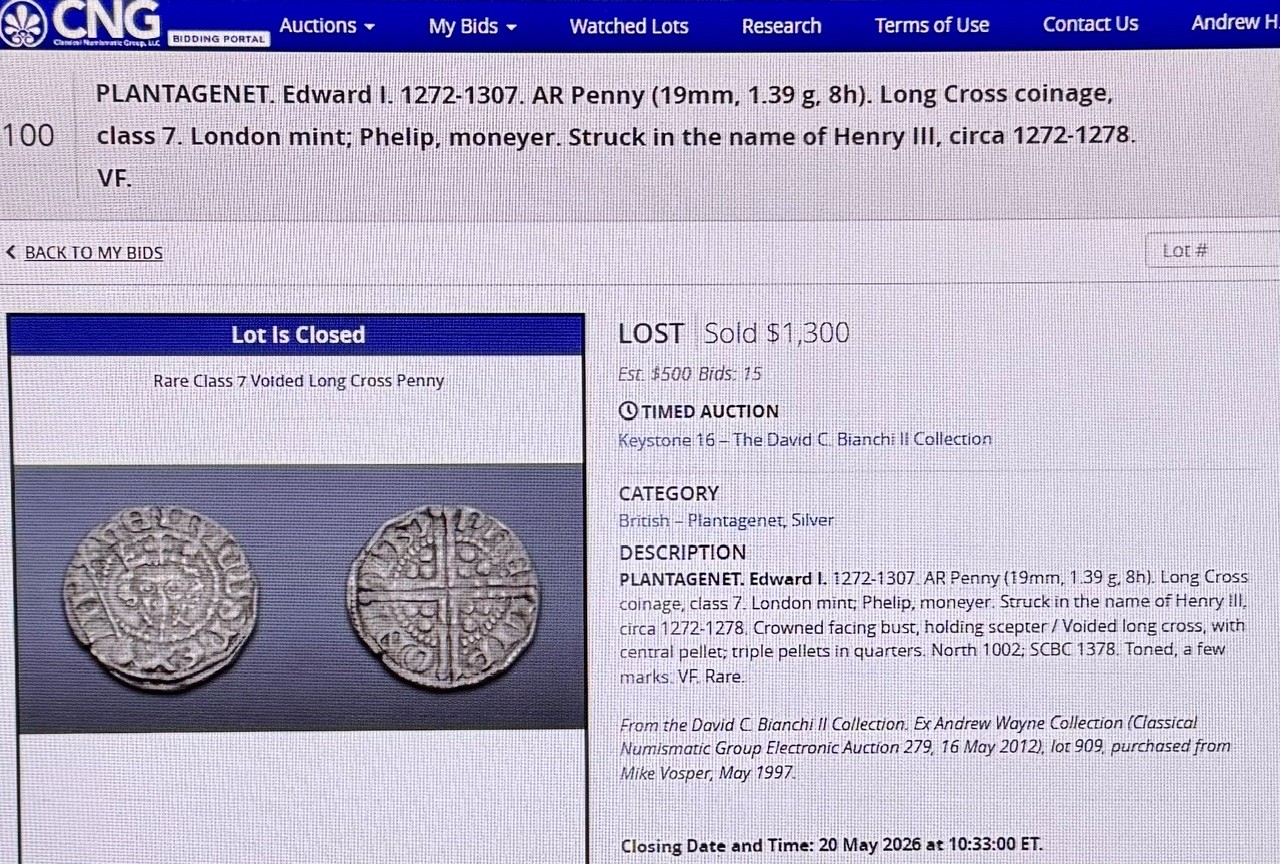
WMH-9214: A++ Edward 1st VOIDED
Long Cross Penny - Posthumous Henry III.
Phase IV coinage struck in Henry's name.
S.R.1378. Struck
between 1272 and 1279 so very much during the reign of Edward 1st. It is strange that Edward 1st, who
was well into his 30’s when he inherited the throne from Henry, had to wait
seven years to see his “New Coinage” enter circulation. There were three posthumous issues, non of which were a patch on the 1279 New Coinage, and were
further limited to three mints only, and realistically only the Bury St Edmond’s mint as London and Durham are rare. I'm delighted to say that this coin is indeed
one of those rare mints - Class 7, Phelip of LONDON.
P[hE]LIP ON
LUND. Note the ligation
of the N of ON and the L of London together with the N and the D of LUND with
the N looking very much like a lombardic "n". Interestingly, the first O of London is a
definite U rather than the ubiquitous V.
Phase IV coinage is synonymous with crude dies (a strange thing
considering the quality dies of Henry III and Edward 1st either side of this
issue) although to be fair, die sinkers had upped their game somewhat by class 7.
Indifferent strikes, almost as if this issue was rushed out, didn't help
the quality of the issue. This coin is a
very solid VF with attractive dark toning and, as the ticket states, is especially
pleasing. The rarity of London as a mint cannot be understated -
this is only the second London example I've had in many
decades. This example recently went
through CNG, selling for around £1,300 after commission, illustrating the
absolute rarity and desirability of the London issue, especially in VF
grade. Old
tickets here. An important coin and, very rarely these
days, one that sets the pulse racing!
£875 RESERVED
(A.B. 27-8-26 Lay-Away)
Provenance:
ex T. Leitch, September 2009,
sold to...
ex The Isladulcie Collection
of Medieval Silver Coins, dispersed by...
ex Spink
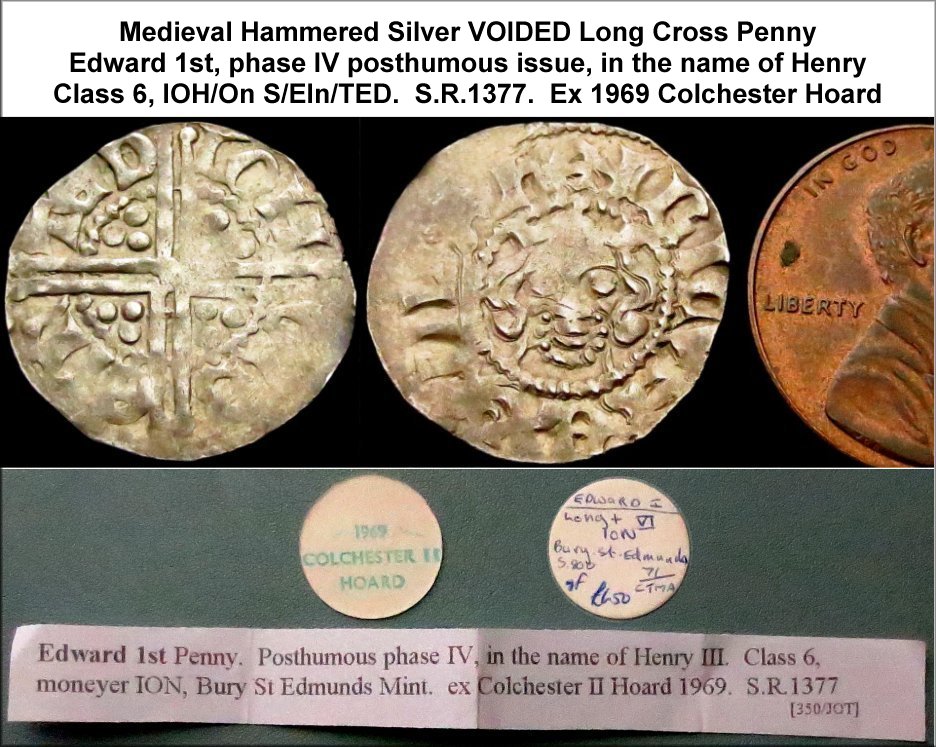
WMH-9405: Edward 1st POSTHUMOUS
Medieval Hammered Silver Voided Long Cross Penny. Phase IV, posthumous issue. Struck under the reign of
Edward 1st, circa 1272-79, but with crude dies bearing the name of Edward's
father, Henry III. Class VI,
c.1274-8. S.R.1377. Obverse: crude bust with large blobbed
eyes, a low crown and long, realistic hair reaching the level of the king's
mouth. Legend reads hENRICVS
REX III with ligations at EN and SR. Reverse: voided long cross with pellets in
quarters, legend reading IOH/On S/EIn/TED with single
ligation at ON - Ion of Bury St Edmonds mint. Class V (and back to class II of Henry III;
class 1 having no mint signature) used S.Edmund as
the mint signature. Class VI, and also
some class V coins, used the mint signature on this coin, although whilst the
inclusion of the letter I is recorded, it is certainly unusual. Before the Colchester Hoard of 1969, there was a grand total of TWO extant examples of Bury St Edmonds class VI coins. Just two. Both moneyer ION, both from a 1916
hoard. There was one other class VI
penny (I've a feeling this may have been a cut half?) also extant at the time:
moneyer Roberd from Durham.
So what of the famous 1908 Brussels' Hoard? Surely that must have contained some
posthumous examples? It did not. The latest coins in that hoard were class 5g. Thus we see how important this 1969
Colchester Hoard was to our understanding of this period and specifically the
entire range, small though it may be, of Edward 1st posthumous coinage. The famous 1980 Coed-y-Wenallt
coin hoard of Empress Matilda coins literally trebled the extant total of coins
overnight, which was such an impressive and monumental event that it is still
talked about in numismatic circles today.
That, numerically at least, is actually fairly insignificant compared to
the impact the Colchester Hoard made in 1969!
The coin itself is a very good example indeed, being much better struck
up than the others I've handled over the years.
The inclusion of the original 1969 Colchester Hoard ticket is about as
good a provenance as you can get with this issue and the reverse dealer
annotation, dated 1971, showing a £6.50 price tag, is reminiscent of the days
at the Cumberland Hotel coin fair (was that really the early 1990's?!) when a
huge hoard of Danegeld Saxon pennies had just been found - there was literally
a heap of loose Saxon hammered pennies on one dealer's table at £80 each to
pick. Just like the posthumous
Colchester Hoard pennies, that pile was soon gone. An impressive coin. £245
Provenance:
ex 1969
Colchester coin hoard
Sold 1971
“New Coinage” in king’s own name: 1279 - 1307
Provincial
Mints
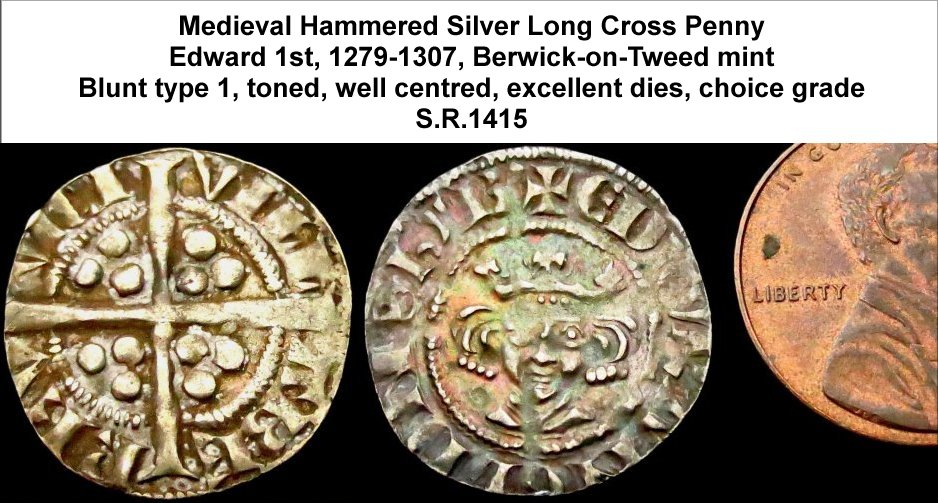
WMH-9287: Edward
1st Medieval Hammered Silver Penny - a CHOICE Example. Blunt type 1, +EDW R ANGL DNS hYB, reverse VILL ABE REV VICI - Berwick mint. S.R.1415. William I of Scotland invaded and attempted to capture
northern England in 1173–74. After his defeat in
1174, Berwick was ceded to Henry II of England under the Treaty of Falaise. That Treaty
was annulled in 1189 and Scotland again took possession when William
paid Richard I of England 10,000 marks sterling to
contribute towards the latter's crusade. In 1291–92, Berwick was the site of Edward I
of England's arbitration in the contest for
the Scottish crown between John Balliol and Robert Bruce, 5th Lord of
Annandale. The decision in favour of
Balliol was pronounced in the Great Hall of Berwick Castle on 17
November 1292.
In 1296, England went to war with France, with which Scotland was in alliance. Balliol invaded England in response, sacking Cumberland. Edward, in turn, invaded Scotland and once again captured Berwick,
destroying much of the town and massacring the burgesses, merchants and
artisans of the town. Edward 1st coinage, provincial mints included, were struck from London dies, except for the
Berwick-on-Tweed coinage, all of which were from local, crude dies. This coin, toned and very well centred, is of
excellent die quality (all the more remarkable considering the crude, local
nature of Berwick dies) and exceptional grade.
You'll not find better so do not miss out on this one. £375
Provenance:
ex Tim
Owen
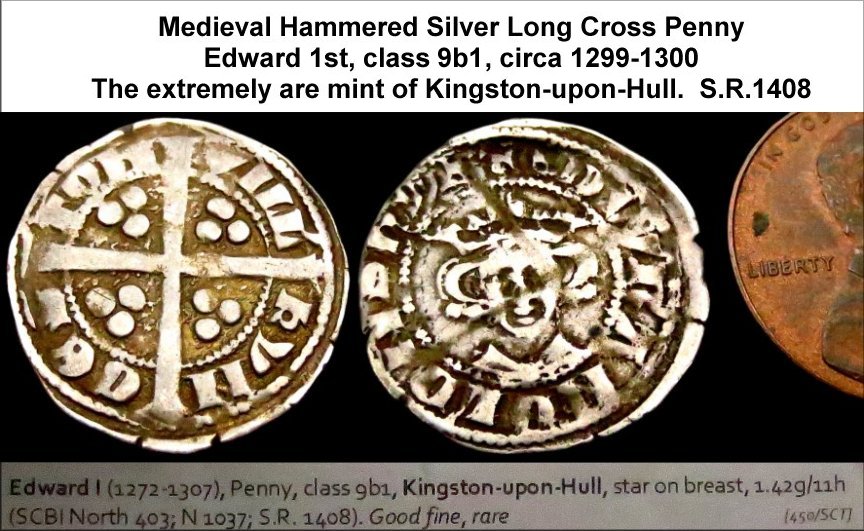
WMH-9223:
Extremely Rare
Mint Edward 1st Medieval Hammered Silver Penny. Star on breast - class 9b, circa 1299-1300. VILL KYN GES TON - the very
rare Kingston upon Hull
mint. There were three reverse
dies: VILL, VILL' and VIL' so this would be the first die, class 9b1. Chester, Kingston-upon-Hull and Exeter are the rarest of all the Edward
1st provincial mints (Kingston-upon-Hull and Exeter also being the only Edward 1st
pennies issued over a single class). Out
of the 12,236 pennies found in the Aberdeen Hoard of 1886, over 12,000 were
English with only 2 being from the Chester mint (both class IIIg),
a single coin from Kingston (IXb) and only two
from Exeter (IXb).
To give some context, Bristol is far from common and yet there
were x52 Bristol mint coins in the hoard; London mint from that hoard was well over
5,000 coins. The few coins you do see
from these three rare mints are nearly always worn. This is a particularly nice example. An extremely rare coin. £385
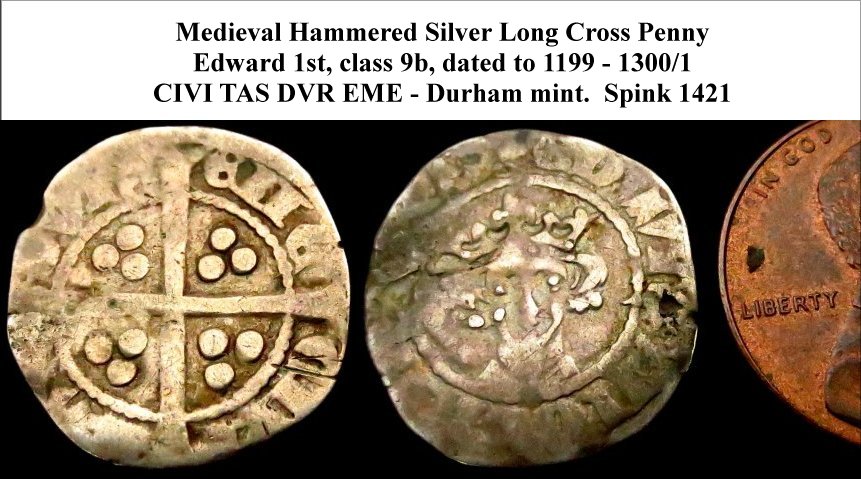
WMH-7780:
Edward 1st Long
Cross Hammered Silver PROVINCIAL Mint Medieval Penny. Class 9b, CIVI TAS DVR EME
– Durham mint.
S.R. 1420.
The coin looks better in the hand.
£65
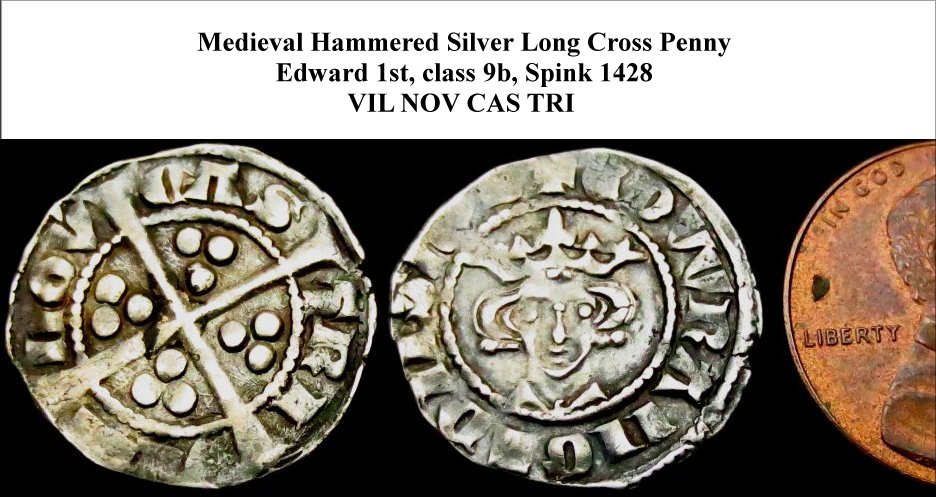
WMH-7749:
Edward 1st
Medieval Hammered Silver Long Cross Penny.
Class 9b, rare Newcastle mint – VIL NOV
CAS TRI. S.R. 1428. Very nice grade for this rarer provincial mint. £175
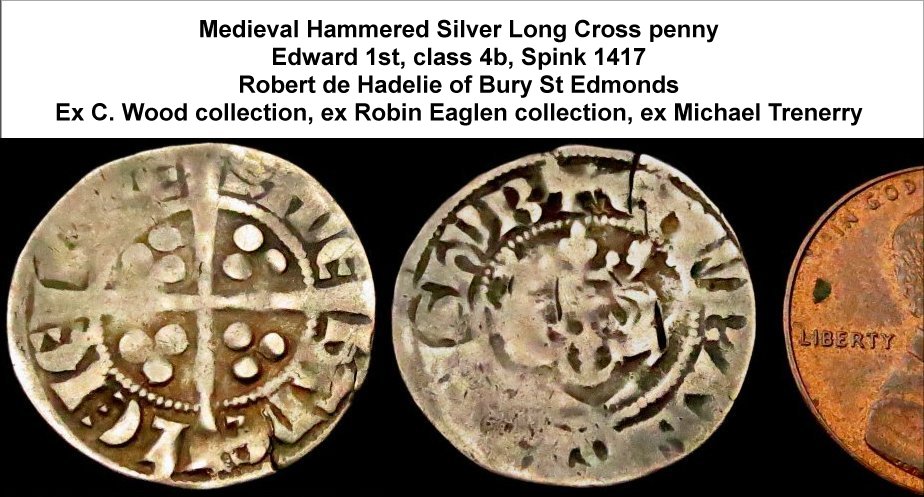
WMH-7887:
Edward 1st Medieval
Rarer Hammered Silver ROBERT de HADELIE Penny. Class 4b, Bury St Edmonds mint, S.R. 1417.
This coin is remarkable as it has the name of the moneyer Robert de
Hadelie (ROBE/RTDE/hADE/LEIE) solely on the
reverse and not the usual mint location. At the recoinage of 1279, a writ ordering dies
to be prepared for John de Northwold, Abbot of Bury
St Edmunds, was issued on 8 November
1279 and
Robert de Hadeleie was sworn in as the abbot's
moneyer around Christmas of that year. An interesting
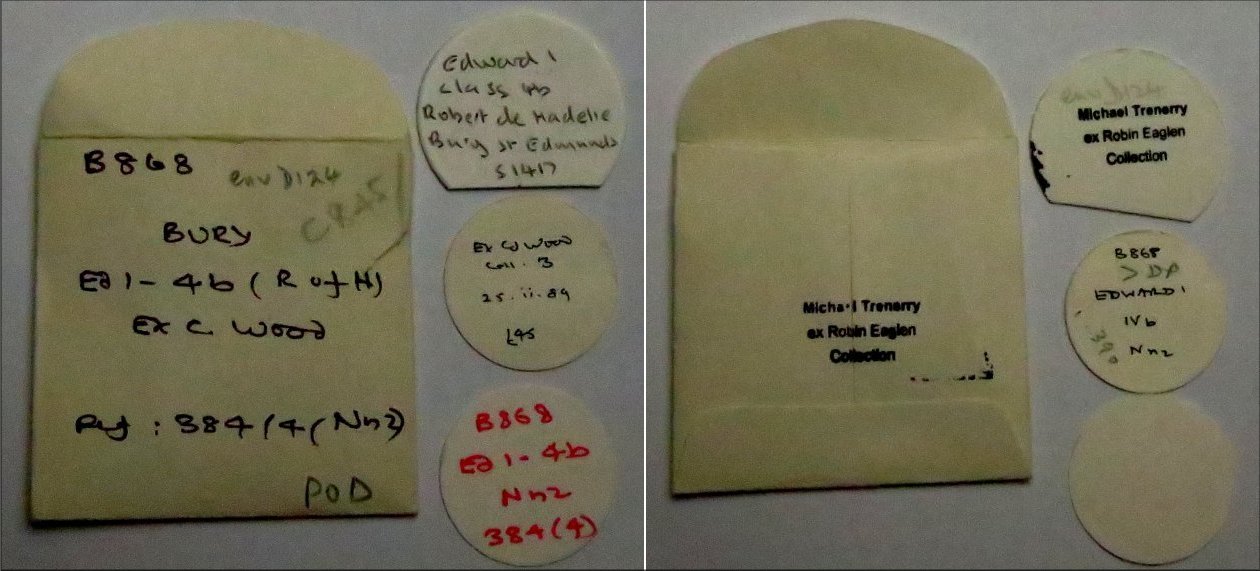
provenance, being ex C.Wood collection, ex Robin Eaglen collection and ex Michael Trenerry. £165
WMH-8091: Edward 1st Medieval Rarer Hammered
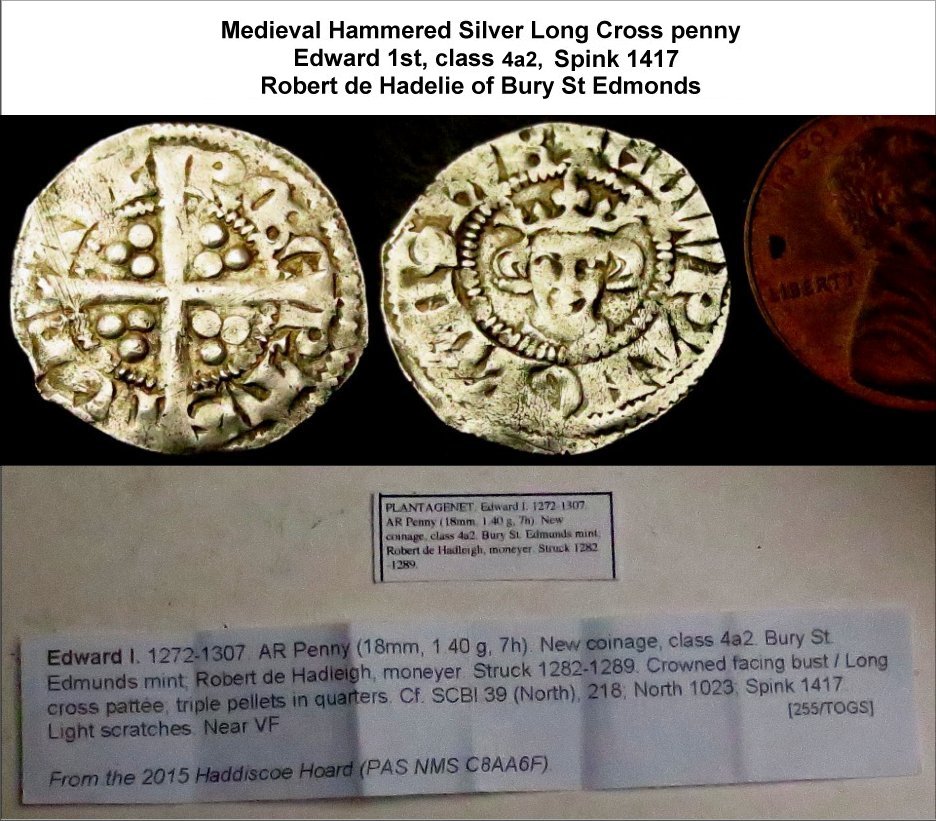
Silver ROBERT de HADELIE Penny. Class 4a2, Bury St Edmonds mint, S.R. 1417.
This coin is remarkable as it has the name of the moneyer Robert de
Hadelie (ROBE/RTDE/hADE/LEIE) solely on the
reverse and not the usual mint location. At the recoinage of 1279, a writ ordering dies
to be prepared for John de Northwold, Abbot of Bury
St Edmunds, was issued on 8 November
1279 and
Robert de Hadeleie was sworn in as the abbot's
moneyer around Christmas of that year. An interesting provenance, being ex Haddiscoe
Hoard, 2015. About VF and
remarkable thus as this issue nearly always turns up with problems. £245
Round Farthings
WMH-9266: Choice Edward 1st Medieval
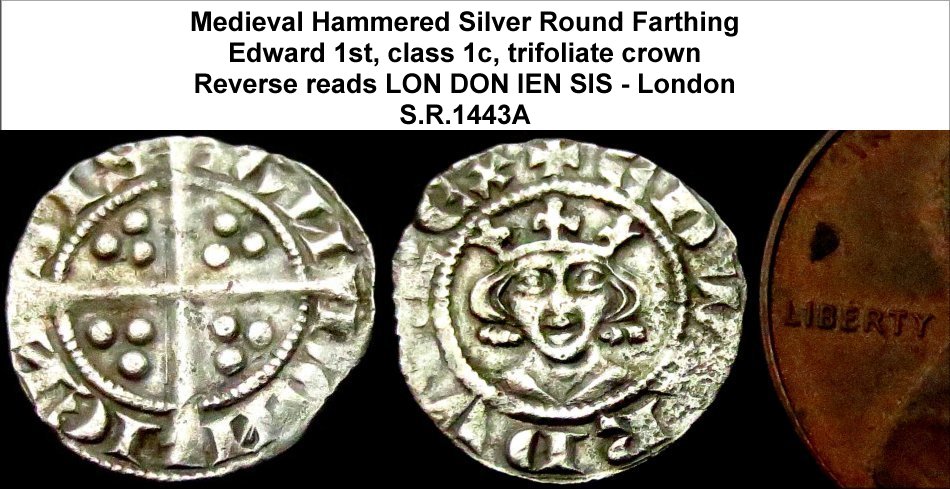
Hammered Silver FARTHING. Struck under the New Coinage from 1279. London mint
(LONDONIENSIS). Class
1c (S.R.1443A), or the more comprehensive Galata Type
4. Two obverse dies, this coin
being #2 with a colon stop, and x3 reverse dies, this coin being #C with all
N's reversed. 2C is one of x4 die
combinations known for this type. Was this the first time that a
round farthing was introduced into English coinage? It was not.
Henry III issued both a halfpenny and a farthing in the earlier short
cross series, both incredibly rare, but that issue wasn't the first time a
halfpenny was introduced into circulation - that was under Henry 1st, BMC 15 (I
have one for sale in the Norman section).
An uncommon coin but in this spectacular grade - far
surpassing the S.R. plate coin - extremely rare indeed. Please note that this is a tiny coin which
has been magnified far beyond what the eye can see so you will observe all the imperfections
that you wouldn't necessarily see on standard sized listings. Collectors and dealers alike will be all too
aware of how hard it is to obtain a very nice Edward penny these days - even
though the pennies are abundant in lower grades, finding a good one is
bizarrely challenging and will invariably cost you well into three
figures. Well, just imagine how hard it
is to get a farthing in this grade! One
word: Choice. £375
Edward II (AD 1307-27) Read
about Edward II
Pennies
WMH-9222:
Edward II
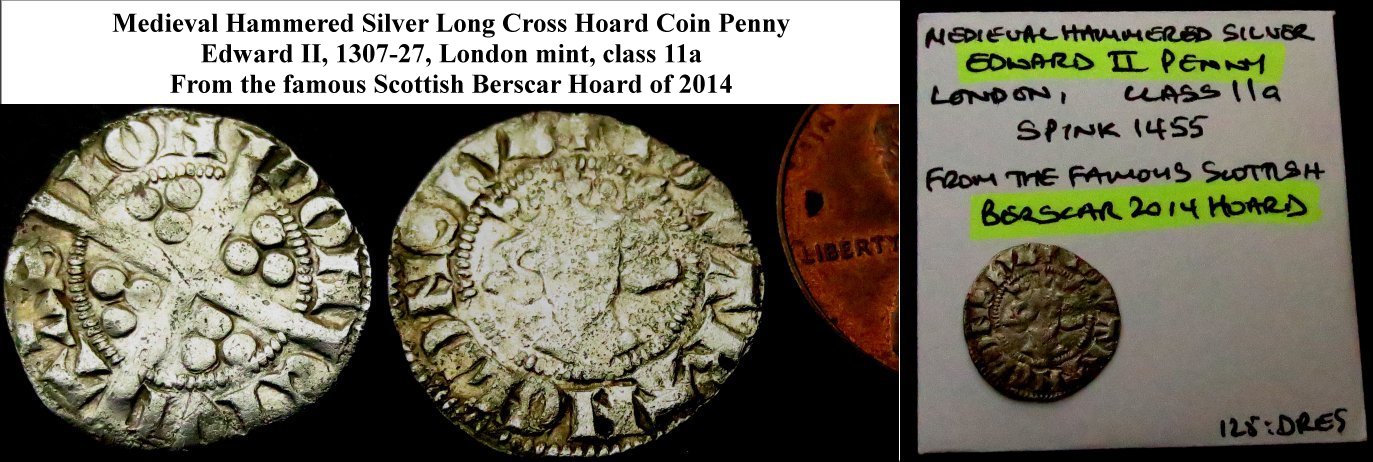
Medieval Hammered Silver Penny. Class 11a (circa 1310-14), London mint.
S.R. 1455.
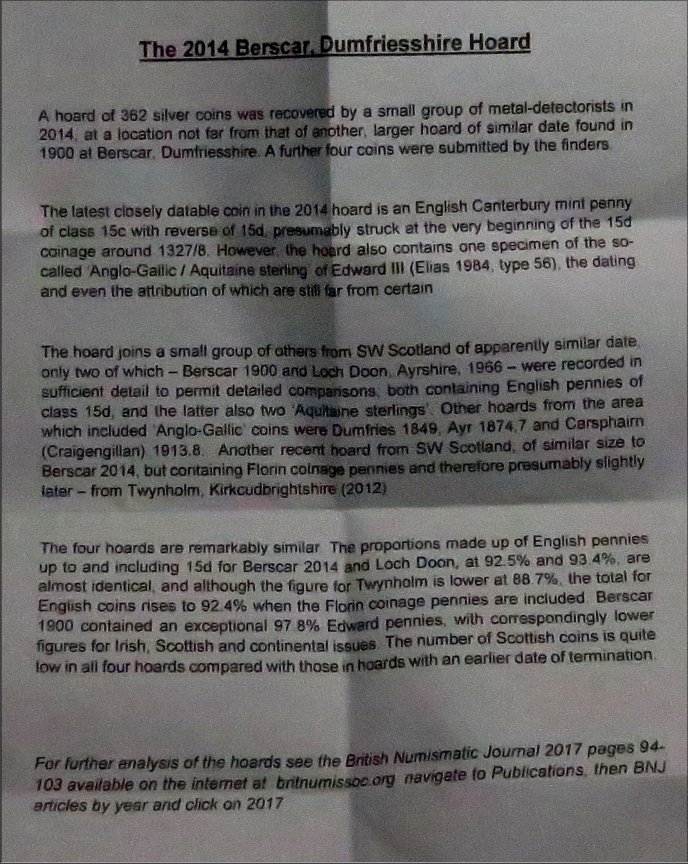
Part of the famous Scottish Berscar
Hoard of 2014. Edward II
coins are much rarer than those from the reign of Edward 1st. Excellent provenance. £145
WMH-9319: Rarer
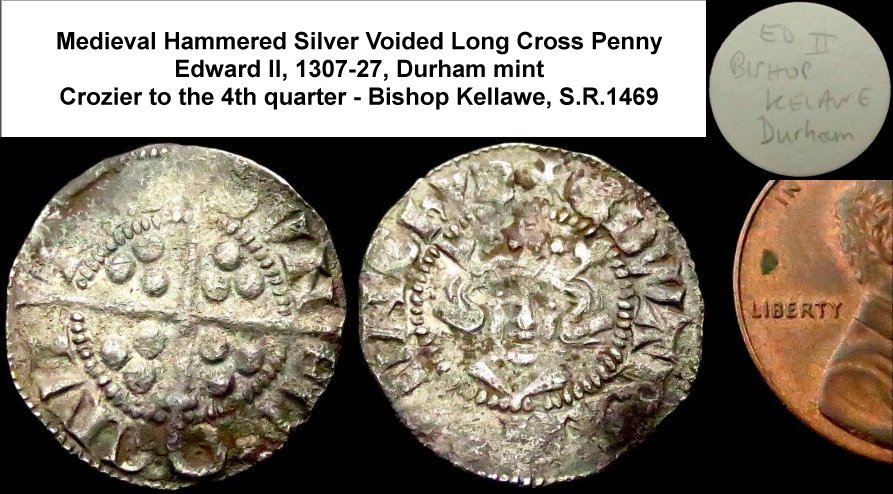
Edward II (2nd) Medieval Hammered Silver Penny. Voided long cross, Durham Episcopal mint signature. Crozier after the
mint signature - struck under Bishop Kellawe. S.R.1369. An outstanding coin in terms of
detail, being one of the very best I've ever handled. This was part of a small hoard or purse-loss
where the coin was in contact with water for much of its 700+ years sabbatical in the ground.
I think you'll be hard pressed to find a better example for sale on the
open market. £235
WMH-9320: Rarer
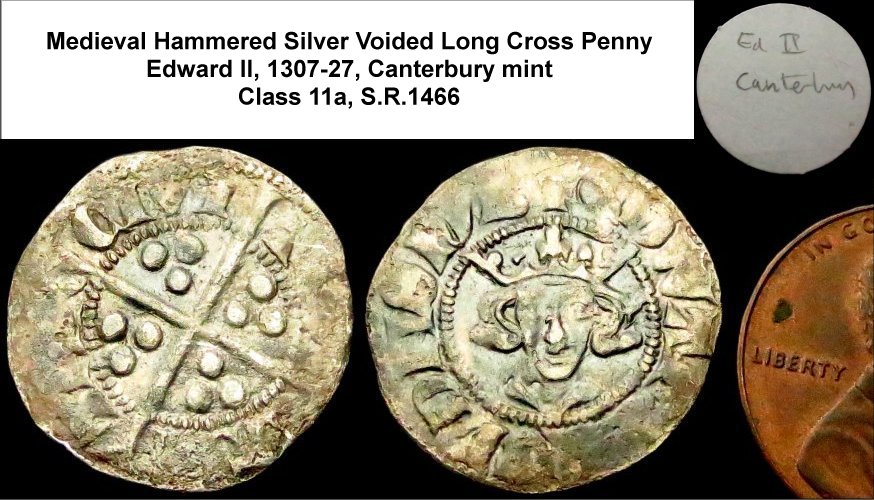
Edward II (2nd) Medieval Hammered Silver Penny. Voided long cross, Canterbury mint signature. S.R.1366. An outstanding coin in terms of
portrait. This was part of a small hoard
or purse-loss where the coin was in contact with water for much of its 700+
years sabbatical in the ground. For an Edward II portrait, you'll be hard
pressed to find a better example for sale on the open market. £145
Other
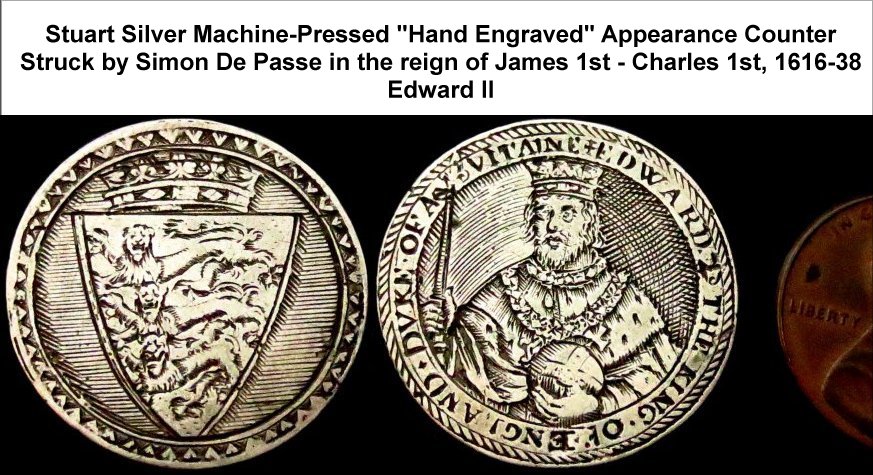
WJC-9339: (7) Edward II : 1616-38
Silver Simon de Passe Token. Machine-pressed silver tokens or counters
depicting the monarchs of England, issued in sets (thought to be thirty six),
composed either of pieces of different monarchs or repetitions of the same
type. Thought to be
primarily used as markers or counters "for reckoning and for play". The dies were very cleverly sunk to give the
impression of a hand-engraved silver token.
Some of these counters were executed early in the 1616-38 period by
Nicholas Hilliard, jeweller; goldsmith and engraver to Elizabeth 1st and
afterwards to James 1st. In 1617,
Hilliard received a patent granting him the monopoly for twelve years of all
the engraved portraits of the King and the Royal Family. He subsequently sold licences to other
engravers to execute these counters, one of which was to Simon de Passe and his brother, both of whom excelled in the art of
engraving. This sub-licence to the de Passe brothers was issued late in the reign of James
1st. Collectively, these tokens are all
termed De Passe tokens for convenience. £225
Provenance:
From a collection put together over a
great many years; dispersed by Spink.
Edward III (AD 1327-77) Read
about Edward III.
Hammered Gold
WAu-7812:
Edward III
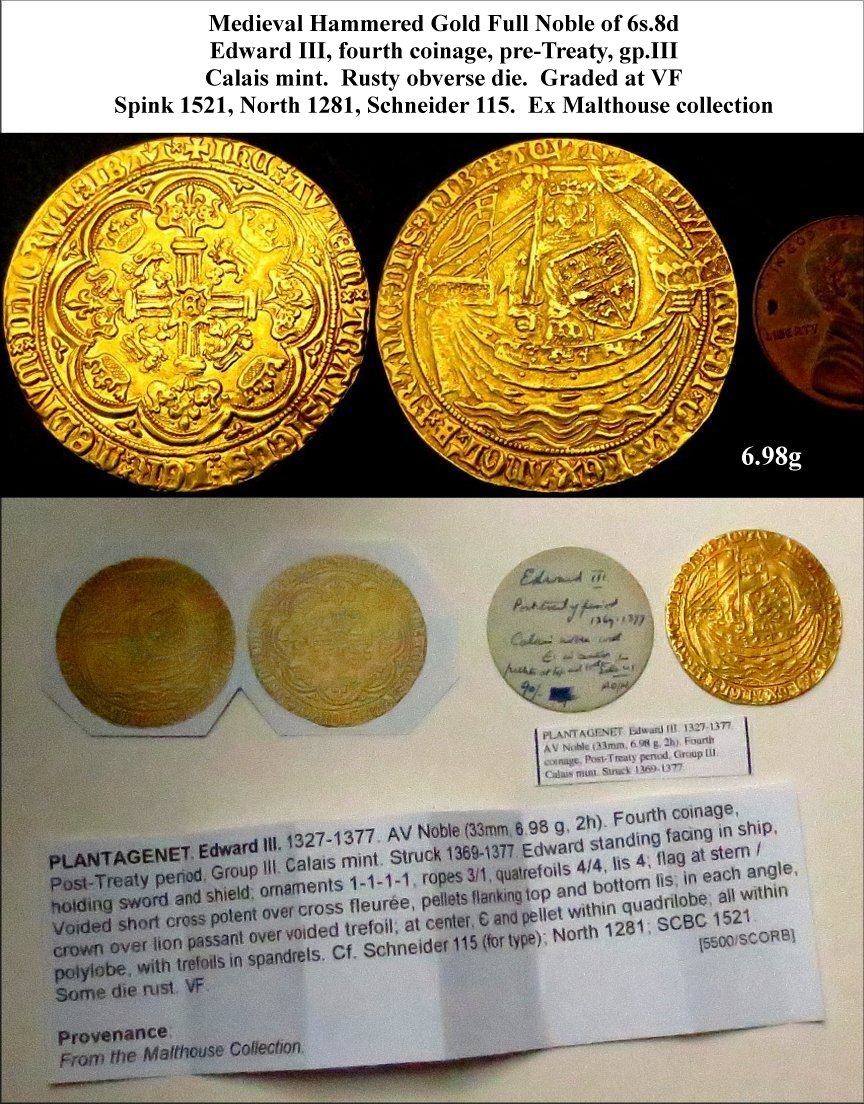
Medieval Hammered Gold Full Noble.
Fourth coinage, post-treaty period of 1369-77, group III. S.R. 1521, North 1281, Schneider 115. Calais mint.
The town of Calais in what is now Northern France was under English rule
from 1347 until 7 January 1558, being a bit of a
vanity statement for the English monarchs in their claim on the French crown.
It cost almost 1/5th of all the revenue collected in England to maintain Calais as an English
possession. The mint was opened in 1363 as a
direct result of the treaty between France and England and meant the mintage of coinage
for England could be outsourced to Calais to aid in the newly formed
cross-channel trading routes. The
relationship between the two countries has perhaps always been a tad strained -
the mint closed in 1440 after really only producing
limited coinage under Edward III, a tiny amount of gold under Richard II and
Henry IV, a miniscule quantity of farthings under Henry V and some of the
earlier coinage of Henry VI. Rusty
obverse dies – perhaps a result of French sea air?! Ex Malthouse
collection; also accompanied by a much earlier, unidentified ticket. £5,450
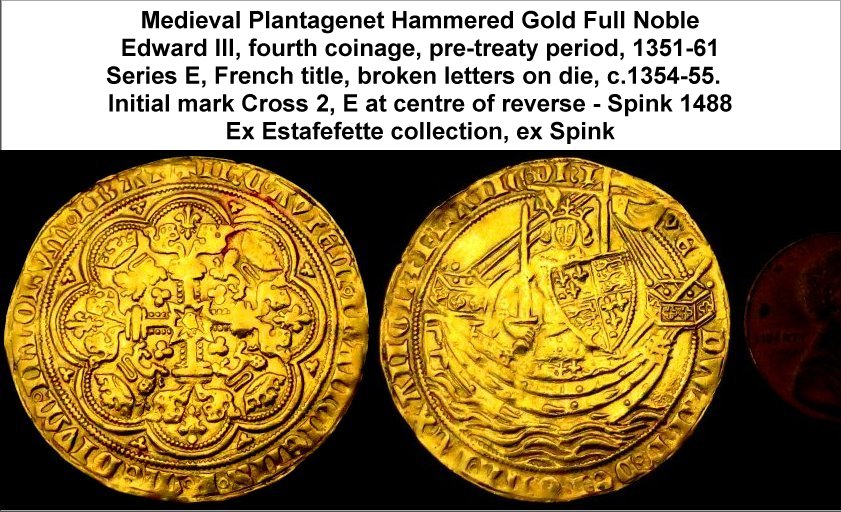
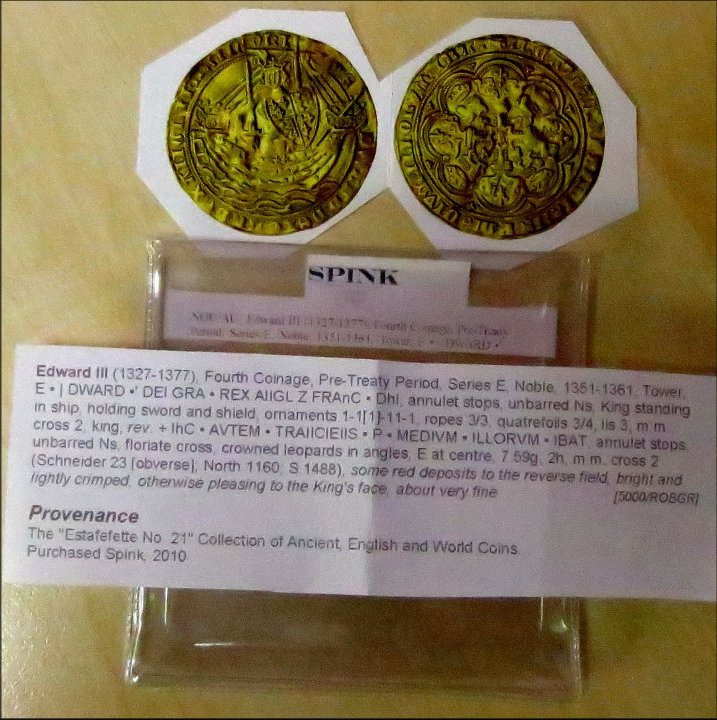
WAu-9021: Edward III Medieval
Hammered Gold Full Noble. Fourth coinage, pre-treaty period, 1351-61. Series E with impaired
letters on the dies so c.1354-55.
Initial mark Cross 2, E at centre of reverse, S.R. 1488, Schneider 23 (the obverse), North
1160. Note the red deposits at 1 o'clock on the reverse.
This is usually the remains of inert red wax where the coin has been
prepared to be copied into a very early iteration of the BMC. With much patience, this coin should be able
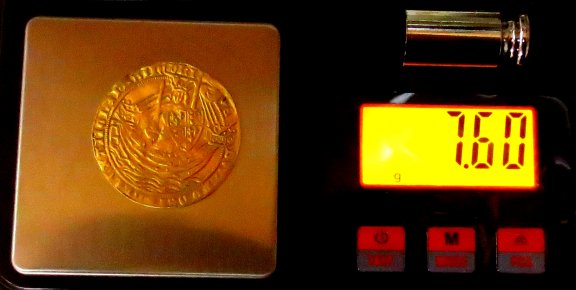
to be located with perhaps a more in-depth provenance. See here for old tickets
and here for
weight. About VF thus
scarce. £4,995
Provenance
Ex Spink (2010), sold to
Ex Estafefette
collection
Hammered Silver
Groats
WMH-7529:
Edward III
Hammered Silver Medieval Groat.
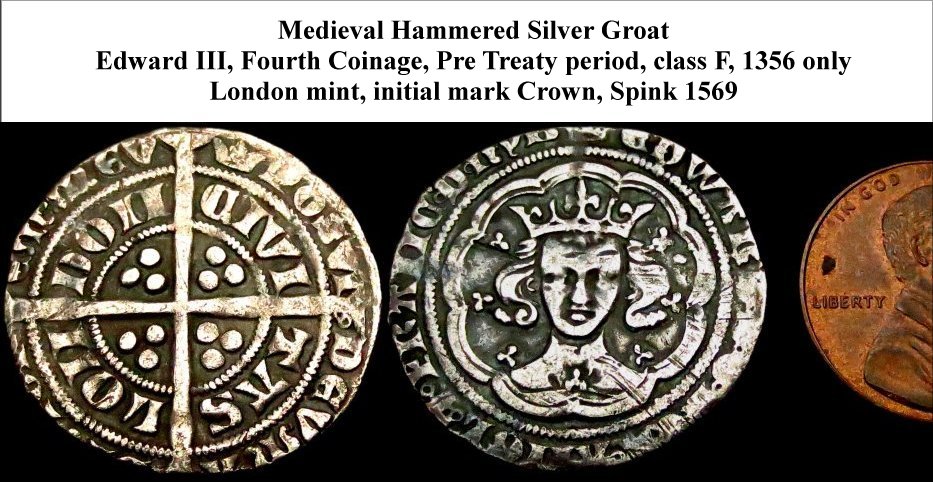
Fourth coinage, pre-treaty period, class F, S.R. 1569. London mint, initial
mark Crown which dates this to 1356 only. A really nice example of this key coin. £325
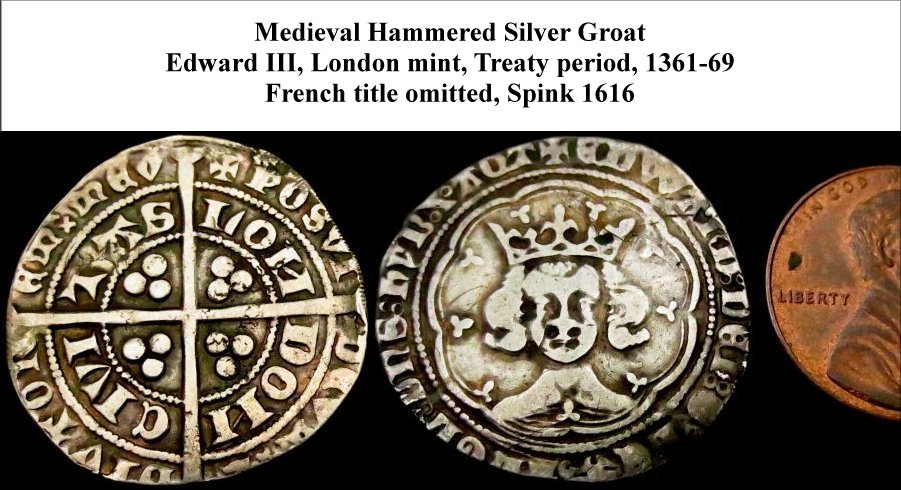
WMH-7588:
Edward III
Medieval Hammered Silver Groat.
Treaty period of 1361-69 with the French title omitted. London mint, initial
mark Cross-Potent. S.R. 1616. Very nice grade coin. £345
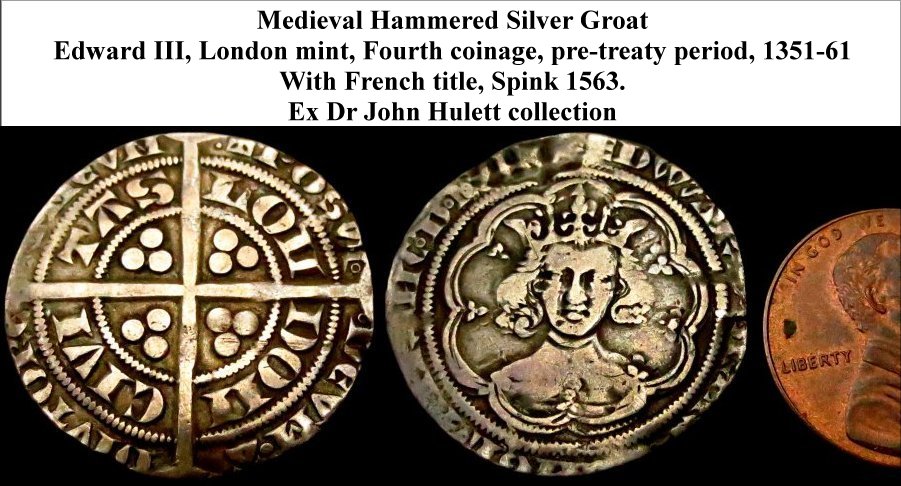
WMH-7589:
Edward III
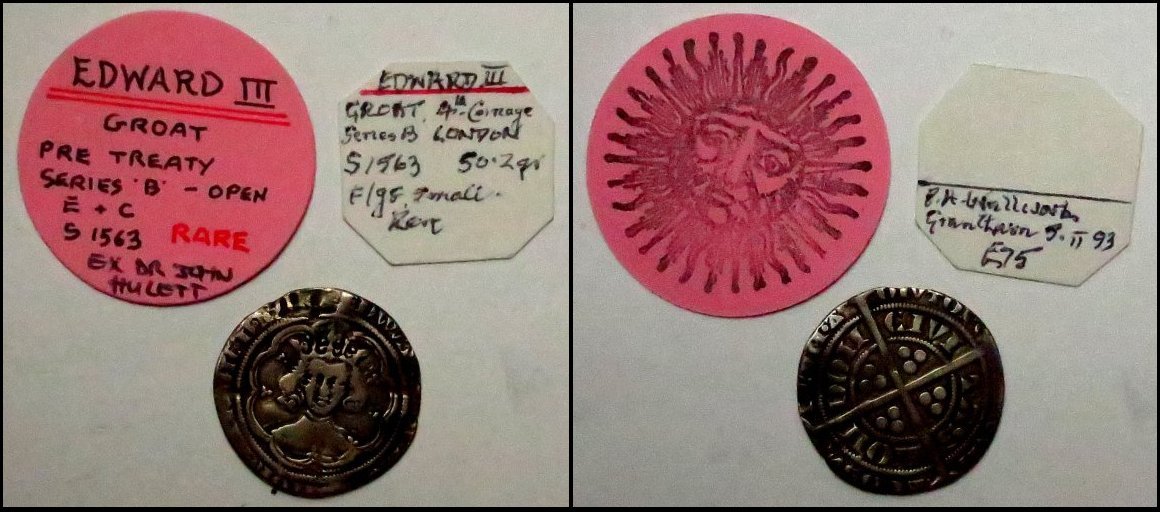
Medieval Hammered Silver Groat. Pre-treaty period of 1351-61 with the French title. London mint, initial
mark Cross 1, series B. S.R. 1563. Very nice grade coin and benefiting from
being the very first Edward III groat issued after the less than successful
Edward 1st issue a few decades earlier. Ex Dr
John Hulett collection (his ticket); purchased from someone from Grantham (typical doctor’s writing!)
in November 1993 for £75. A very nice coin.
£465
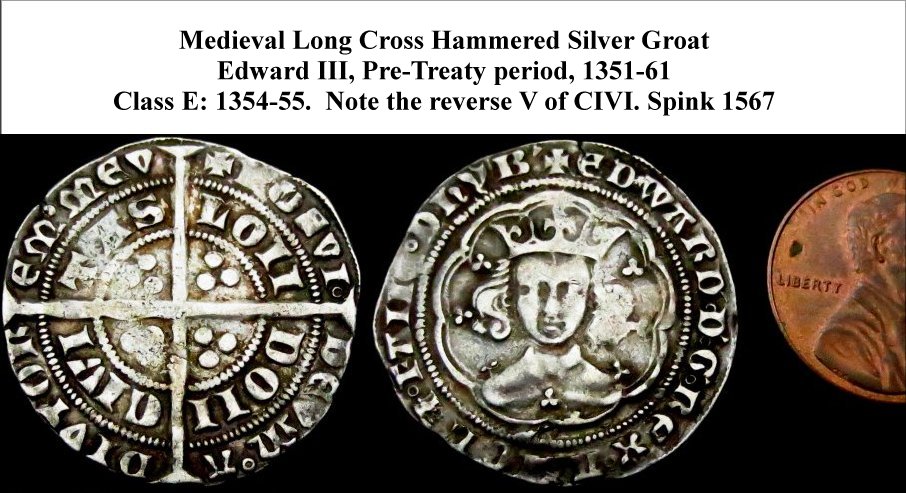
WMH-7766:
Edward III
Medieval Hammered Silver Groat. Pre-Treaty period of 1351-61. London mint, initial
mark Cross 2. Class E with the all important nick in the
reverse V extremely apparent; 1354-55. S.R. 1567. A lovely coin. £395
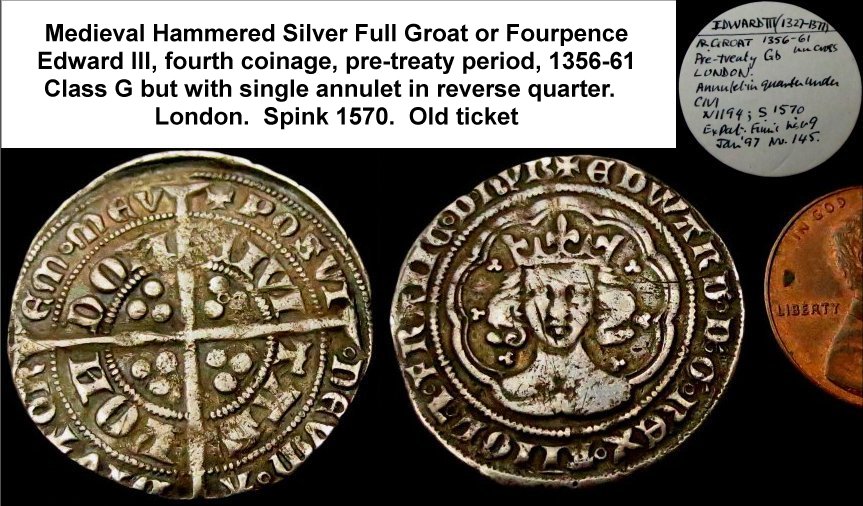
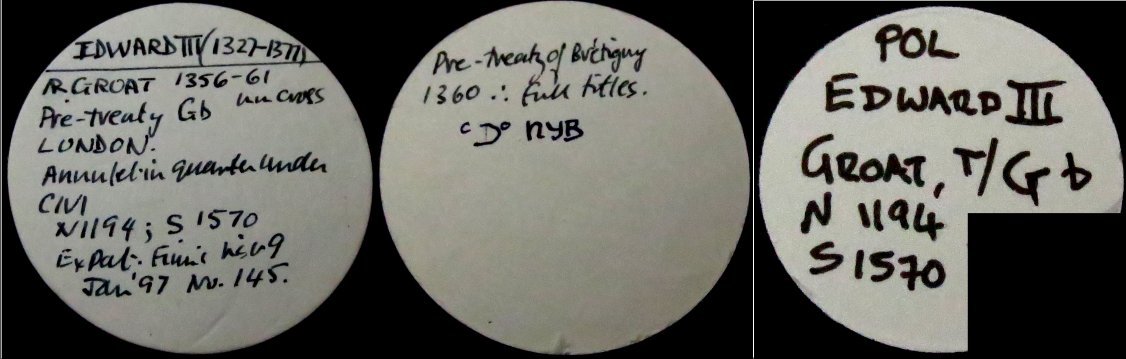
WMH-8092: Edward III Medieval Hammered
Silver Groat. Fourth coinage, pre
Treaty period, class Gb,
1356-61. Initial mark
Cross 3. London mint, single annulet in one
reverse quarter with annulet stops throughout the obverse and reverse legends -
S.R. 1570. Ex Patrick
Finn, January 1997. Sold with a couple
of old tickets. A very nice coin.
£325
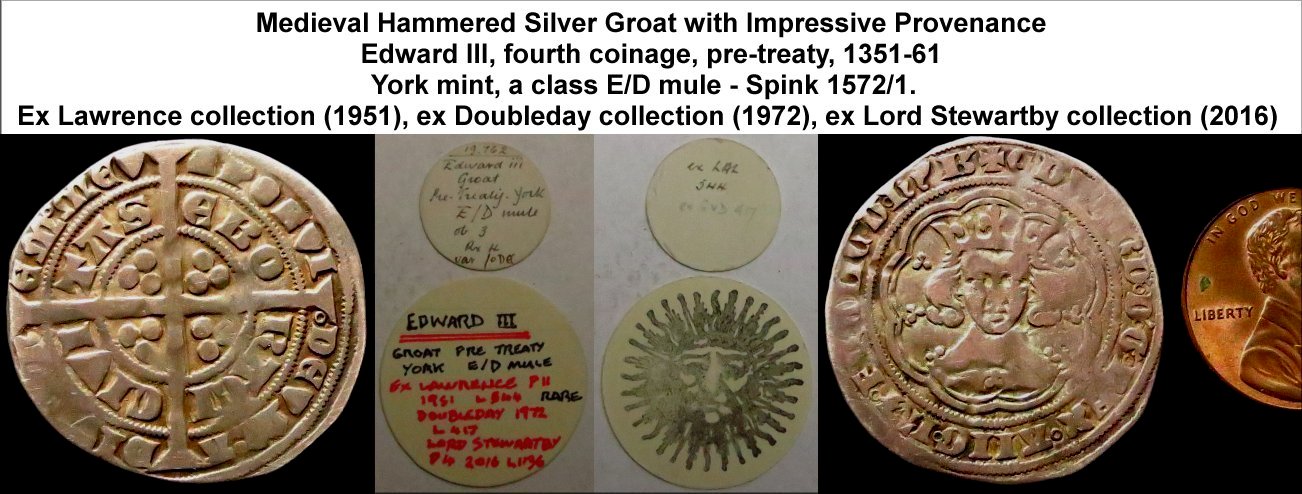
WMH-8148:
Edward III Medieval
Hammered Silver Groat with Impressive Provenance. Fourth coinage, pre-treaty
period, 1351-61. French titles,
rarer York mint, a class E / D mule. S.R. 1572/1. Very rare in this grade for this mint and with such impressive
provenance. £495
Provenance:
ex Lawrence
collection (1951)
ex Doubleday collection (1972)
ex Lord Stewartby (dispersed
2019)
purchased by Tim Owen (his ticket)
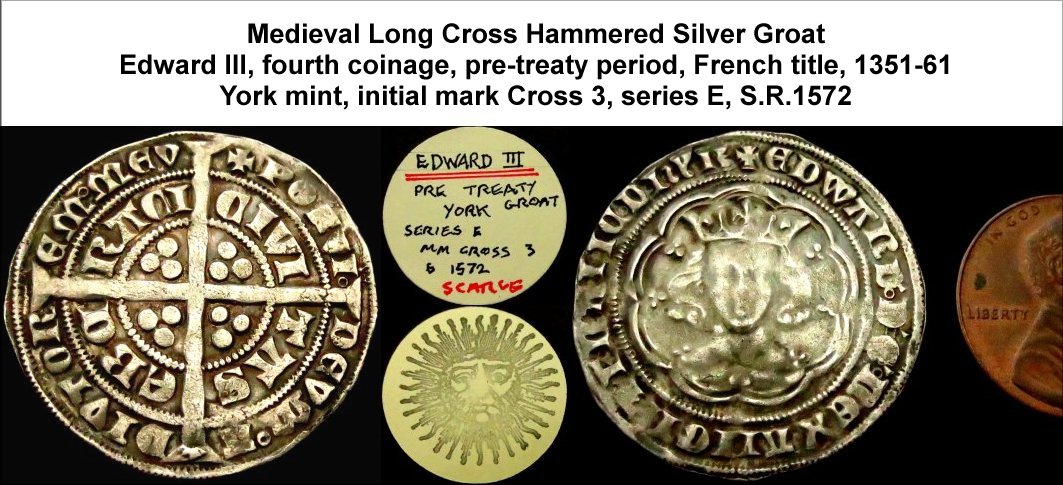
WMH-9342: Edward
III Medieval Hammered Silver Groat. Fourth coinage,
pre-treaty period, series E, French title. Initial mark Cross 3, c.1356-61. The more desirable York mint.
S.R.1572. Along
with series F (initial mark Crown, c.1356 only), these two issues stick out as
being distinctive. Series E is well
known for its use of "broken letters" (a result of worn out die
punches), typically the reverse V of CIVI having a small "nick" out
of the right diagonal. This coin is
really interesting in that the nick out of the letter V hasn't yet happened,
indicating an early strike within series E.
What we do have is the start of that die punch letter breaking,
manifesting itself in the form of a tiny circular crack. Later issue coins will show the crack was
enough to remove that very small portion of the right diagonal to give us the
now famous nicked letter V. A remarkably
full flan coin, well centred both sides with clear
legends. The grade is actually high -
the dies were too shallow for the face, something that got worse over time and
is perhaps best illustrated by the Richard II silver coinage where pence is
atrocious and the groats are never sharp.
It wasn't really until Henry VI that the die sinkers got their act
together and allowed moneyers to strike coins with sharp busts. A very interesting and
appealing coin. £465
Provenance:
ex Tim Owen - his early ticket
Halfgroats
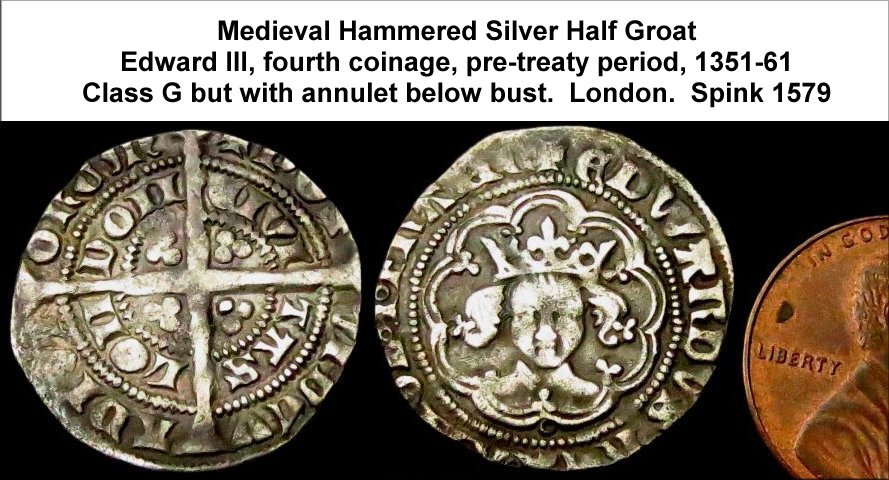
WMH-8093: Edward III Medieval Hammered
Silver Halfgroat. Fourth coinage,
pre Treaty period, class G, 1356-61. Initial mark Cross 3.
London mint, single annulet below the
bust with only two annulet stops on the obverse legends - S.R. 1579. A very nice coin. £225
Other
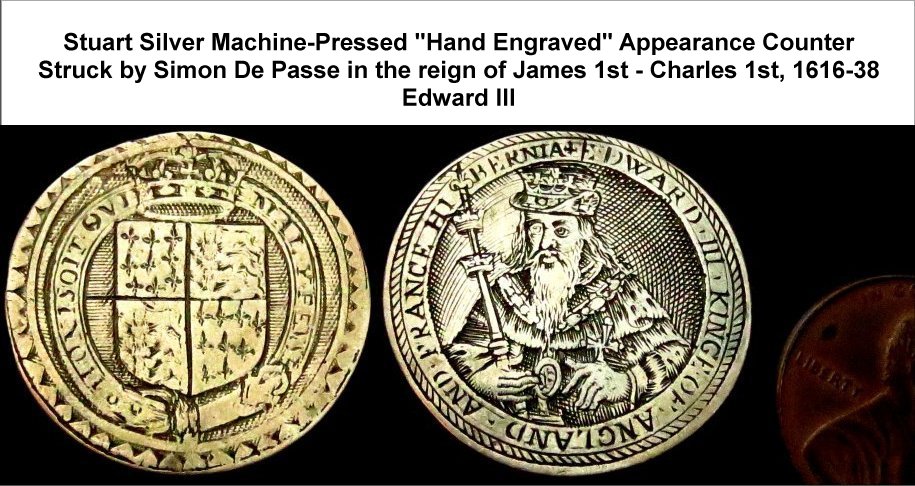
WJC-9340: (8) Edward III : 1616-38
Silver Simon de Passe Token. Machine-pressed silver tokens or counters
depicting the monarchs of England, issued in sets (thought to be thirty six),
composed either of pieces of different monarchs or repetitions of the same
type. Thought to be
primarily used as markers or counters "for reckoning and for play". The dies were very cleverly sunk to give the
impression of a hand-engraved silver token.
Some of these counters were executed early in the 1616-38 period by
Nicholas Hilliard, jeweller; goldsmith and engraver to Elizabeth 1st and
afterwards to James 1st. In 1617,
Hilliard received a patent granting him the monopoly for twelve years of all
the engraved portraits of the King and the Royal Family. He subsequently sold licences to other
engravers to execute these counters, one of which was to Simon de Passe and his brother, both of whom excelled in the art of
engraving. This sub-licence to the de Passe brothers was issued late in the reign of James
1st. Collectively, these tokens are all
termed De Passe tokens for convenience. £225
Provenance:
From a collection put together over a
great many years; dispersed by Spink.