George II (1727-60) Read about George II
Halfcrowns
WG-6982:
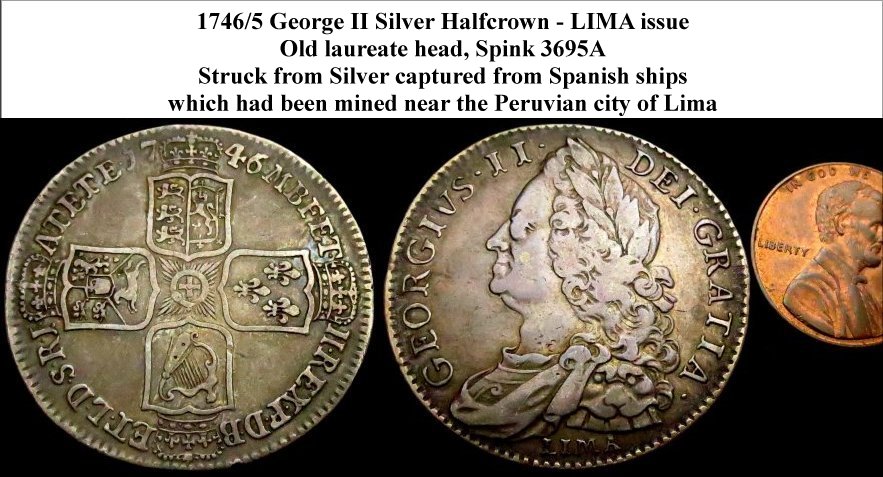
1746 over 5 George II
Silver “LIMA” Halfcrown. Old head, nicely toned and nice grade. S.R.3695A. LIMA below the king’s bust
- this is a reference to silver captured from Spanish ships, which had been
mined near the Peruvian city of Lima, then a part of the
Spanish Empire. Most of this silver was
captured in a single action by a ship commanded by Commodore George Anson
RN. Upon receiving this bounty, it was
decided by the British government that the silver would be sent to the Royal
Mint to be coined. There was so much of
it that it took scores of wagons to transport it all to the Tower. Huge crowds gathered in awe at the spectacle
of the captured loot making its way through the streets of London. £225
Maundy Silver
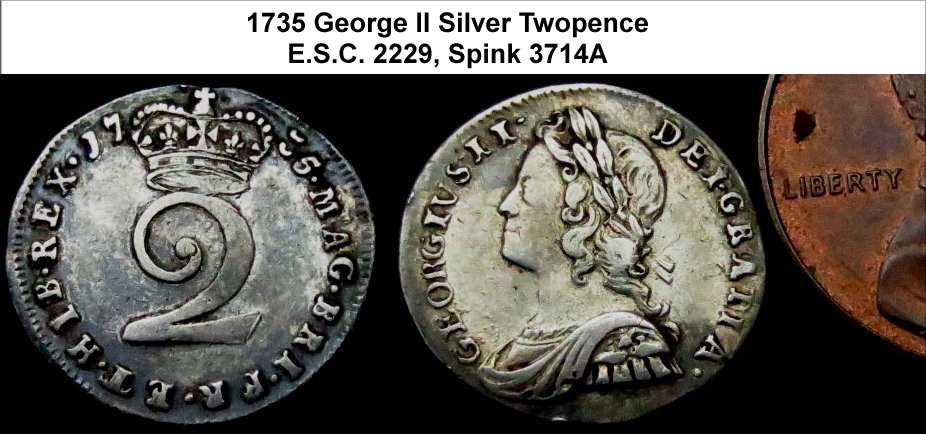
WG-6023: 1735 George II Silver Twopence. ESC 2229. £59
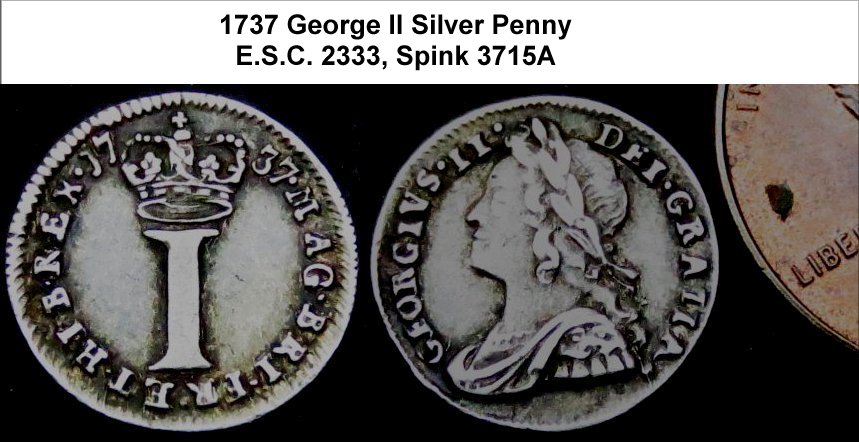
WG-6024: 1737 George II Silver
Penny. ESC 2333. £59
Silver Proofs
WG-9243:
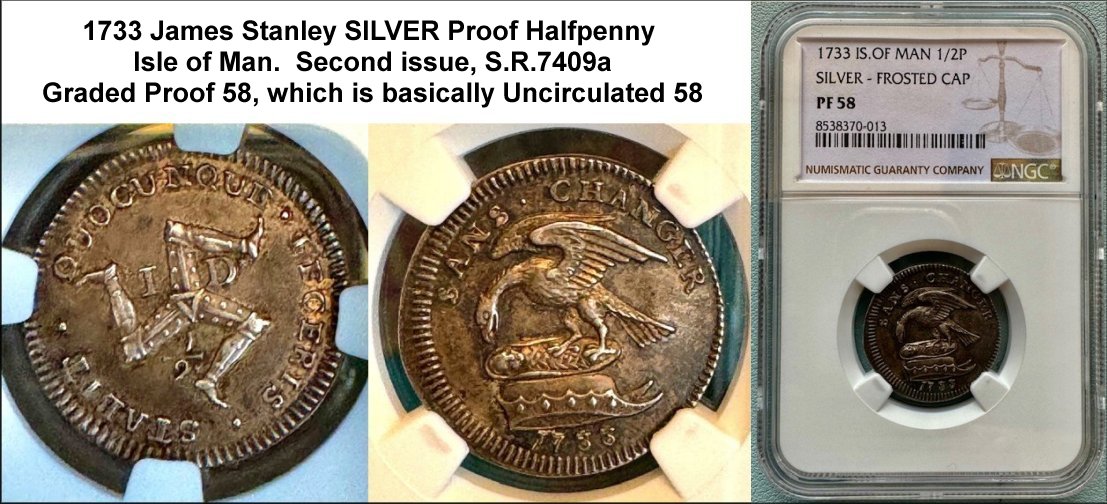
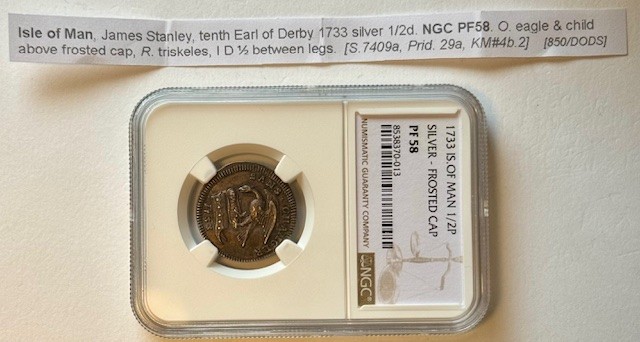
1733 James
Stanley SILVER PROOF Halfpenny - Isle of Man. Second issue, S.R.7409. This issue was die-struck as opposed to the
1709 first issue which was cast. James
Stanley was the 10th Earl of Derby (that city being absolutely nowhere near the
Isle of Man!), the Stanley family having been granted the
sovereign rights of Man way back in 1409.
The Earls of Derby held the island first as Kings and subsequently as
Lords. Through the vagaries of British
inheritance law, the island was inherited by James Murrey,
second Duke of Atholl in 1736 who then sold it on to
the British crown in 1765 for the sum of £70,000 - over £13,000,000 in today's
money. Situated in the Irish Sea, Man was once an independent
Viking kingdom. Not many Vikings left
now but plenty of motorbikes in late may, early June of each year. Official mintage figures are extant showing
us that only £300 in pennies and £200 in halfpennies were struck. Of those £200 in
halfpennies, only a handful would have been the silver proofs, ie specially
made coins, struck in precious metal with great care and attention, showing how
good the subsequent copper coinage was going to be from the dies. The Irish
1722-4 copper issue was struck by William Wood, who is fairly well known in
numismatic circles having given his name to the issue - the Wood's Irish
issue. Wood's successors were Amos
Topping and Samuel Dyall, working out of Castle Rushen. It was those
successors that were responsible for this 1733 IOM second issue. These silver proofs have always been extremely
popular. I've left this coin in
the NGC holder (I usually remove them - an easy process although once
removed, they ain't going back in! - as UK collectors tend to not favour slabbed
coins) because it adds reassurance to buyers.
Being such an important coin, the issue has been copied, specifically in
the 1960's by a jeweller in Lancashire. NGC would be
completely aware of this and would not for one second have
accepted this coin if it was even remotely deemed a forgery. I've known several instances of random coins
being returned unslabbed to owners by NGC as forgeries where the consensus had
been that they were actually genuine coins - they are that paranoid about
maintaining their status of only slabbing genuine coins. Graded by NGC as Proof 58 (Unc 58) with attractive toning to add further to the coin. A very rare and desirable
coin.  £775
£775
Provenance:
Purchased from the estate of
a Northern collector
WG-9244:
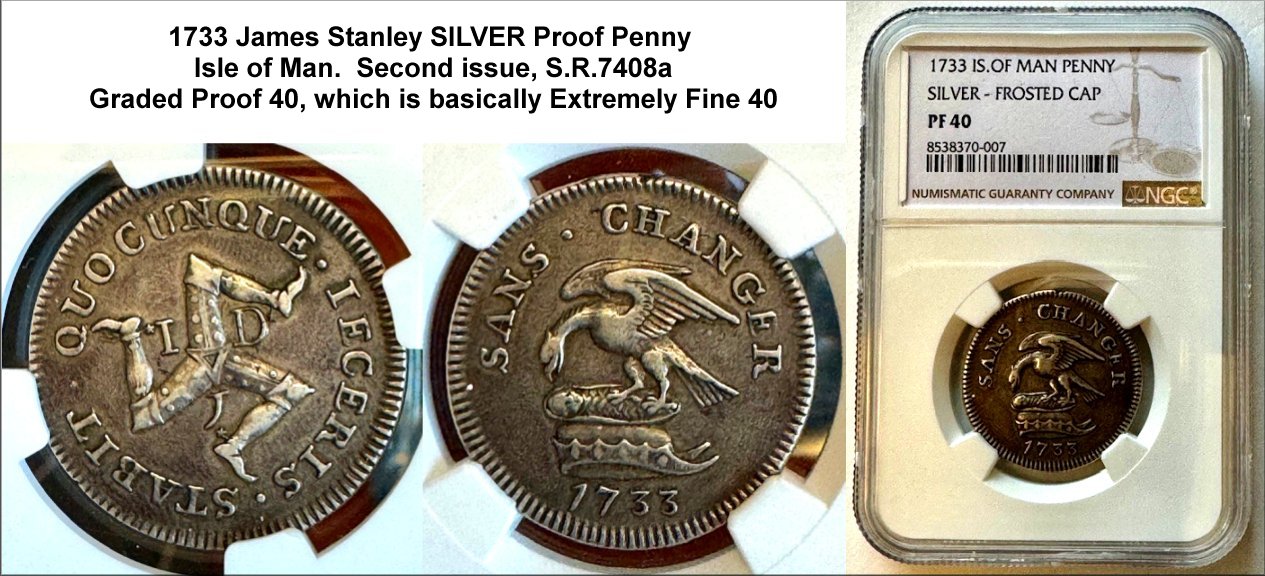
1733 James
Stanley SILVER PROOF Penny - Isle of Man.
Second issue, S.R.7409. You rarely
see the copper pennies - you never see the silver proof pennies! This issue was die-struck as opposed to the
1709 first issue which was cast. James
Stanley was the 10th Earl of Derby (that city being absolutely nowhere near the
Isle of Man!), the Stanley family having been granted the
sovereign rights of Man way back in 1409.
The Earls of Derby held the island first as Kings and subsequently as
Lords. Through the vagaries of British
inheritance law, the island was inherited by James Murrey,
second Duke of Atholl in 1736 who then sold it on to
the British crown in 1765 for the sum of £70,000 - over £13,000,000 in today's
money. Situated in the Irish Sea, Man was once an independent
Viking kingdom. Not many Vikings left
now but plenty of motorbikes in late may, early June of each year. Official mintage figures are extant showing
us that only £300 in pennies and £200 in halfpennies were struck. Of those £300 in Pennies (remember, it was a
larger value but there were ultimately fewer pennies struck compared to the
halfpennies), only a handful would have been the silver proofs, ie specially
made coins, struck in precious metal with great care and attention, showing how
good the subsequent copper coinage was going to be from the dies. The Irish
1722-4 copper issue was struck by William Wood, who is fairly well known in
numismatic circles having given his name to the issue - the Wood's Irish
issue. Wood's successors were Amos
Topping and Samuel Dyall, working out of Castle Rushen. It was those
successors that were responsible for this 1733 IOM second issue. These silver proofs have always been
extremely popular. A
lovely grade coin being. I've left this coin in
the NGC holder (I usually remove them - an easy process although once
removed, they ain't going back in! - as UK collectors tend to not favour
slabbed coins) because it adds reassurance to buyers. Being such an important coin, the issue has
been copied, specifically in the 1960's by a jeweller in Lancashire.
NGC would be completely aware of this and would not for one second have accepted this coin if it was even remotely deemed a
forgery. I've known several instances of
random coins being returned unslabbed to owners by NGC as forgeries where the
consensus had been that they were actually genuine coins - they are that
paranoid about maintaining their status of only slabbing genuine coins. Graded by NGC as Proof 40
(EF 40) with some toning to add further to the coin. £1,250 in 2025 S.R. price guide. An extremely rare and
desirable denomination. £985
Provenance:
Purchased from the estate of
a Northern collector
Copper
WG-9242:
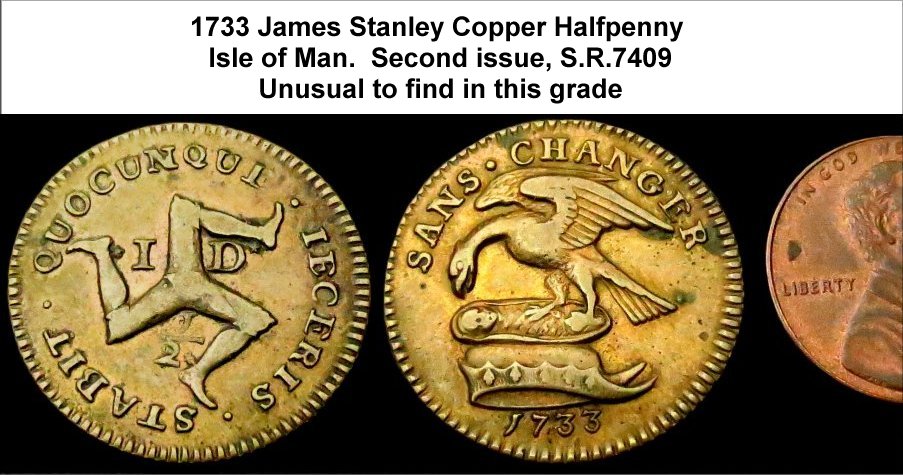
1733 James
Stanley Copper Halfpenny - Isle of Man.
Second issue, S.R.7409. This
issue was die-struck as opposed to the 1709 first issue which was cast. James Stanley was the 10th Earl of Derby
(that city being absolutely nowhere near the Isle of Man!), the Stanley family having been granted the
sovereign rights of Man way back in 1409.
The Earls of Derby held the island first as Kings and subsequently as
Lords. Through the vagaries of British
inheritance law, the island was inherited by James Murrey,
second Duke of Atholl in 1736 who then sold it on to
the British crown in 1765 for the sum of £70,000 - over £13,000,000 in today's
money. Situated in the Irish Sea, Man was once an independent
Viking kingdom. Not many Vikings left
now but plenty of motorbikes in late may, early June of each year. Official mintage figures are extant showing
us that only £300 in pennies and £200 in halfpennies were struck. The Irish 1722-4 copper issue was struck by
William Wood, who is fairly well known in numismatic circles having given his
name to the issue - the Wood's Irish issue.
Wood's successors were Amos Topping and Samuel Dyall,
working out of Castle Rushen. It was those successors that were responsible
for this 1733 IOM second issue. These
coins, especially in this desirable grade, are becoming more collectable - even
the 2026 Coins of Scotland, Ireland and the Islands prices them highly (£800),
which is a very welcome change from them.
A lovely grade coin with some lustre. £195